Transit Density and the Physical Limits of Mature Estate Housing
Singapore’s plan for over 6,000 homes in Toa Payoh West tests how far rail proximity can compensate for urban concentration
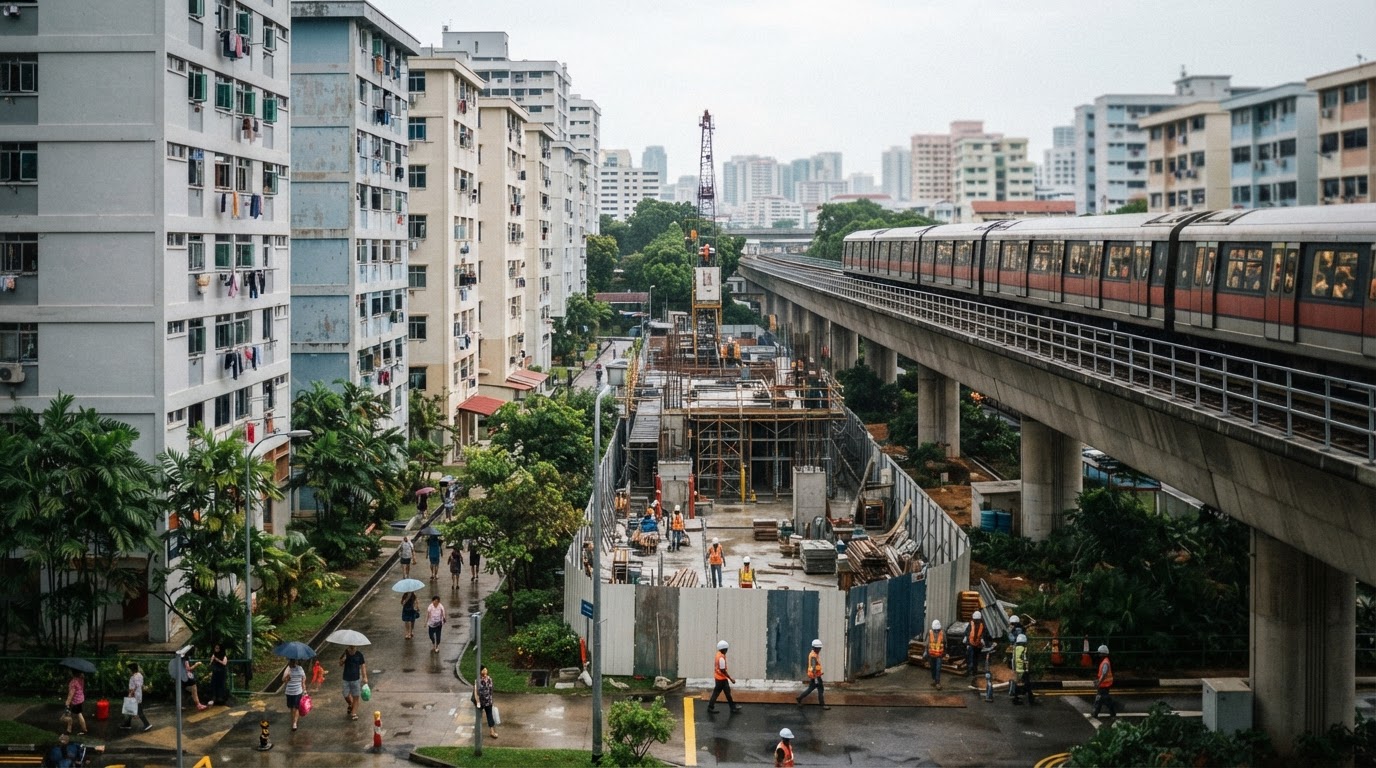
SINGAPORE
Public housing expansion inside established metropolitan perimeters operates on a rigorous arithmetic constraint. Over 6,000 new homes planned for Toa Payoh West represent a concentrated densification of mature residential land, clustered explicitly around Caldecott MRT station. The area's first BTO project, Toa Payoh Hillside, will offer about 1,600 flats in the November 2026 sales exercise under the Housing and Development Board. Placing high-volume residential blocks directly against mass transit nodes reflects orthodox municipal planning, yet the sheer volume of units exposes the operational tensions inherent in squeezing new supply into built environments. Urban planners increasingly look to transit interchanges to absorb demographic growth, but physical land limits inevitably shape the outcome.
State-directed housing frameworks across the Asia-Pacific region frequently encounter identical land pressures. Rapid urbanization and geographic boundaries leave municipal planners with few alternatives beyond extracting greater utility from existing acreage. By concentrating over 6,000 homes alongside Caldecott MRT station, housing authorities attempt to resolve household supply shortfalls without extending public utility networks outward into undeveloped territory. Such proximity minimizes the requirement for supplementary road infrastructure and anchors passenger numbers directly into rail corridors. Municipal administrators view this compact model as a prudent financial measure that maximizes existing investments in public transport.
Transit capacity and mature estate density
Economic logic suggests that grouping civic amenities and residential towers around an existing transit node maximizes the return on public capital already committed to rail links. Commuters walking directly from high-density residential towers to station platforms bypass surface street congestion altogether. This spatial configuration provides clear functional efficiencies for municipal administration and urban transit operators. Residents gain immediate access to transport lines, while the Housing and Development Board satisfies a portion of persistent domestic housing demand across mature districts. High-density infill reduces the capital expenditure required to establish entirely new townships from scratch.
Physical proximity to a transit interchange cannot entirely eliminate the spatial pressures of inserting thousands of households into an existing neighborhood.
Yet this density model invites structural scrutiny when tested against ground-level community capacity. Adding thousands of families into a consolidated sector alters pedestrian volumes, shared recreational areas, and local services in ways that rail connectivity alone cannot mitigate. When about 1,600 flats enter the market through Toa Payoh Hillside in November 2026, the surrounding urban grid must absorb an immediate concentration of household needs. Clustered station amenities alleviate transit bottlenecks, but they do not automatically expand green space or relieve strain on commercial and community facilities originally established for lower residential volumes. Land scarcity forces trade-offs between residential density and open public space.
The mechanics of public land allocation
Proponents of aggressive redevelopment argue that mature towns provide superior social integration compared to greenfield developments situated on peripheral urban borders. Toa Payoh possesses established public infrastructure, established commercial ecosystems, and direct connections to broader employment centres. From an equity perspective, injecting new public housing stock into such districts enables younger buyers to enter central zones rather than being relegated to peripheral towns. Denying new housing in mature areas would worsen spatial divisions between older residents in central nodes and newer families on the urban periphery. Balancing generational turnover in older neighborhoods remains an essential social objective for public planners.
The critical limitation lies in the physical ceilings of mature urban environments. Integrating over 6,000 homes into Toa Payoh West demands an exacting distribution of civic amenities so the district avoids overburdening localized service nodes. Public transit functions effectively as an arterial conveyor, but daily living conditions depend on communal spaces, localized pedestrian circulation, and estate maintenance. Whether the November 2026 launch of Toa Payoh Hillside establishes an efficient standard for mature estate infill depends on how successfully that concentration of homes functions once the remaining parcels are fully inhabited. Sustainable density requires more than rail connections; it requires civic infrastructure capable of enduring heavy everyday use.
Sources
Newsletter
Pacific Daily
A curated briefing from Thailand, Asia-Pacific and the world.