The Spectacle of Bukangi Exposes Urban Gaps in Marine Conservation
Crowds flocking to Busan's trapped shark highlight how viral curiosity outpaces coastal policy across the region.
SINGAPORE
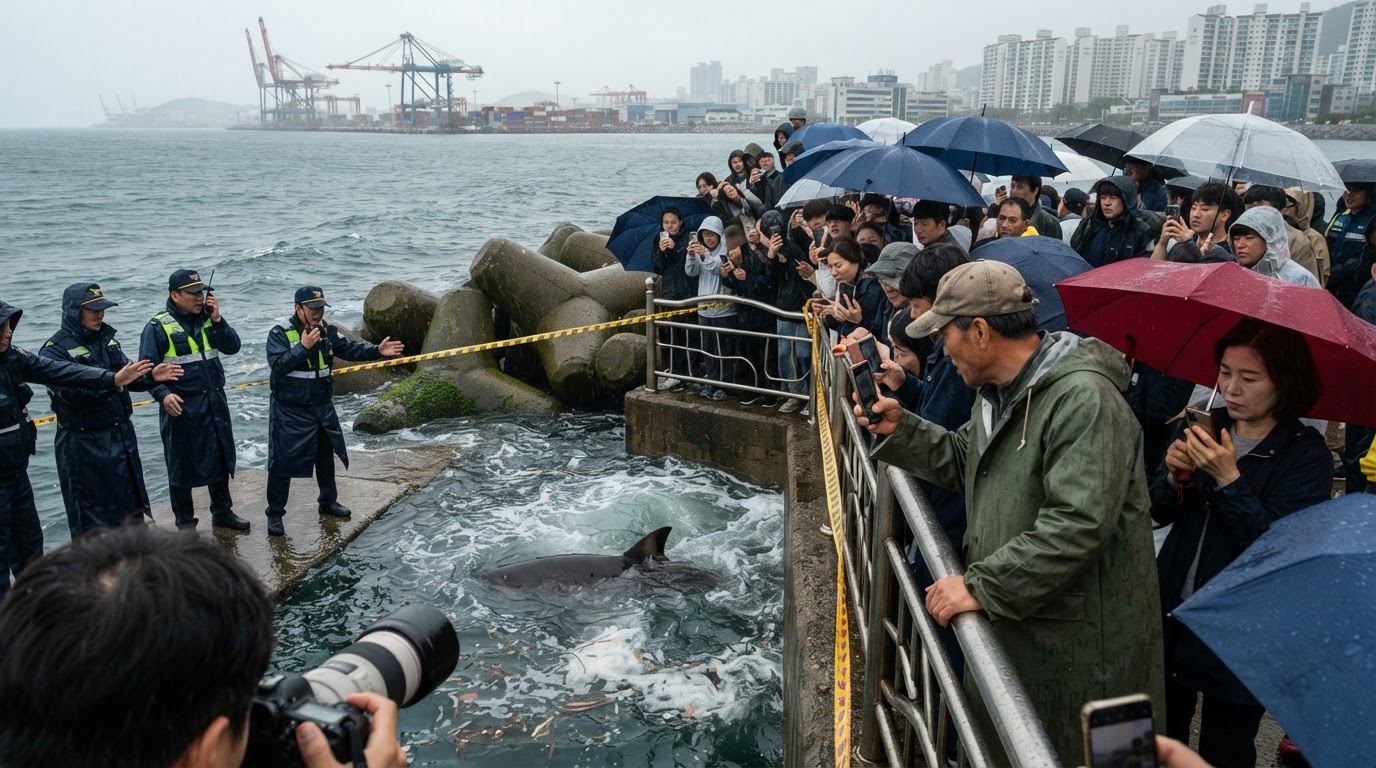
Foot traffic does not resolve an operational failure. In Busan, South Korea’s second-largest city, municipal authorities counted nearly 1.4 million spectators along a shallow canal where a three-meter shark has remained trapped since mid-September. The animal, dubbed Bukangi after the adjacent waterfront park, swims wedged between commercial office towers and an active passenger ferry terminal. Municipal teams have staged at least two documented extraction efforts to guide the animal to open water. Both attempts failed.
Public interest followed the standard viral trajectory across South Korea and coastal China as video recordings circulated online. Researchers associated with Mokpo National University, alongside scholars including Hong Sun-kee at the Institution of Island Cultures, infer that anomalous water temperatures increasingly shift migratory corridors, drawing pelagic species toward metropolitan shipping infrastructure. Media coverage quickly noted that the specimen belongs to the Carcharhinus genus and carries an endangered designation under the IUCN Red List. That biological classification transforms a municipal novelty into an ecological emergency.
Civic advocates often present sustained public attention as an inherent conservation asset. The operative assumption holds that direct visual contact with an endangered predator expands popular ecological awareness, generating civic pressure that eventually finances coastal protection. From this perspective, drawing over a million spectators to an industrial wharf achieves educational outreach that public institutions rarely match through standard messaging.
The Extraction Deficit
When evaluated against operational outcomes, that civic thesis collapses. Attendance tallies registered record interest while municipal response mechanisms delivered zero progress toward animal extraction. Crowd congestion along public railings actually increased administrative pressure to mount hurried, visible shepherding attempts rather than deliberate interventions guided by marine telemetry. The trapped animal became an urban attraction, masking the underlying logistics deficit that allowed the entrapment to persist.
Commercial ports are engineered to maximize freight throughput, not preserve marine fauna. Deep-water channels terminate in abrupt concrete bulkheads, sluice gates, and turbulent ferry basins that disorient pelagic navigators chasing coastal schools. In Busan, municipal administrators proved capable of tracking visitor volume with precision, yet local maritime services lacked the specialized gear and physical containment protocols needed to extract an animal of this mass from confined water. Spectator metrics expanded rapidly. Rescue capability remained static.
Shifting Industrial Baselines
Converting an endangered marine predator into civic entertainment exposes how poorly coastal infrastructure accommodates oceanic displacement.
This incident illustrates a structural vulnerability shared across industrializing coastlines in East Asia. If rising sea surface temperatures between South Korea and China continue displacing pelagic species into heavily trafficked transit lanes, municipal strandings will recur with greater frequency. When an apex predator enters an artificial shipping canal, municipal governments cannot treat containment as public theater or rely on improvised net lines to substitute for coordinated marine protocols.
Effective mitigation requires pre-arranged salvage frameworks, port navigation rules calibrated to wildlife alerts, and formal command structures linking municipal port captains directly to academic marine institutes. Without institutionalized response mechanisms, stranded wildlife will continue to languish under the cameras of assembled crowds. The survival of displaced apex species along industrial coastlines now depends on whether municipal authorities treat urban canal strandings as technical emergencies rather than public entertainment.
Sources
Newsletter
Pacific Daily
A curated briefing from Thailand, Asia-Pacific and the world.