The Narrow Arithmetic of the Dnipro Truce
A six-day humanitarian corridor across Kherson exposes the tactical mechanics behind temporary pauses in protracted warfare
SINGAPORE
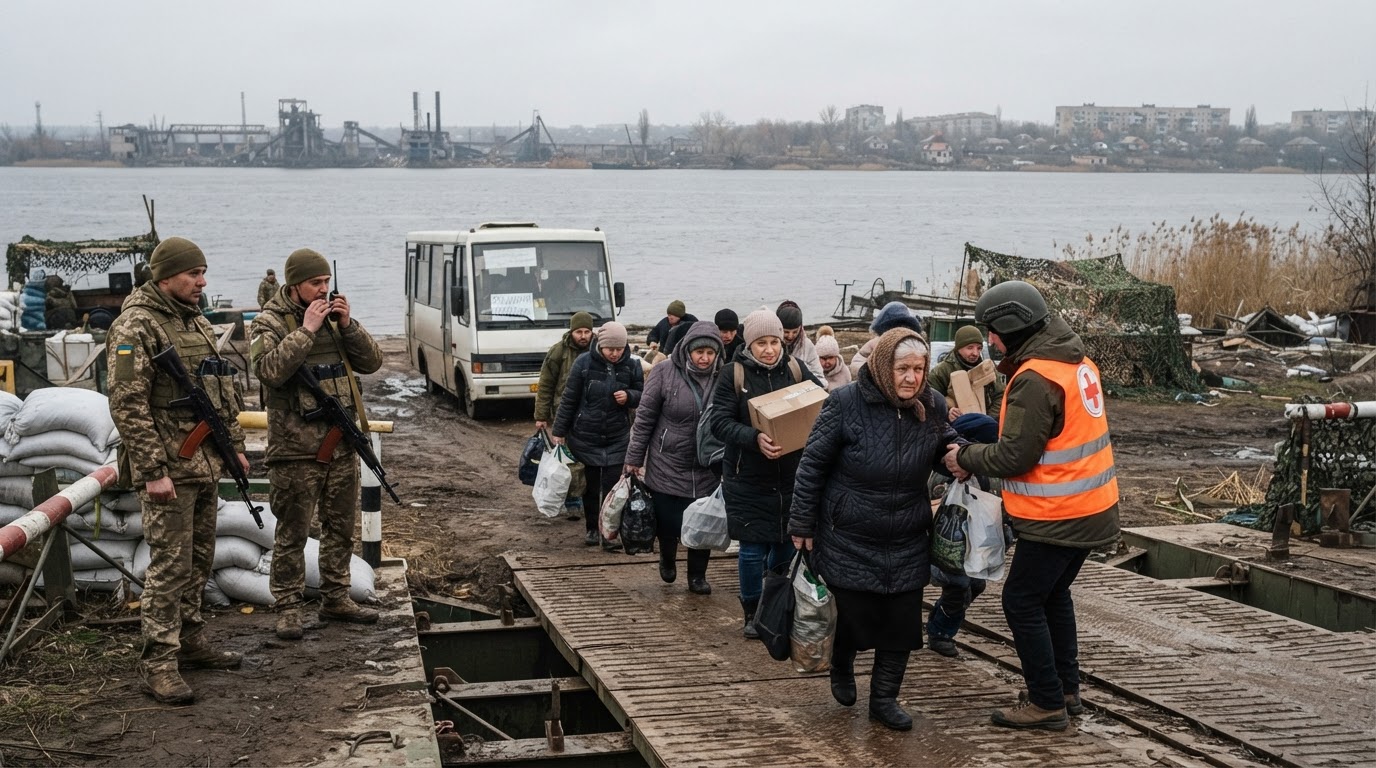
Military truces during prolonged ground campaigns rarely signal an impending peace; more frequently, they mark the points where two exhausted operational postures briefly align. In southern Ukraine, along the bends of the Dnipro River, the expiration of a six-day local ceasefire around the Russian-held town of Oleshky underscores that distinction. The temporary halt in fire, recorded as the longest local pause in fighting since Russia launched its full-scale invasion in 2022, allowed the Ukrainian military to evacuate 167 people from threatened southern sections of the Kherson region on Sunday, Nov 1. Two days earlier, convoys had removed busloads of residents from Oleshky itself, while across the water from Kozatske, St. Andrew's Cathedral in Russian-occupied Nova Kakhovka stood in quiet relief under an aid corridor verified through Oct 31, 2026.
Observers scanning such developments for indications of general settlement consistently misread how localized agreements function. An evacuation window is not an ideological concession. It is an operational transaction in which both belligerents calculate that the temporary extraction of non-combatants confers a temporary advantage or relieves an unsustainable rear-echelon burden.
The Utility of Limited Pauses
For Ukrainian planners, securing the departure of 167 civilians reduces the administrative and humanitarian friction in an active combat sector where artillery exchanges across riverbanks make civilian survival precarious. For Russian occupying forces holding Oleshky, facilitating the exit of trapped populations removes logistical obligations from a strained military administration without surrendering territorial control. Neither side ceded terrain, abandoned strategic positions, or dismantled fortification networks during the six-day duration.
The temporary halt in fighting was an operational transaction, not a path to settlement.
The broader counterargument advanced by diplomatic commentators suggests that any sustained pause, regardless of its geographic limits, establishes a precedent for negotiated freezes elsewhere along the front. According to this reasoning, bilateral cooperation over civilian convoys and specific crossing corridors builds technical mechanisms that can later be scaled into wider ceasefires. That logic assumes that tactical communication naturally matures into political compromise.
Evidence from earlier stages of the conflict points in the opposite direction. Evacuations in Kherson during 2022 and 2023 demonstrated that localized demographic clearance frequently precedes renewed kinetic intensity. When civilians are removed from contested urban pockets, the constraints on indirect fire and heavy munitions diminish rather than expand. A cleared battlefield offers commanders greater tactical latitude, not less.
Strategic Lessons Beyond the Dnipro
For strategic planners across the Asia-Pacific watching the mechanics of modern containment, the Oleshky corridor offers an unvarnished lesson in the durability of high-intensity attrition. The conflict along the Dnipro demonstrates that modern hostilities do not require mutual trust to produce coordinated truces; they require mutual operational incentive. Without that incentive, agreements collapse the instant their immediate purpose expires.
Governments in Asia that evaluate maritime flashpoints and buffer arrangements often treat humanitarian corridors as evidence of de-escalation. The reality visible across the Kherson front reveals the opposite dynamic. The evacuation of 167 residents on Sunday did not alter the balance of artillery across the Dnipro River. It simply concluded a precise logistical window, leaving both forces confronting the same riverline positions with fewer non-combatants standing in the field of fire.
Sources
Newsletter
Pacific Daily
A curated briefing from Thailand, Asia-Pacific and the world.