The Judicial Erasure of Hong Kong Civic Resistance
A decade-long sentence for Joshua Wong formalises the permanent conversion of political opposition into statutory liability
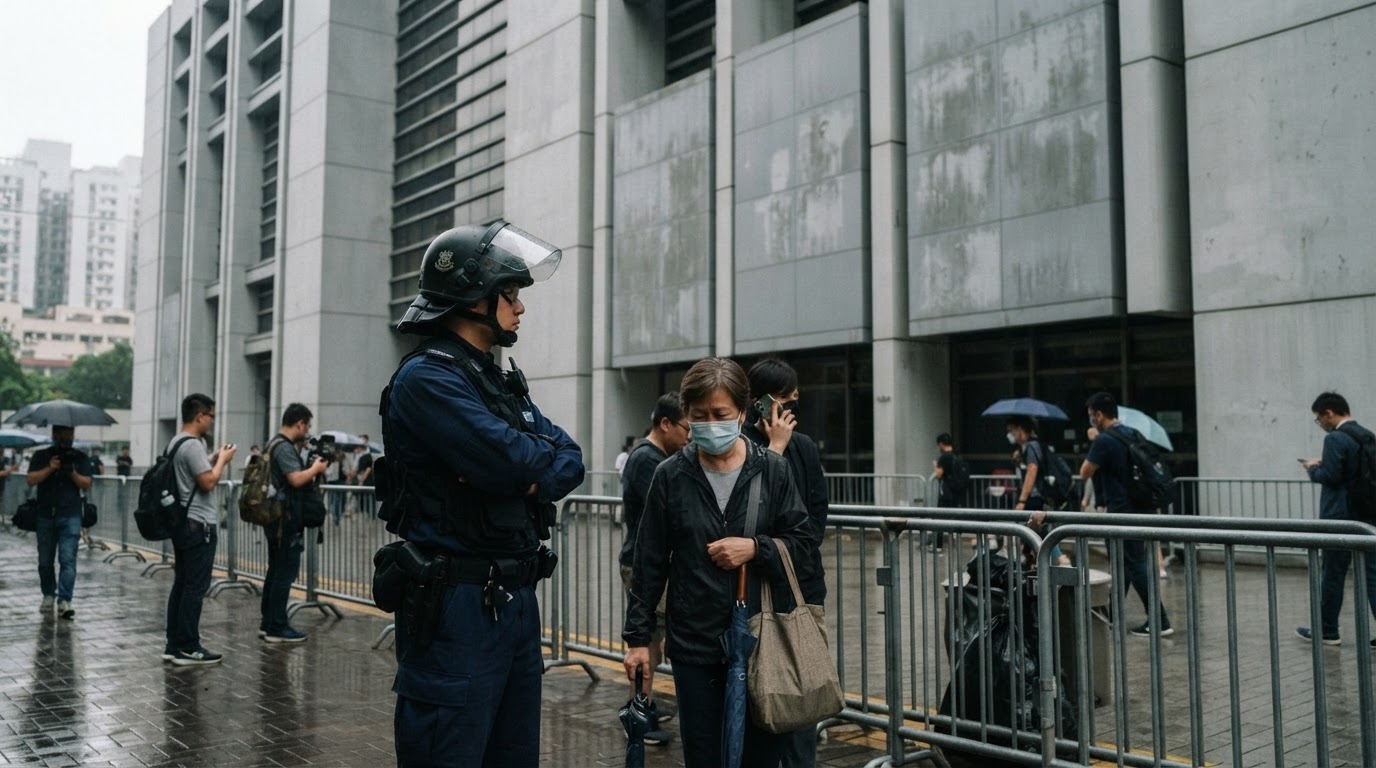
HONG KONG
Judicial sentencing in Hong Kong no longer registers as an episodic containment of street unrest, but as the systematic retirement of an entire political cohort. On Thursday, Nov 5, Joshua Wong received a penalty of 10 more years in jail after pleading guilty to collusion with foreign entities under the national security law introduced in 2020. Having remained behind bars since 2020, the former student organizer will reach the age of 40 before completing his term. That arithmetic reveals the structural shift inside the Asian financial center, where the state has moved from managing active protests to extinguishing the biological and civic prime of those who led them.
Twelve years earlier, the relationship between Beijing and the special administrative territory operated under different parameters. During the 2014 Umbrella Movement, Wong addressed crowds outside the office of then Hong Kong Chief Executive Leung Chun-ying on Oct 3, 2014, spearheading what evolved into one of the most visible challenges to China's Communist Party in decades. At that stage, civic mobilization still functioned under the assumption that public assemblies could force procedural concessions from the local executive. The institutional boundary separating mainland security imperatives from local common law practices remained porous yet operationally distinct.
Statutory Absorption
The implementation of the national security framework in 2020 terminated that ambiguity. What changed was not the intensity of official rhetoric, but the administrative capacity of the judicial apparatus to convert past civic advocacy into perpetual custody. By classifying cross-border political engagement as illicit collusion, the legal code redefined customary political lobbying as a sovereign violation. Wong's successive legal proceedings demonstrate how procedural mechanics now neutralize adversarial figures without provoking the operational disruptions of mass arrests in city streets.
Critics of this interpretation might argue that legal proceedings against high-profile activists simply enforce statutory regularity, deterring unauthorized foreign intervention while stabilizing commerce. That argument, however, misconstrues the regional consequence of using long-term incarceration against non-violent figures. Hong Kong derived its international standing precisely from legal predictability that insulated civil life from ideological discipline. Subjecting a generation of public figures to rolling sentences removes the buffer between commercial governance and state power.
Institutional Realignment
Across the wider Asian hemisphere, this consolidation resets the strategic calculus for regional observers and foreign capitals. Governments that once engaged the territory as a distinct diplomatic ecosystem must now treat its courtrooms as direct extensions of mainland policy directives. The decade added to Wong's detention confirms that the threshold for foreign collusion has been widened to encompass standard international appeals, creating permanent exposure for any cross-border institutional contact.
This structural realignment leaves external commercial partners facing a definitive contradiction. While the Asian commercial hub maintains regulatory efficiency for capital allocation, its political architecture has fully aligned with mainland doctrines of internal security. Joshua Wong, entering prison in his twenties and slated to emerge at 40, embodies the cost of that integration. The unresolved tension confronting the territory is whether a global business capital can sustain institutional credibility when political continuity requires the permanent subtraction of domestic dissent.
Sources
Newsletter
Pacific Daily
A curated briefing from Thailand, Asia-Pacific and the world.