The Evolutionary Trap Behind Crocodilian Survival
Deep-time persistence across warm latitudes demonstrates ecological stability, yet geographic confinement leaves modern reptiles exposed to acute territorial disruption.
SINGAPORE
Long-term biological continuity frequently conceals acute structural vulnerability. When an asteroid struck Earth 66 million years ago, causing an ecological collapse that eliminated the dinosaurs, crocodilians survived the planetary shock. That survival constituted neither random fortune nor an abrupt evolutionary transformation. Modern crocodilians—encompassing today's crocodiles, alligators, caimans and gharials alongside extinct relatives—have maintained an unbroken lineage since emerging more than 240 million years ago during the Triassic Period. Scientific findings released in October 2026 indicate that this endurance rested on a singular physiological trait: an unyielding affinity for warm climates maintained across hundreds of millions of years.
Thermal conservatism served as an exceptionally durable preservation strategy. By remaining tied to equatorial and subtropical latitudes, crocodilians anchored their biology to consistent environmental bands. That physiological commitment carried the broader clade, including early branches within Pseudosuchia, past catastrophic shocks and climatic cooling intervals dating back toward the Permian boundary. While terrestrial ecosystems collapsed and continental arrangements shifted, warm aquatic corridors spanning lands that now form Australia, India, and Florida provided sufficient baseline stability for populations to endure.
Geographic Rigidity and Ecological Specialization
This macro-evolutionary record introduces a core paradox for environmental assessment across the Asia-Pacific. Enduring for more than 240 million years without fundamental physiological restructuring suggests that crocodilians possess remarkable structural stability. Because their metabolic functions rely on external thermal inputs, lineage survival depended on the absolute continuity of tropical river corridors, estuarine mangroves, and humid wetlands. Survival was never an expression of boundless environmental flexibility; rather, it was the direct outcome of occupying a specific thermal niche and never vacating it.
The deep-time continuity of crocodilian lineages reflects geographic confinement rather than boundless adaptability.
That historical mechanism has reached a severe structural boundary. Across deep time, climate shifts occurred across epochs that permitted gradual geographic tracking, allowing lineages across India and Australia to adjust their distributions alongside migrating waterways. Modern human landscape modification does not permit that ancestral mobility. While warmer baseline temperatures might appear to broaden the theoretical habitat zone for reptiles, the terrestrial and freshwater corridors required to support real relocation are irrevocably blocked by industrial expansion, coastal urbanization, and water control engineering.
Structural Bottlenecks in the Modern Era
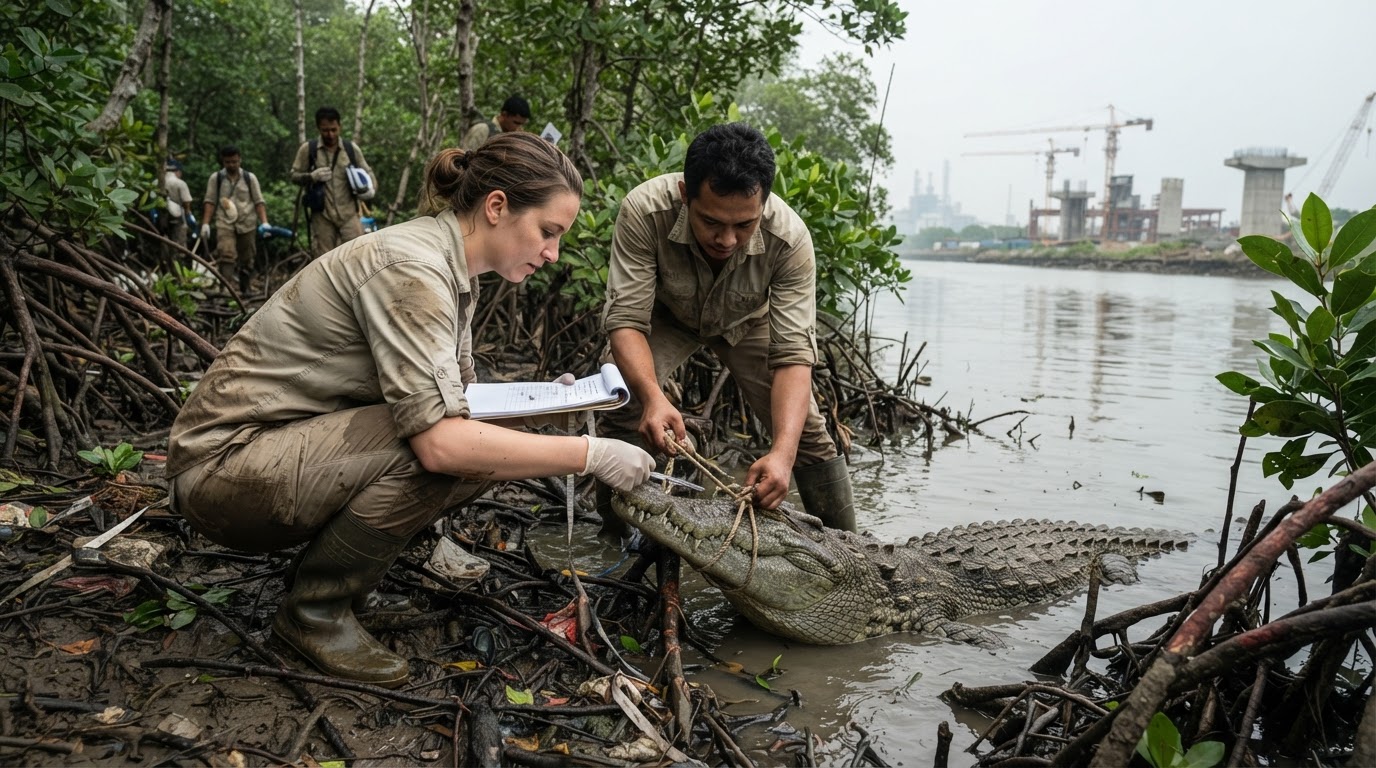
The analytical assumption that deep-time persistence guarantees long-term survival misreads the nature of prehistoric resilience. Crocodilians cannot follow changing temperature zones when concrete coastal embankments, intensive agriculture, and commercial waterways fragment river basins. The populations that survived the asteroid catastrophe 66 million years ago did so because equatorial river systems remained structurally open, allowing breeding groups to persist within unfragmented thermal reserves.
Conservation strategies within the Asia-Pacific frequently treat crocodilians as indestructible survivors of prehistory rather than organisms bounded by rigid physical requirements. Their biological strategy functioned only when physical geography allowed uninhibited movement across vast regional basins. At present, the aquatic networks across Australia and river systems in India are heavily divided by human infrastructure and sovereign borders. The unyielding commitment to warm climates that carried crocodilians through ancient global extinctions now confronts an immovable modern obstacle: a built environment that permanently confines them to fragmented, isolated enclosures.
Sources
Newsletter
Pacific Daily
A curated briefing from Thailand, Asia-Pacific and the world.