The Enclosed Horizon of Khao Lak
Hospitality architecture along Thailand’s Andaman coast increasingly attempts to domesticate conservation, turning ecological stewardship into an interior amenity.
SINGAPORE
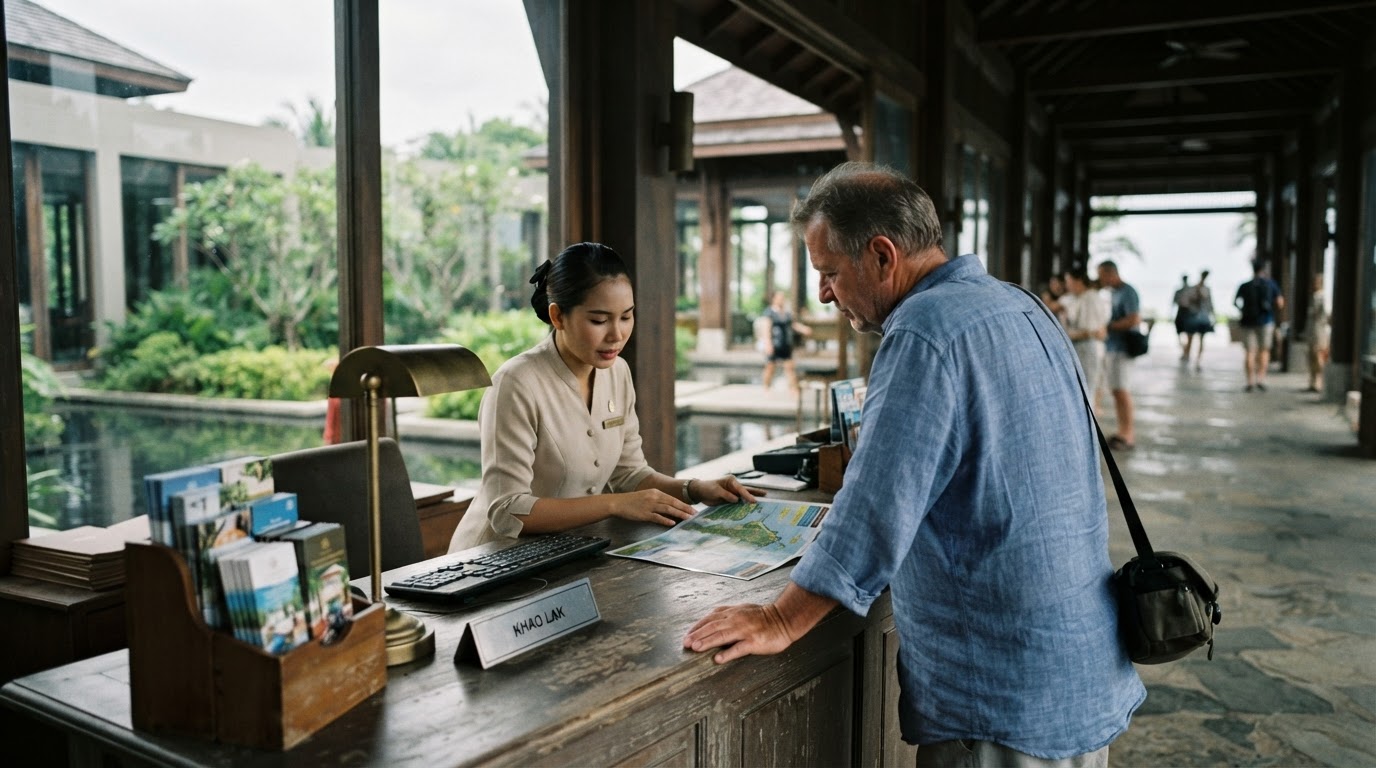
A coastal resort operates as an apparatus of deliberate exclusion, calibrating sightlines toward the sea while keeping the frictions of the surrounding territory firmly outside its perimeter. At JW Marriott Khao Lak Resort & Spa in southern Thailand, recently assessed by CN Traveller, this spatial logic reaches an instructive expression. The property does not merely frame the coastal landscape as a passive backdrop. Instead, the compound internalises environmental systems, absorbing marine conservation and agriculture into the private choreography of guest movement.
Across the Asia-Pacific, luxury hospitality has moved away from simple beachfront pavilion clusters toward expansive, self-contained compounds. Properties from Roku Kyoto under Hilton to Fiji Marriott Resort Momi Bay have established a regional pattern where site planning functions as total environmental insulation. At Khao Lak, the installation of an onsite Bamboo Shark Nursery and Conservation Center alongside organic farming grounds signals a deliberate evolution in what large-scale tourism master planning chooses to construct. Conservation ceases to be an external expedition. The habitat is built directly into the floor plan.
The Architecture of Domestication
What does such an expansive master plan refuse to do? It refuses to allow the marine environment to remain wild, unmediated, or sovereign beyond its boundary wall.
By incorporating captive rehabilitation tanks and deliberate agrarian zones within a leisure enclosure, the property alters the civic relationship between tourism infrastructure and regional ecology. The sea is transformed from a common maritime landscape into an aestheticised garden, curated under private security and private maintenance.
The resort perimeter no longer marks where development ends, but where the natural world is systematically domesticated.
This spatial arrangement suggests an unresolved tension between genuine environmental remediation and corporate territorial control. Maintaining an active marine nursery provides tangible shelter for vulnerable local species, operating where municipal public facilities along the coastline are frequently absent. The spatial investment is real. Yet the layout establishes an uneasy architectural bargain, positioning species survival as a programmatic feature of private leisure.
Territorial Containment and its Limits
Local coastal communities depend on an open, functioning marine ecosystem that extends far beyond artificial boundary walls. When luxury developments annex ecological functions into landscaped corridors, they risk obscuring the broader environmental strains that large-scale resorts inevitably impose on local water tables, energy grids, and coastal soil. The building presents itself as a self-sustaining refuge. In spatial terms, it remains wholly reliant on external infrastructure.
This model of containment offers visitors the comfort of ecological participation without demanding that they confront the contested reality of coastal land use in Thailand. The guest encounters oceanic life not as a fragile wild frontier, but as a managed pavilion amenity. As regional resort design across the Asia-Pacific continues to replicate this template of enclosed ecological spectacle, the architecture risks forgetting its most fundamental obligation. A compound cannot substitute for the wild horizon it claims to protect.
Sources
Newsletter
Pacific Daily
A curated briefing from Thailand, Asia-Pacific and the world.