The Balance Sheet of Hominin Survival in Shanidar Cave
Excavated bones bearing both healed trauma and fatal spear trauma reveal how prehistoric groups balanced social investment against inter-band violence.
SINGAPORE
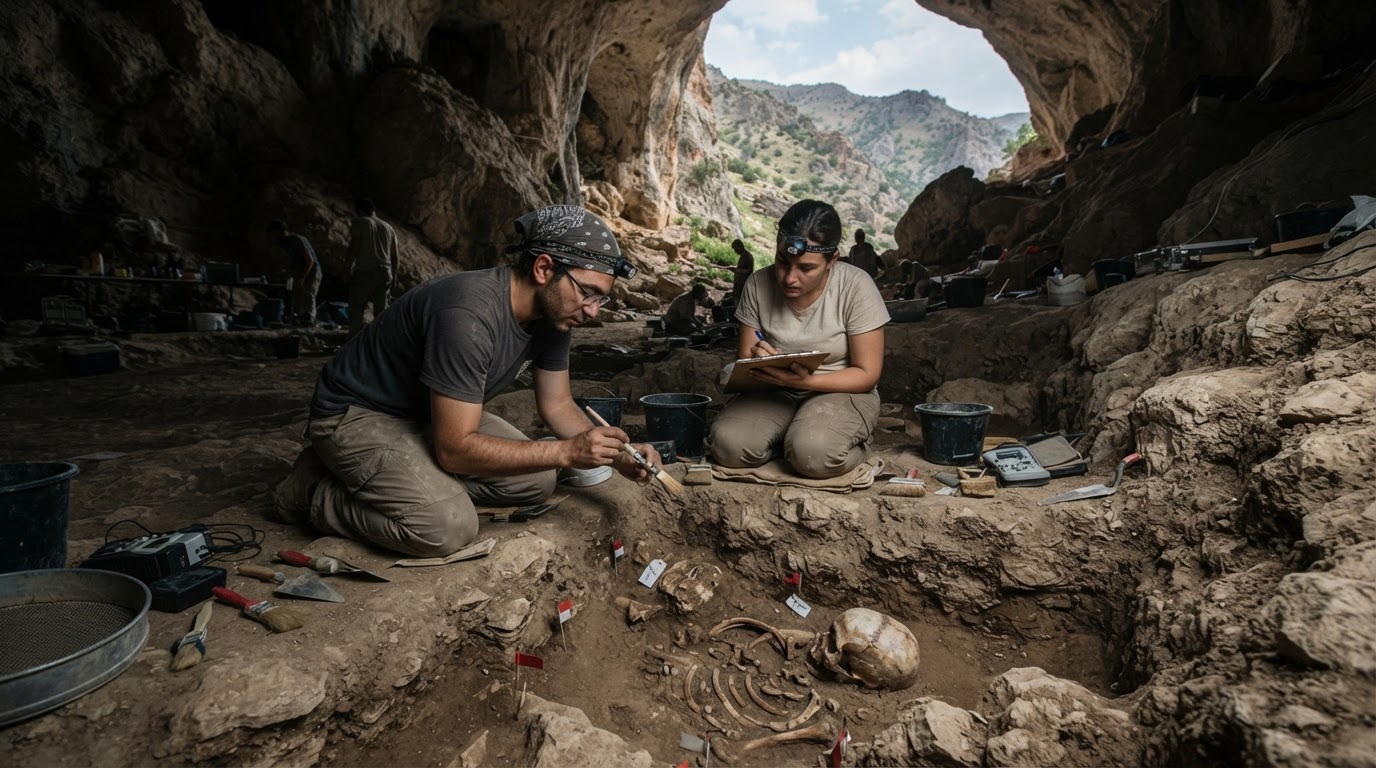
Skeletal remains recovered from Shanidar Cave in the Zagros Mountains of northern Iraq document two distinct events on a single partial Neanderthal skeleton: an earlier, nonfatal injury that healed, and a subsequent fatal wound from a spear. Prof Graeme Barker and fellow researchers made the photographic and skeletal evidence public in October 2026. This finding provides an empirical baseline for evaluating how early hominin groups structured social assistance alongside lethal territorial competition.
Sustaining an incapacitated adult required a measurable diversion of group resources. In Pleistocene subsistence conditions, provisioning an injured member diverted finite food reserves away from active hunters. The healed trauma identified on the Shanidar bones indicates that the group chose to absorb that cost over an extended recovery timeline rather than abandon the casualty. From an operational perspective, this decision suggests the presence of an economic surplus sufficient to carry non-producing dependents. Preserving experienced members protected critical skills, tool-making knowledge, and communal memory that would otherwise be lost to the group.
Yet the evidence of violence challenges any reading of unqualified social benevolence. The fatal puncture was inflicted by a spear, confirming that lethal force was an active factor within the hominin operating environment across Iraq's Kurdistan. Defensive investments in collective care existed directly alongside physical confrontations capable of terminating that investment abruptly.
Resource allocations and inter-band competition
Cooperative care functioned as a functional survival strategy rather than an ethical indulgence. By committing calories to an injured peer, small bands preserved valuable social capital under unforgiving ecological pressures. Group cohesion directly improved physical durability. Convalescence represented an upfront investment in operational continuity.
Conversely, territorial competition between foraging units imposed recurring shocks. When resource basins tightened or game migrations shifted, neighbouring bands confronted each other over prime hunting grounds and sheltered cavern sites. The puncture wound on the recovered skeleton demonstrates that hominins manufactured weapons capable of inflicting targeted mortality on other hominins. Band solidarity safeguarded internal members, but it provided no systemic insulation against lethal external friction.
Archaeological discourse since 2012 has frequently segregated early human behaviour into polarized models of mutual altruism or unmitigated brutality. Discoveries synthesized across 2025 and 2026 demonstrate that these two pressures operated concurrently. Care networks and organized physical aggression formed complementary instruments of group persistence. Internal cohesion maximized productivity, while coordinated armed defense preserved territory.
What remains analytically uncertain is the exact context of the fatal strike. Current osteological evidence cannot differentiate whether the lethal spear strike stemmed from external inter-band combat, competitive raiding, or internal communal disciplinary action. Until stratified taphonomic deposits yield contextual artefacts linking the fatal strike to a specific weapon lineage, the balance between intra-group discipline and external territorial warfare remains an open question.
Sources
Newsletter
Pacific Daily
A curated briefing from Thailand, Asia-Pacific and the world.