Taiwan's Drone Initiative Signals Broader Regional Reconfiguration
The recent meeting between Taiwan’s Vice President and Michigan’s Governor, centered on drone collaboration, highlights an evolving strategic calculus within the Asia-Pacific.
SINGAPORE
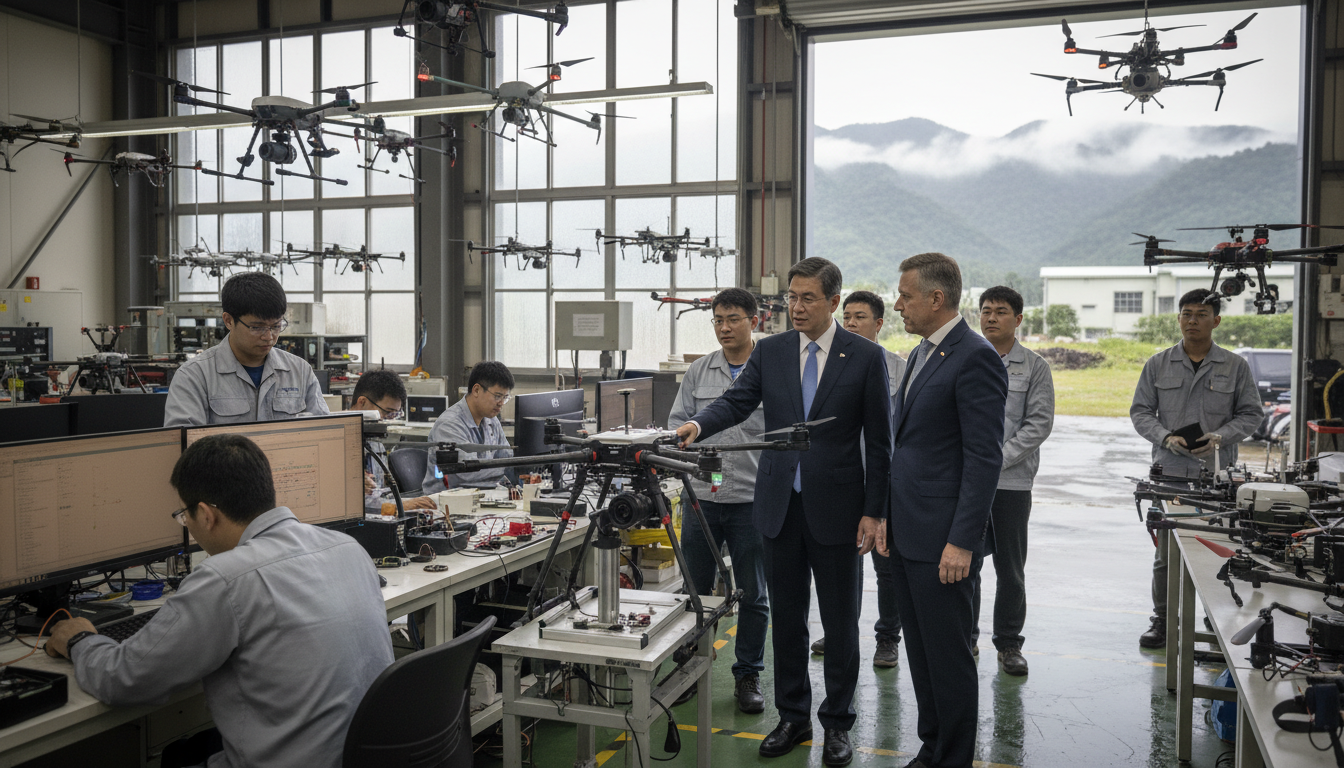
The September 17 meeting between Taiwan Vice President Lai Ching-te and Michigan Governor Gretchen Whitmer, focused on drone cooperation, illustrates a shift in how Taiwan seeks to secure its capabilities and integrate into a broader global supply chain. This engagement, while framed around technological partnership, holds implications for the regional security landscape, particularly for nations like Thailand navigating an increasingly complex geopolitical environment.
Historically, Taiwan’s defense posture has relied heavily on conventional hardware and, more recently, on a 'porcupine' strategy emphasizing asymmetric capabilities. The focus on drone technology, as indicated by this high-level meeting, represents a concrete step in operationalizing the latter. This move signals a recognition that distributed, cost-effective defense assets can complicate potential aggression scenarios. The partnership with a U.S. state, rather than the federal government, suggests a nuanced approach to cultivating strategic alliances, potentially bypassing some diplomatic sensitivities while still leveraging American technological expertise.
For Southeast Asian nations, including Thailand, such developments present both opportunities and challenges. An increase in Taiwan's self-sufficiency and deterrent capabilities could theoretically contribute to regional stability by making a cross-strait conflict less probable, or at least more costly. However, it also signifies an intensifying competition for technological advantage and supply chain resilience. Thailand, which has its own defense modernization goals and maintains complex relationships with both China and the United States, must assess how these evolving technological partnerships impact its own strategic autonomy and economic interests.
The Taipei Times, in its reporting, framed the discussion as primarily about “drone cooperation.” While this provides a direct window into the stated agenda, the underlying capability shift is more significant than the specific item of collaboration. The shift is not merely about acquiring drones but about developing indigenous capabilities and securing supply lines for critical components, which is a foundational element of modern defense.
A potential counterargument posits that this collaboration is largely symbolic, a gesture of support from a U.S. state rather than a pivotal defense pact. The argument suggests that Michigan’s role, while politically significant, may offer limited tangible military impact compared to direct federal defense agreements. However, this perspective overlooks the strategic value of diversifying partnerships and leveraging sub-federal entities to build resilience against potential supply chain disruptions and political pressures. The ability to source and co-develop technology with a U.S. state contributes to a broader ecosystem of support that is harder to disrupt than a single, high-profile federal agreement.
The implications for regional actors extend to the broader economic sphere. The push for drone manufacturing capability in Taiwan could create new industrial supply chains, impacting existing patterns of trade and investment. Nations like Thailand, which are actively seeking foreign direct investment and technological transfer, will need to consider how these shifts in high-tech manufacturing influence their own industrial strategies and partnerships. The regional consequence is a gradual re-ordering of technological alliances, driven by security imperatives but manifested through economic and industrial collaboration.
The unresolved tension lies in how regional powers will react to this deepening technological cooperation. While it aims to enhance Taiwan's deterrence, it could also be perceived as an escalation by actors who view such partnerships as undermining regional stability. Thailand’s careful diplomacy will be tested as it seeks to balance economic engagement with security concerns in an increasingly fractured technological landscape.
Sources
Newsletter
Pacific Daily
A curated briefing from Thailand, Asia-Pacific and the world.