Submerged Ballots and Administrative Fragility
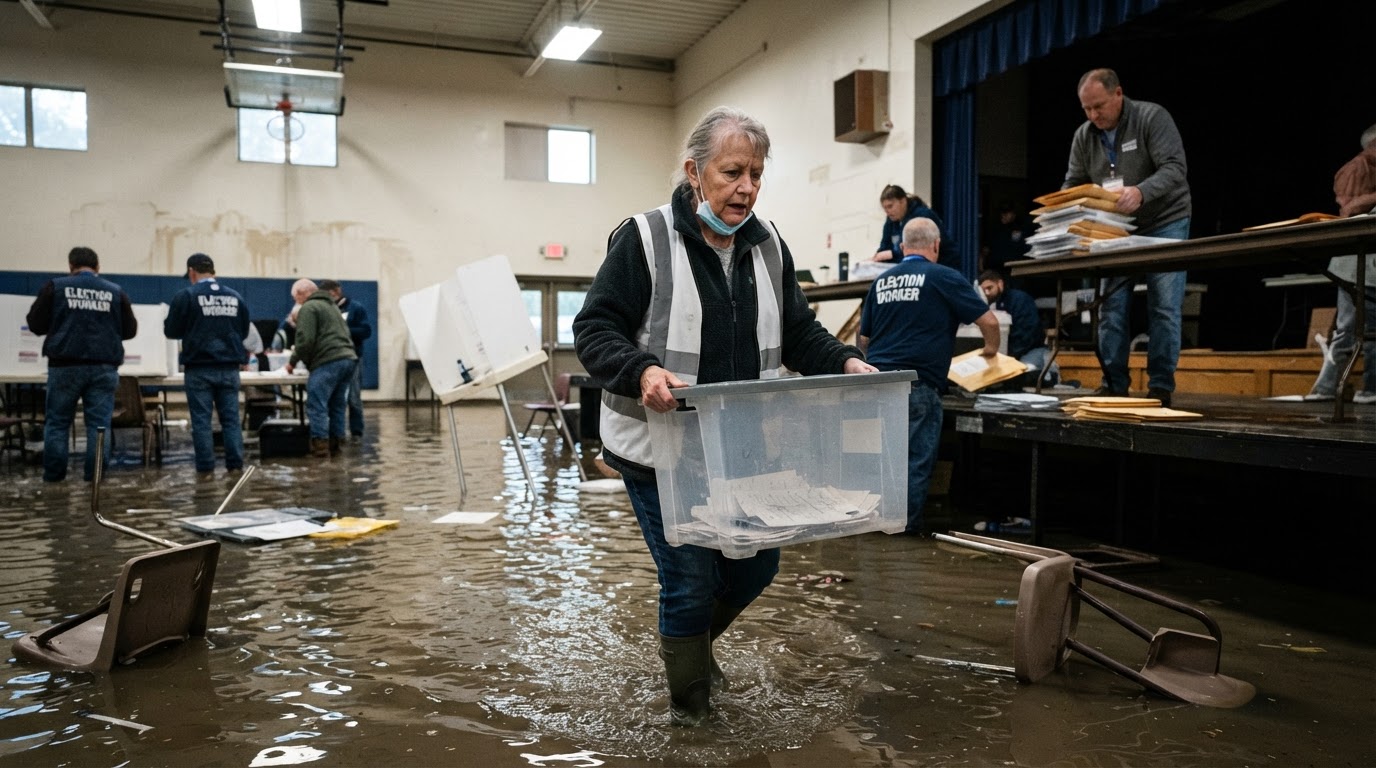
Disrupted polling stations during the United States midterms demonstrate that hydrological volatility now threatens institutional routine across both developed and developing states.
SINGAPORE
Electoral administration assumes a static physical world where municipal buildings remain dry and accessible. When flooding forced polling sites to relocate during the United States midterm elections in November 2026, that assumption collapsed in the world's wealthiest jurisdiction. Severe inundation interrupting access to the ballot is not an isolated Western logistical mishap. Viewed from the Asia-Pacific, the emergency in North America mirrors an accelerating institutional breakdown that regional planning ministries have confronted throughout the year.
Industrialised polities have long treated municipal climate exposure as a problem of capital expenditure rather than democratic continuity. State institutions budgeted for higher sea walls and revised property insurance codes, assuming basic governance functions would proceed uninterrupted. The emergency relocation of American ballot boxes demonstrates that water intrusion can paralyze sovereign mechanisms without warning. Severe hydrological events bypass standard bureaucratic continuity plans, converting routine civic duties into triage operations.
Physical geography enforces severe administrative boundaries.
The Geography of Disruption
Across Asia, the operational consequences of unchecked precipitation have registered on a catastrophic scale. In July 2026, extreme rainfall triggered flash floods and typhoons that damaged communities across the continent. By September, the United Nations Development Programme calculated that flooding in Nepal had generated 2.2 million tonnes of debris, overwhelming local administrative capacity and wiping out vital infrastructure. While an American municipality relocates a precinct to an adjacent dry school, evidence from South Asia indicates that an inland district in Nepal loses its municipal records and physical roads entirely.
Coastal administrative centers face a different structural impasse. In October 2026, an ADB report warned that Asia-Pacific coasts face mounting flood risks, demanding urgent intervention from regional governments. The contrast between coastal financial hubs and mountainous river basins outlines two distinct institutional vulnerabilities. Maritime capitals face slow-motion capital degradation and regular storm surges, whereas rural interior valleys suffer total physical severance from national supply lines and administrative services.
Institutional inertia often rests on the counterargument that mature economies possess sufficient fiscal reserves and technical redundancy to absorb seasonal flooding without altering state capacity. Wealthy administrative districts can indeed erect temporary barriers, deploy backup generators, and reroute voters across alternative transit corridors within hours. That confidence overlooks how rapidly compound weather shocks drain institutional flexibility. Fiscal redundancy cannot restore submerged transport corridors or replace displaced civic personnel when regional power grids fail simultaneously.
Compounding Strains on Governance
Physical disruption inevitably alters political stability. Administrative bodies under acute climate pressure face declining operational legitimacy when primary obligations go unfulfilled. If civil authorities cannot guarantee dry polling stations or clear 2.2 million tonnes of wreckage, public reliance on administrative predictability fractures. Emergency measures, once introduced to handle exceptional weather events, risk becoming permanent governance substitutes.
The analytical inference is straightforward: institutional resilience cannot be bought merely with retrospective disaster allocations.
The unresolved question facing planners in North America and Asia alike is whether institutional frameworks can adapt faster than the frequency of extreme weather shocks. Capital budgets remain tied to historical hydrological baselines that no longer reflect regional meteorological reality. Until public administration redesigns its critical civic functions for continuous physical disruption, institutional procedures will remain hostage to the next high-water mark.
Sources
Newsletter
Pacific Daily
A curated briefing from Thailand, Asia-Pacific and the world.