Sovereignty and the Sports Endorsement Ledger
Kylian Mbappe discovers the non-negotiable boundaries of corporate diplomacy in China
SINGAPORE
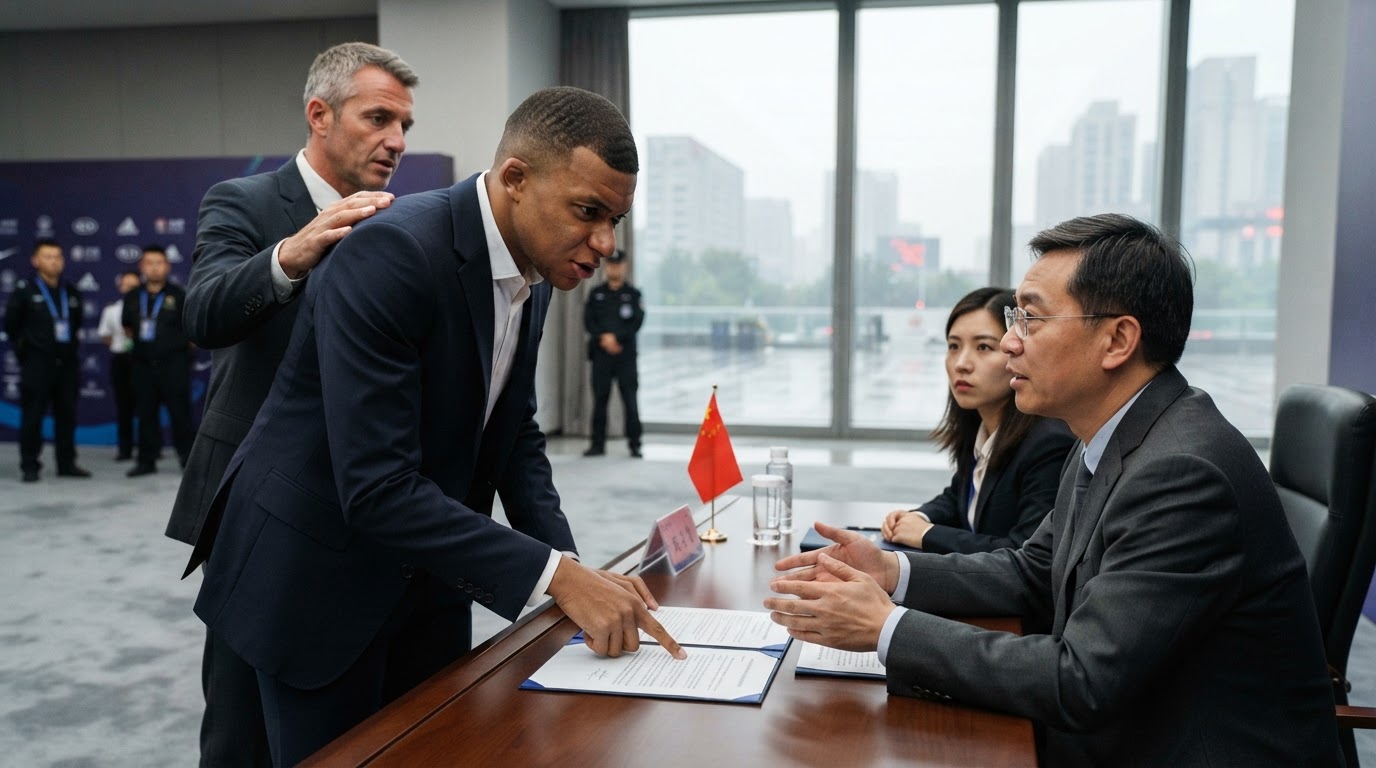
Athletic branding across East Asia has long relied on the assumption that global celebrity operates in a political vacuum, converting marquee athletic visibility into consumer goods sales without requiring players to master local sovereign sensitivities. That operational premise collapsed this week. Real Madrid forward Kylian Mbappe disrupted that fragile separation when a video interview clip circulated showing him amused by an online image superimposing his face onto Mao Zedong, whom he characterized as "some guy, think he's a Chinese dictator". By Wednesday, Oct 28, 2026, authorities in Beijing formally stated they took an apology from Mbappe "seriously", yet the preceding backlash—marked by cancelled sponsor contracts and Spanish football broadcasts abruptly pulled from screens—demonstrated how swiftly sovereign orthodoxy overrules commercial utility.
The friction exposes a recurring blind spot in European athletic management. For decades, international football agencies have treated global talent as ideologically neutral content suitable for distribution into any consumer jurisdiction willing to purchase television rights and dairy products. At a supermarket in Beijing on Oct 28, promotional material for Chinese dairy firm Mengniu still displayed France's Mbappe in the center, flanked by Argentina's Lionel Messi and Spain's Lamine Yamal. This retail juxtaposition captured the broader commercial ambition: foreign sporting icons positioned to drive domestic sales. But that commercial posture rests on compliance that foreign athletes rarely recognize until punitive enforcement begins.
Orthodoxy as an Unwritten Contract
Inside mainland China, commercial visibility is fundamentally contingent on political compliance. Corporate sponsors dropped Mbappe within hours of the clip circulating, an outcome that reflects the reality of commercial survival in a market where public association with political disrespect creates fatal regulatory exposure.
China said Wednesday it took seriously an apology from Real Madrid superstar Kylian Mbappe after comments he made poking fun at Mao Zedong sparked a social media storm.
Domestic enterprises such as Mengniu cannot absorb proximity to public disparagement of foundational state figures. When Mbappe reduced historical leadership to casual satire, the commercial apparatus responded not out of brand sensitivity, but through institutional necessity.
Sponsors evaluate risk through an asymmetrical balance sheet. A marquee European star can accelerate quarter-on-quarter visibility, but alignment with perceived political insult jeopardizes operational security. The quick intervention of official media and broadcast regulators highlights how rapidly commercial sports rights can be quarantined when state sensibilities are breached.
The Asymmetry of Asian Market Risk
Regional comparisons underscore the unique vulnerability of commercial sports properties operating in Beijing compared with neighboring markets. In Southeast Asian commercial hubs, foreign celebrity commentary rarely triggers coordinated state boycotts or broadcast suspensions, allowing retail brands to navigate controversies through routine public relations adjustments. In Japan and South Korea, public scrutiny typically measures athlete propriety against contractual duties and social decorum rather than state-defined historical narratives. In China, by contrast, historical interpretation remains inextricably bound to state legitimacy, turning unscripted personal commentary into an economic liability for European leagues.
Spanish football executives and club directors now face an escalating policy dilemma. Real Madrid cannot easily insulate broadcast contracts and sponsorship revenue from the off-pitch statements of individual athletes who are socialized in Western media environments where satirical disrespect is routinely tolerated. Apologies accepted by Beijing may temporarily arrest diplomatic fallout, but they do not eliminate commercial caution among state-linked enterprises.
This dynamic leaves European football facing an unresolved structural tension: sports organizations remain desperate to monetize Chinese consumer scale, but their highest-earning assets remain fundamentally unequipped for the ideological conditions required to operate there.
Sources
Newsletter
Pacific Daily
A curated briefing from Thailand, Asia-Pacific and the world.