Philippine Legal Maneuvers Reflect Enduring Institutional Fissures
A political figure's stance in a high-profile case underscores the persistent challenge to judicial independence, casting a long shadow over governance stability in the Asia-Pacific.
SINGAPORE
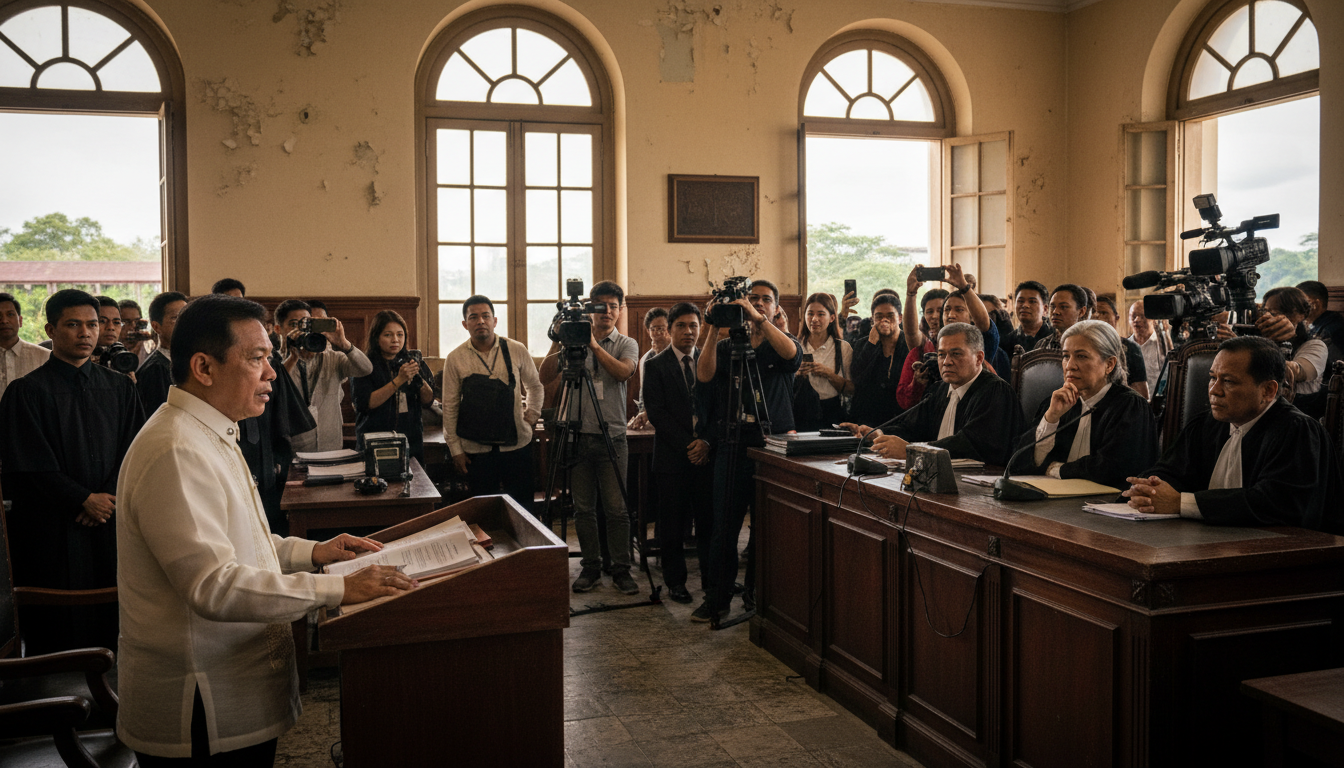
The reported intervention of a political figure in a legal proceeding, siding with the prosecution after the defense attempted to bar an ex-Sandiganbayan justice, signals a consistent characteristic of Philippine political dynamics. This event, reported on September 14, 2026, is not an isolated incident but rather a continuation of historical patterns where the judiciary's autonomy becomes a battleground for political influence.
The core capability under scrutiny is the judiciary's ability to operate independently of political pressure. The defense team's argument, attempting to prevent the testimony of the former Sandiganbayan justice as a 'surprise witness,' highlights an effort to shape the judicial process. The position taken, aligning with the prosecution, can be seen as either upholding procedural integrity or as a strategic move within the broader political landscape. It bears recalling that in March 2016, a political figure was tied with Bongbong Marcos in the vice-presidential race, illustrating established positions within the political hierarchy.
Historical context provides clarity. The Philippines has a documented history of legal proceedings involving high-profile political figures. A former President was arrested on fraud charges in November 2011. More recently, in March 2025, former President Duterte faced arrest, leading to broader discussions on the plight of drug war victims. These events collectively demonstrate a persistent tension between political actors and the legal framework. It was also reported that an investigation into an alleged death threat by Sara Duterte against President Marcos was ongoing in January 2025, further illustrating the intertwining of political and judicial processes.
The challenge for judicial independence is not merely about specific cases but about the enduring institutional capacity to resist external pressures. When a high-ranking political figure takes a public stance in a trial, it inevitably projects an image of political engagement with judicial outcomes. This engagement, regardless of its stated intent, can introduce a perception of susceptibility into the legal system. A reported 'intense assault' from the Senate and the subsequent stance taken by the House of Representatives in February 2024 further illustrates the inter-branch friction that can spill into, or be influenced by, legal interpretations and processes.
For the Asia-Pacific region, the Philippines' experience presents a pertinent case study. The stability of governance and the predictability of legal frameworks are foundational for regional order and economic confidence. A judiciary perceived as vulnerable to political maneuvers, even through the actions of individual political figures, complicates this perception. While the immediate outcome of this specific legal motion is confined to the Philippine context, the broader pattern of political figures influencing judicial processes represents an unresolved tension within the nation's institutional architecture. The capacity for the judicial system to consistently enforce laws without perceived political leverage remains a crucial, ongoing challenge.
Sources
Newsletter
Pacific Daily
A curated briefing from Thailand, Asia-Pacific and the world.