Paris Under Fire Exposes the Fragility of Elite Stability
Violent weekend clashes and fiscal strain dismantle the illusion that Europe's commercial center can decouple from domestic living costs
SINGAPORE
Metropolitan order relies on an unspoken economic bargain: high-value commercial centers operate under the presumption that municipal stability can be permanently insulated from domestic financial strain. That assumption fractured across French urban centers on Saturday, Oct 31, 2026. Clashes erupted across Paris and regional cities after hundreds of thousands of demonstrators mounted a third consecutive weekend of protests targeting surging living costs and education policy. By Sunday, Nov 1, judicial authorities in France had formally opened an attempted murder investigation following petrol bomb attacks that left an officer engulfed in flames.
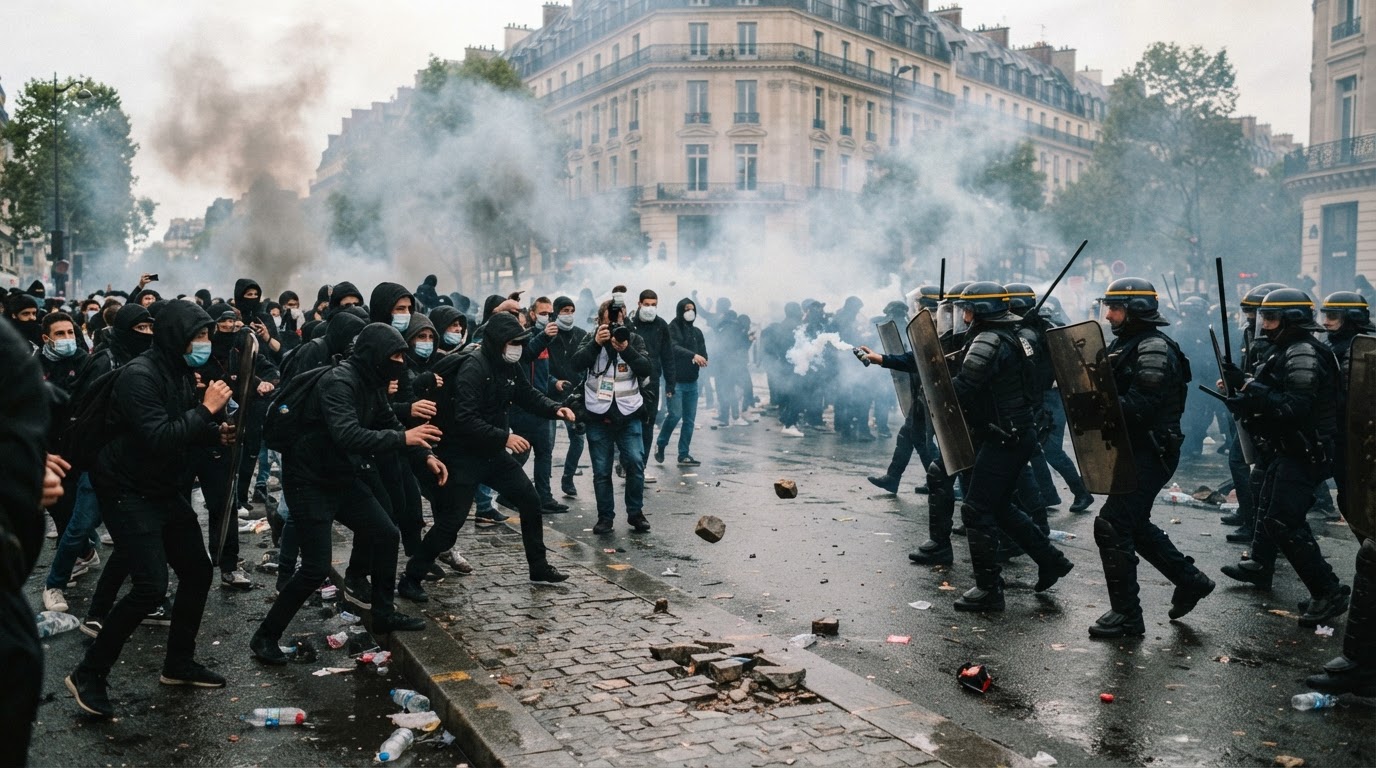
The scale of public confrontation demonstrates that civil unrest has escalated beyond conventional industrial friction. According to statements from the Paris police prefecture, several hundred rioters broke from broader demonstration marches to assault security detachments with projectiles and improvised incendiary devices. A burning vehicle captured on Oct 31, 2026, underscored the physical breakdown of public space in a capital that serves as the premier showroom for global discretionary capital.
The Friction of Unequal Pressures
Street violence of this magnitude cannot be evaluated solely as a policing failure. It represents the sharp physical manifestation of wider macroeconomic deterioration. Weeks before the weekend confrontations, the euro slipped to a 17-month low on Oct 5, 2026, driven lower by mounting anxiety over sovereign debt in France. When currency depreciation coincides with persistent inflation in household essentials, the gap between institutional priorities and basic living standards widens rapidly.
Several hundred rioters broke from broader demonstration marches to assault security detachments with projectiles and improvised incendiary devices.
For international capital and cross-border commercial operators, the weekend unrest challenges a fundamental operational premise. Global retail networks, institutional investors, and sovereign wealth entities have treated premier European capitals as self-contained havens where prestige consumption remains completely detached from local social fractures. The presence of hundreds of thousands of citizens on urban thoroughfares protesting basic survival costs directly disrupts that model. When municipal security forces become targets of lethal violence, the physical security of commercial districts and public transport hubs ceases to be guaranteed.
Alternative interpretations frame the violence as an isolated breach driven strictly by fringe extremist cells rather than systemic economic collapse. Interior Minister Laurent Nunez and regional security officials face genuine tactical challenges from organized factions seeking confrontation with state authorities. Yet viewing petrol bomb attacks strictly through the lens of criminal radicalism ignores the scale of the broader mobilization. Hundreds of thousands of peaceful marchers do not sustain three consecutive weekends of street actions without profound, unaddressed economic desperation.
Limits of the Insulated Showcase
Sustained civil instability threatens the international commercial standing of France across key external trading partners, including China and Australia. As the euro remains weakened by sovereign debt commitments, domestic authorities find their fiscal margins narrowing just when social spending demands are intensifying. The state cannot easily fund structural concessions on education or living expenses without compounding the debt pressures that unsettle foreign exchange markets.
France now confronts a severe policy dilemma. Deploying heavy security cordons may suppress tactical rioting in central boulevards, but enforcement alone does not lower the price of household necessities or restore municipal equilibrium. The attempted murder probe initiated on Nov 1 confirms the acute legal and tactical severity of the current crisis. What remains unresolved is how any modern administrative center can preserve its reputation as an effortless showcase of stability while domestic purchasing power continues to deteriorate beneath it.
Sources
Newsletter
Pacific Daily
A curated briefing from Thailand, Asia-Pacific and the world.