Pacific Gale Fronts Expose Infrastructure Vulnerability to Rapid Weather Reversals
Severe gales fanning scrub fires before sudden cold snaps demonstrate the operational strain of volatile pressure corridors on regional transport and civil defense.
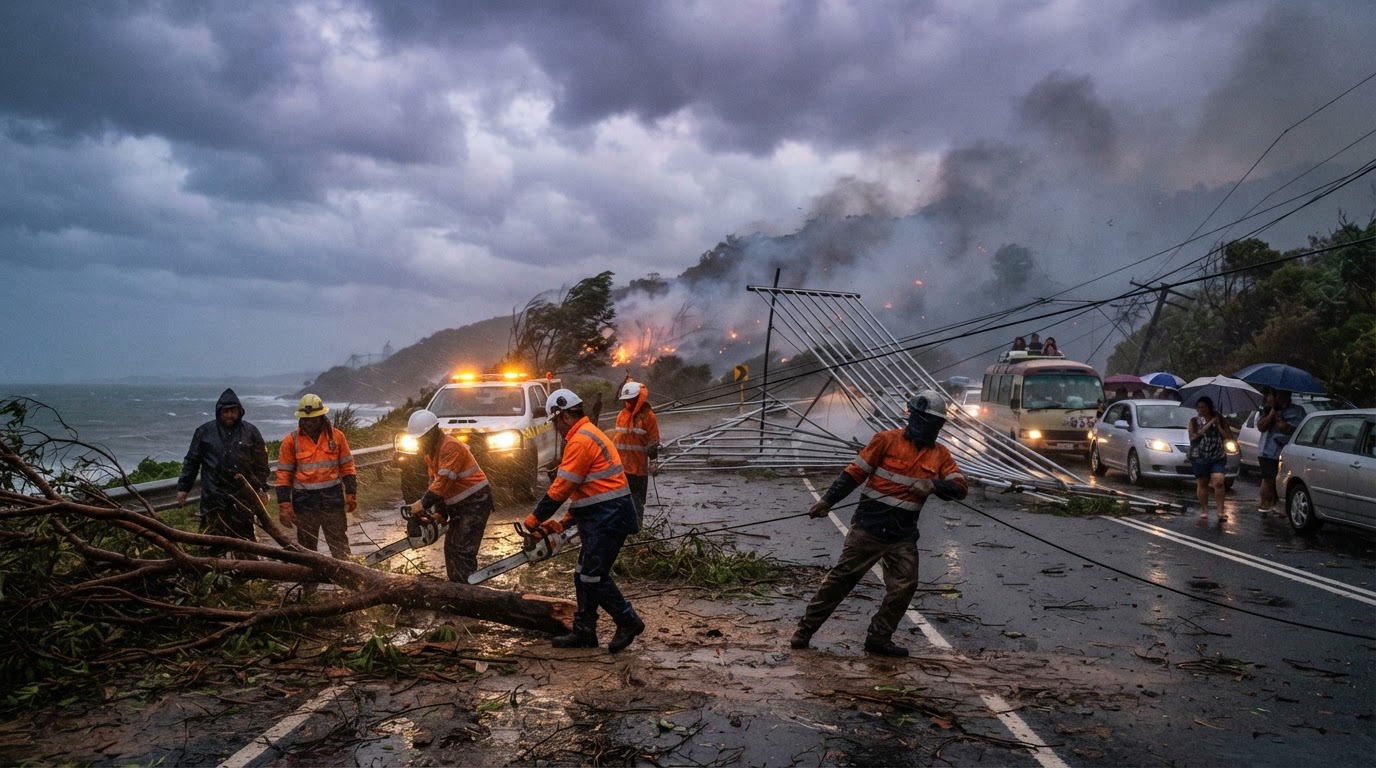
Maritime civil planning assumes that atmospheric systems dissipate across predictable seasonal curves, yet coastal topography routinely turns standard pressure gradients into volatile operational bottlenecks. Early on Tuesday, strong north-westerlies battered transport corridors and municipal hubs, with Wellington airport recording winds of 113 km/hr before dawn. These recorded velocities accelerated scrub fires along exposed lee slopes while grounding regional aviation links. At the same time, regional forecasts warned of incoming cold weather alongside alternating thermal shifts. When severe wind events collide with immediate temperature drops, municipal management models designed around singular hazard profiles experience acute institutional friction.
Historical response frameworks across the Pacific have traditionally isolated fire suppression logistics from cold-weather emergency management. This administrative separation falters when air masses invert within hours. On Morning Report, MetService head of weather news Heather Keats stated that the wind was making it difficult to fight wildfires, though incoming rain was expected to assist ground crews as another front arrived over the South Island on Wednesday. Her assessment points to an underlying operational reality: physical exposure along maritime margins creates compounding liabilities. Ground units managing firebreaks along ridgelines cannot easily redeploy assets when high-velocity gusts abruptly give way to moisture-laden polar fronts.
Topographic Fractures and Municipal Cost
Regional topography magnifies these meteorological shifts across disparate administrative zones. Elevated interior features, including the Tararua Ranges and Mt Kaukau, channel westerly airflows directly into vulnerable downwind districts across Wairarapa, Marlborough, and Canterbury. Farther south, territories spanning Buller, Grey, Mt Somers, and Dunedin absorb contrasting shocks as dry downslope winds shift toward maritime squalls. In practical terms, local councils bear immediate infrastructure wear, absorbing transit closures alongside escalated civil defense costs without supplementary central resources.
One counterargument holds that episodic gale cycles represent regular maritime fluctuations rather than novel infrastructure deficits. Proponents of this view suggest that commercial airports, arterial roads, and provincial firefighting services already carry structural safety margins calibrated to absorb routine disruptions from Monday through Thursday. That institutional logic, however, rests on the assumption of adequate recovery windows between opposing weather phases. When severe gales fan active blazes immediately prior to sharp drops in temperature, local response reserves deplete before standard restoration cycles can begin.
The Lingering Civil Dilemma
The fundamental challenge concerns how regional authorities distribute finite resources between frontline containment and long-term asset hardening. Inland policy offices frequently fund emergency services based on isolated statistical averages, underestimating how rapidly alternating weather shocks compromise coastal utility networks. If sudden windstorms impede wildfire control while heralding immediate temperature drops, emergency operators must maintain conflicting logistical postures at once. This dual exposure strains machinery, threatens local power distribution, and exposes transport corridors between regional harbors and interior hubs to accelerated physical wear.
Public expenditure continues to favor reactive disaster response over continuous structural fortification across the South Island corridor. While central funding mechanisms prioritize rapid recovery following acute weather emergencies, long-term capital rarely reaches local transport routes subject to cumulative environmental degradation. That structural policy disconnect between central capital allocation and coastal maintenance realities remains unresolved.
Sources
Newsletter
Pacific Daily
A curated briefing from Thailand, Asia-Pacific and the world.