Melbourne Decouples Place from Spectacle
By using American football to lure Asian leisure travellers, Victoria wagers that global spectator brands matter more than local urban identity.
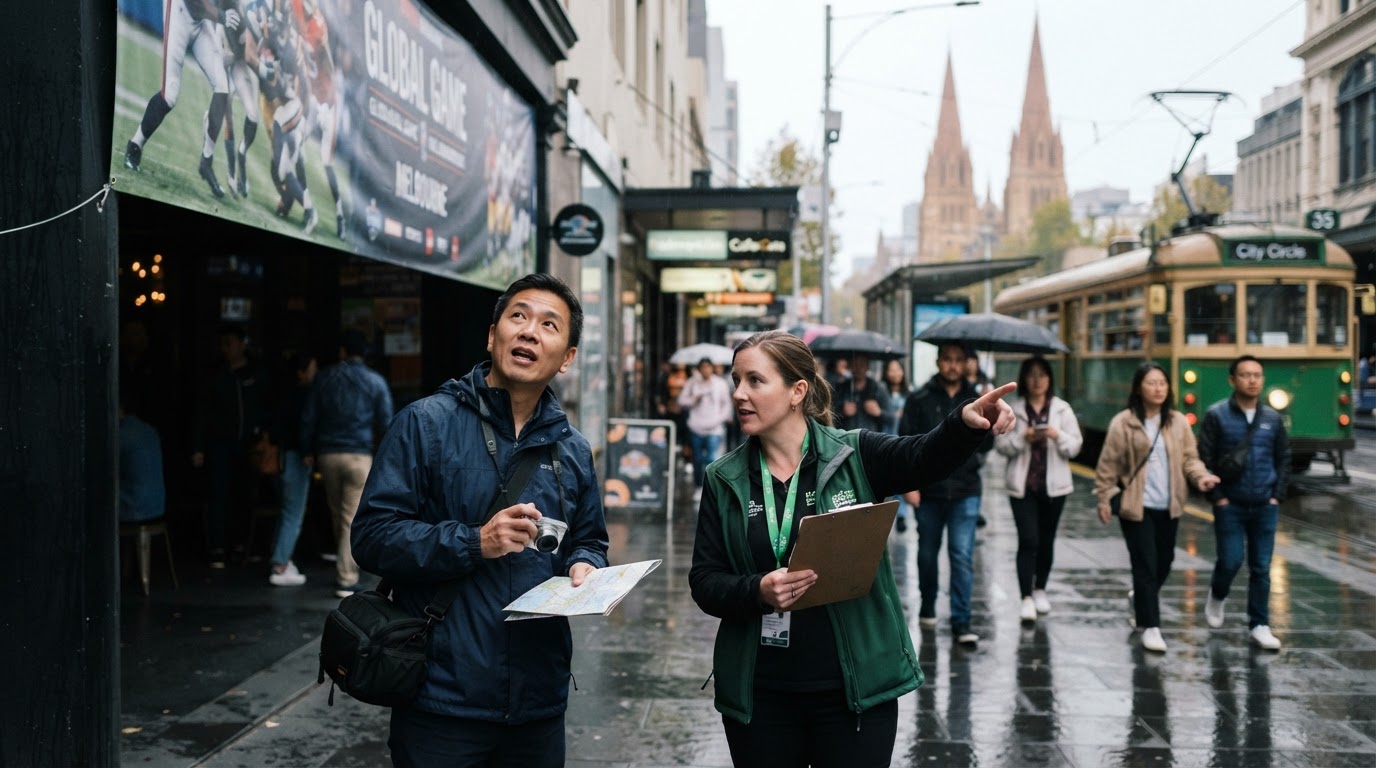
MELBOURNE
Across the broad turf of the Melbourne Cricket Ground, the painted yard lines of American gridiron briefly replaced the concentric boundaries of Australian winter football. For decades, the stadium derived its civic authority from domestic sporting rituals, its turf shaped strictly by the cadence of cricket and Australian rules. Last month, that seasonal calendar accommodated an unfamiliar fixture: the Los Angeles Rams facing the San Francisco 49ers under a multi-year hosting agreement negotiated by Victoria. What emerged was a temporary spatial transformation designed entirely for an international audience.
State tourism authorities celebrated the immediate outcome. The fixture delivered record hotel occupancy across the central city, drawing ticket buyers from 38 countries. Significantly, the crowd pulled heavily from urban outbound corridors across Asia, including China, Hong Kong, Indonesia, Japan, South Korea, Malaysia, the Philippines, Singapore and Thailand. Tourism officials viewed the audience as proof of a new commercial frontier. As Shae Keenan noted, Asia forms an essential component of the international visitor economy, serving as a primary target for market expansion.
The Neutral Arena
Yet the economic calculation contains a quiet contradiction. For decades, Australian tourism promotion across East and Southeast Asia relied on territorial specificity: coastal ecologies, regional vineyards, and civic heritage. By importing an American sports fixture into Victoria, policymakers have altered the fundamental proposition. Melbourne is no longer selling itself as a distinct southern hemisphere destination; it is positioning its primary arena as a geographically convenient neutral stage for brand entertainment licensed from the United States.
"Asia is an incredibly important part of our international visitor economy. It s certainly where we have a really strong aspiration to grow our position."
This shift reflects an evolving consumer reality across Asian metropolises. For affluent residents in Bangkok, Singapore, or Manila, sovereign borders have become incidental to leisure consumption. If a marquee match between California franchises cannot easily be seen at home, a flight south to Victoria offers a viable weekend detour. The visitor arrives not to experience the peculiarities of Victoria, but to consume a global media product within a time zone that requires minimal physical adjustment. Urban proximity and calendar alignment take precedence over local exploration.
The Perils of Borrowed Spectacle
The durability of this strategy remains contested. Sceptics within urban planning and regional tourism observe that events anchored in imported intellectual property generate transient footfall rather than durable civic connection. When a municipality spends public resources and stadium access on foreign sports syndicates, it enters an escalating bidding contest against rival capitals. Any city with an aviation hub, adequate bed capacity, and a compliant stadium can bid for the same fixture in subsequent seasons. Transience is built into the contract.
There is, nevertheless, a persuasive commercial logic behind the wager. Traditional long-haul travel patterns are shifting, with younger Asian consumers demonstrating higher willingness to travel for single, highly concentrated entertainment events rather than multi-week touring itineraries. If Melbourne secures a multi-year footprint with the NFL, it captures high-spending regional travellers who might otherwise bypass southeastern Australia entirely. Commercial sports deliver concentrated, predictable spikes in hospitality bookings that conventional scenic campaigns rarely achieve.
The broader implication extends well beyond stadium management. As gateway cities compete for regional middle-class leisure expenditure, the distinct cultural character of the host city risks becoming secondary to the spectacle on offer. Melbourne's pitch to Asian visitors suggests that civic distinctiveness is no longer enough to anchor international tourism. In its place sits the leased spectacle, occupying turf once shaped by the city's own traditions, welcoming visitors whose eyes remain fixed on an imported game.
Sources
Newsletter
Pacific Daily
A curated briefing from Thailand, Asia-Pacific and the world.