Jakarta Security Surge Exposes the Limits of Coercive Stability
Mobilising more than 9,000 officers against student protests marks an institutional pivot from electoral confidence to street-level containment
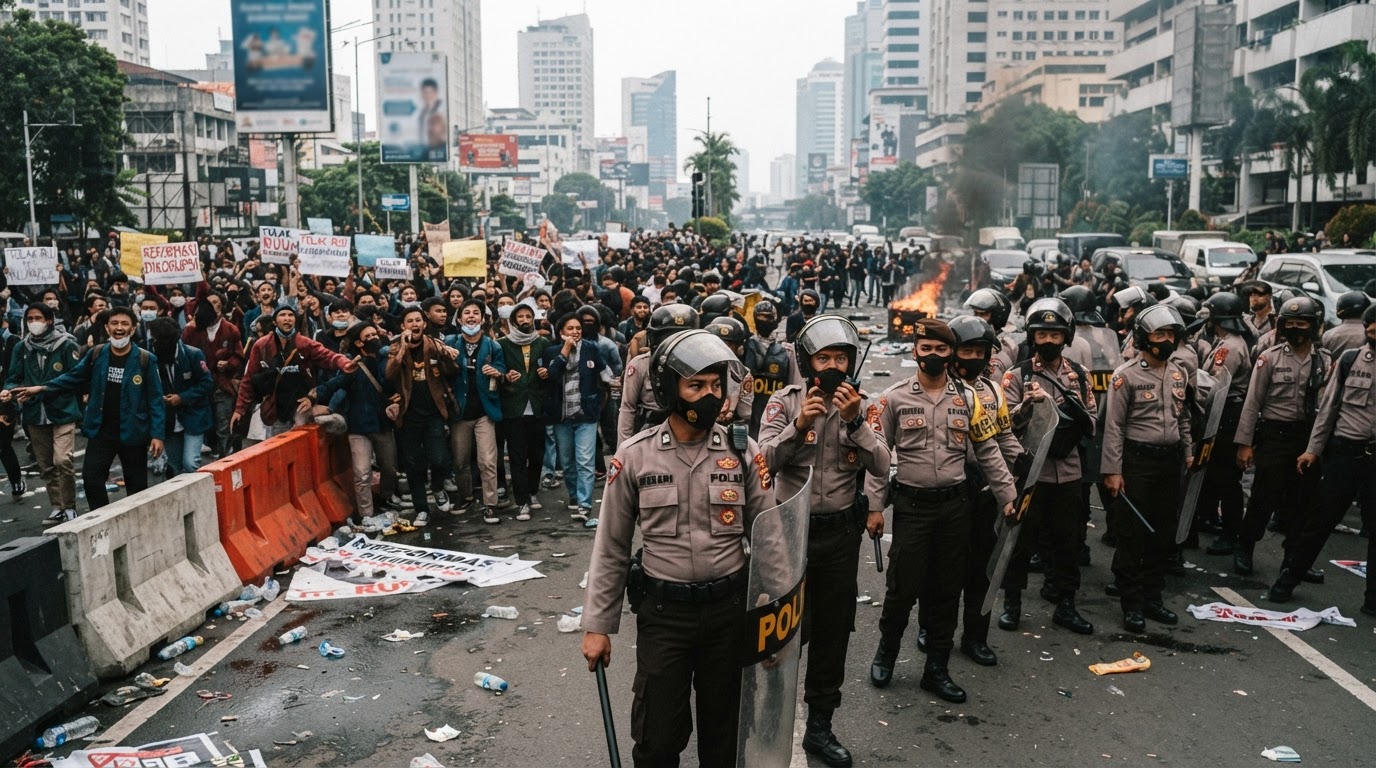
JAKARTA
State authority in Indonesia has long measured its stability by the volume of security personnel required to hold the capital's public avenues. When municipal authorities order more than 9,000 police officers into Jakarta to manage demonstrations marking President Prabowo Subianto's two years in office, the tactical scale speaks directly to an administrative apprehension. Tactical mobilisations of this size indicate an executive posture pivoting from negotiated consensus toward street containment. Independent polling confirmed that presidential popularity was on the wane, providing measurable context for why municipal commanders anticipated significant unrest.
Organised civic delegations, notably including students from the University of Indonesia, mobilised across several designated assembly points in Jakarta. Their platform united two structural pressures that rarely align so cleanly: severe recent forest fires across rural provinces and an intensifying rout on the domestic stock market. By coupling environmental destruction directly to equity contraction, student organisers altered the customary boundaries of Indonesian political agitation. Environmental failure alienates agrarian regions, while market deterioration unsettles commercial elites. Force cannot bridge that political divide.
Economic Strain and Tactical Mobilisation
Law enforcement representatives maintained that extensive security preparations were standard operational precautions. City police spokesperson Budi Hermanto indicated that personnel would be positioned at several spots to maintain civic order and protect municipal infrastructure. Managing metropolitan transport arteries during large-scale assemblies requires substantial logistical readiness. This institutional rationale is procedurally defensible.
Yet defensive containment reflects an underlying fragility. When an administration requires thousands of officers to protect its public standing at the two-year mark, the political coalition underpinning executive rule is under tangible strain. Police cordons resolve immediate logistics, but they do not arrest macroeconomic decay.
Physical containment on city boulevards leaves the underlying financial and ecological catalysts completely untouched.
This confrontation stands in stark contrast to earlier administrative posture. During a press conference at the Presidential Palace in Bogor on Jan 11, 2025, President Prabowo Subianto projected an image of firm command, asserting state authority over domestic development priorities. The subsequent twenty months have exposed the limits of that initial projection. Decreasing public support, recorded in recent polling, illustrates how quickly political capital dissipates when administrative delivery falters on multiple fronts simultaneously.
Regional Capital and Unresolved Grievances
Regional market observers follow these domestic tensions with close attention. As Southeast Asia's largest economy, Indonesia provides institutional weight to regional stability, and persistent instability in Jakarta introduces immediate friction into cross-border investment flows. A prolonged domestic crisis over natural resource management and market confidence complicates regional economic coordination, raising risk assessments for capital assessing sovereign commitments across the archipelago.
Deploying security cordons across Jakarta maintains physical order for a single afternoon. That tactical outcome, however, leaves structural policy failures unresolved. The administration can clear avenues, but police barricades cannot halt forest fires or reverse equity losses. The central government now confronts the reality that reliance on security forces cannot substitute for policy correction.
Sources
Newsletter
Pacific Daily
A curated briefing from Thailand, Asia-Pacific and the world.