Head Trauma Protocols and Player Vulnerability in International Cricket
Steve Smith's anxiety after a Durban bouncer reveals how standard testing struggles with the psychological weight of accumulated injury
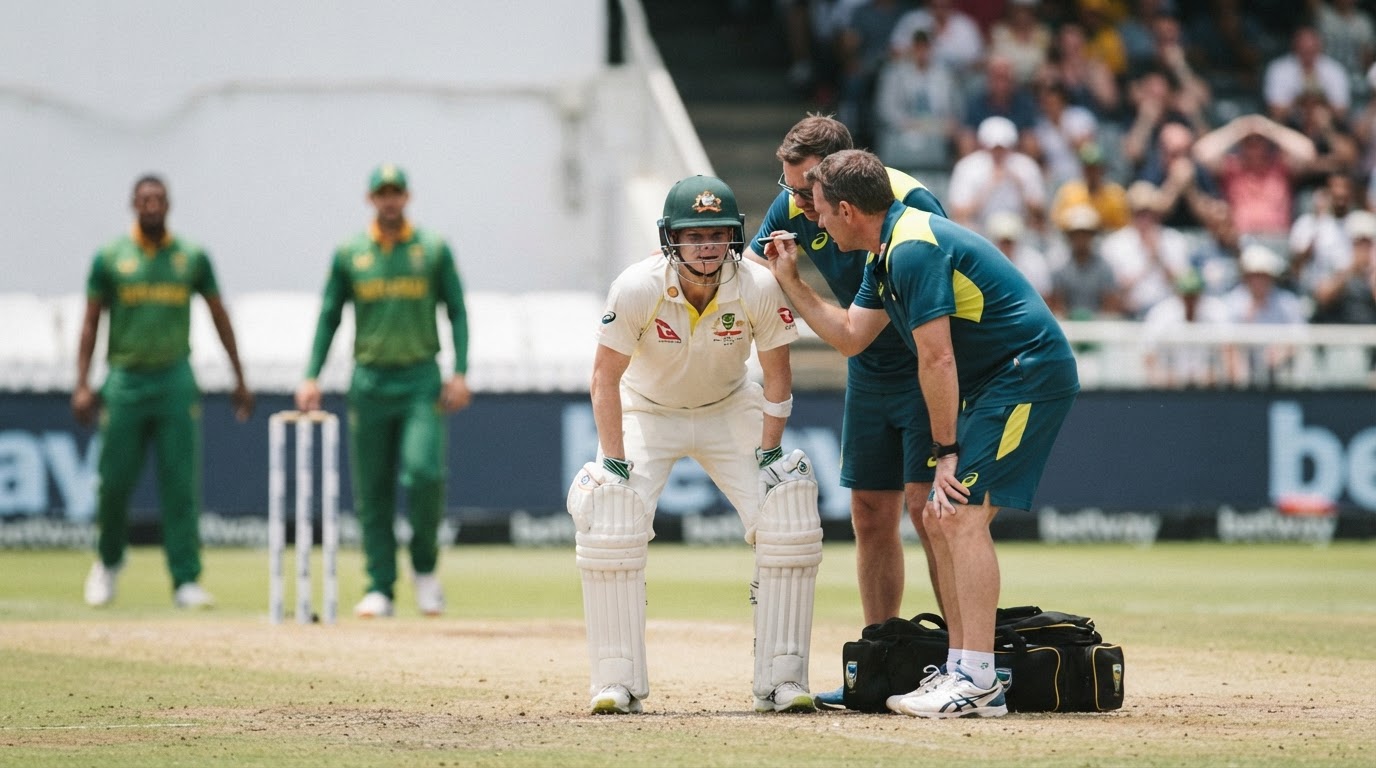
Elite professional sport relies on standardized clinical benchmarks to protect human capital, yet standardized testing cannot register the psychological friction that follows repeated physical trauma. Both realities exist concurrently whenever high-impact collisions occur on the international stage. When Australian batsman Steve Smith absorbed a delivery to the helmet from South African fast bowler Anrich Nortje at Kingsmead in Durban, administrative machinery functioned precisely as intended. Formal concussion examinations commenced immediately, overnight monitoring took place, and the former captain eventually rejoined team preparations. What formal protocols solved on paper, however, did not resolve the interior burden that an athlete experiences when facing another serious head injury.
Smith entered that Monday encounter with a recorded history of multiple concussions suffered across his career. A fast delivery striking protective gear is an ordinary hazard of top-tier cricket, yet the psychological resonance of such an impact compounds with every prior episode. Clinical frameworks assess cognitive reactions, pupil response, and physical equilibrium against established baseline data. They are structurally incapable of measuring how memory and apprehension influence an athlete who has previously spent weeks sidelined by neurological distress.
I was a little bit anxious after the hit, to be honest,
Smith acknowledged that reality directly when addressing the confrontation. The remark exposes a persistent blind spot in sports governance across the Commonwealth and the wider Asia-Pacific sphere. Modern governance frameworks operate on a binary threshold: a participant either manifests diagnostic deficits or returns to active competition. That operational design serves fixture continuity and commercial broadcasting commitments, but it leaves the individual athlete to absorb the invisible friction of returning to the crease.
Clinical Baselines and Athletic Apprehension
Navigating the aftermath of a head blow involves two distinct trajectories: physiological recovery and mental readiness. Speaking ahead of subsequent preparations in Gqeberha, Smith described his relief following the Kingsmead incident: "So, yeah, fortunately, I woke up well. I passed all the tests, and things recovered pretty quickly," he noted.
Passing clinical evaluations confirms that immediate cognitive function meets medical thresholds. It does not certify that an individual feels entirely prepared to confront extreme physical risk again. Historically, international cricket operated for decades without concussion substitutes or formalized medical oversight. The institutional introduction of mandatory testing represented substantial progress, providing systematic checks from the Ashes encounters against England through to bilateral tours in South Africa.
Yet institutional progress frequently halts at procedural compliance. Sporting bodies design guidelines to manage legal exposure and ensure player availability, creating an environment where clearance is treated as complete recovery. When high-speed deliveries arrive with relentless pace, technical execution demands unhesitating focus. Even marginal anxiety disrupts the split-second mechanics required to evade high-velocity impacts, generating elevated risks that clinical checklists cannot monitor.
Structural Pressures Across International Fixtures
The tension between administrative timelines and human preservation becomes acute during major international campaigns. High-profile contests, such as the Second Test at the Gabba in Brisbane during the Ashes in December 2025, show how quickly organizational attention pivots back toward competitive execution once a player receives medical approval. Tour itineraries allow little room for voluntary caution, and squad selections continuously assert pressure on seasoned players to prove their immediate readiness.
Governing bodies have developed extensive manuals for immediate pitch-side care, yet post-clearance mental support remains largely informal. Athletes are expected to normalize the danger once an examining physician signs off on standard reaction times. When an established international batter publicly admits to lingering anxiety after a helmet strike, the disclosure indicates that modern safety guidelines capture only the front half of traumatic injury.
The broader governance system remains tethered to measurable diagnostic criteria, even as the psychological residue of repeated concussions alters how competitors weigh continued exposure. Sports administrations can verify the absence of acute symptoms, but they cannot legislate away the vulnerability that lingers behind the helmet.
Sources
Newsletter
Pacific Daily
A curated briefing from Thailand, Asia-Pacific and the world.