Head Injuries and the Limits of Premier League Industrial Duty
The collision between Emiliano Martinez and Jarrad Branthwaite exposes the structural friction between elite physical trauma and the commercial machinery that exports it.
SINGAPORE
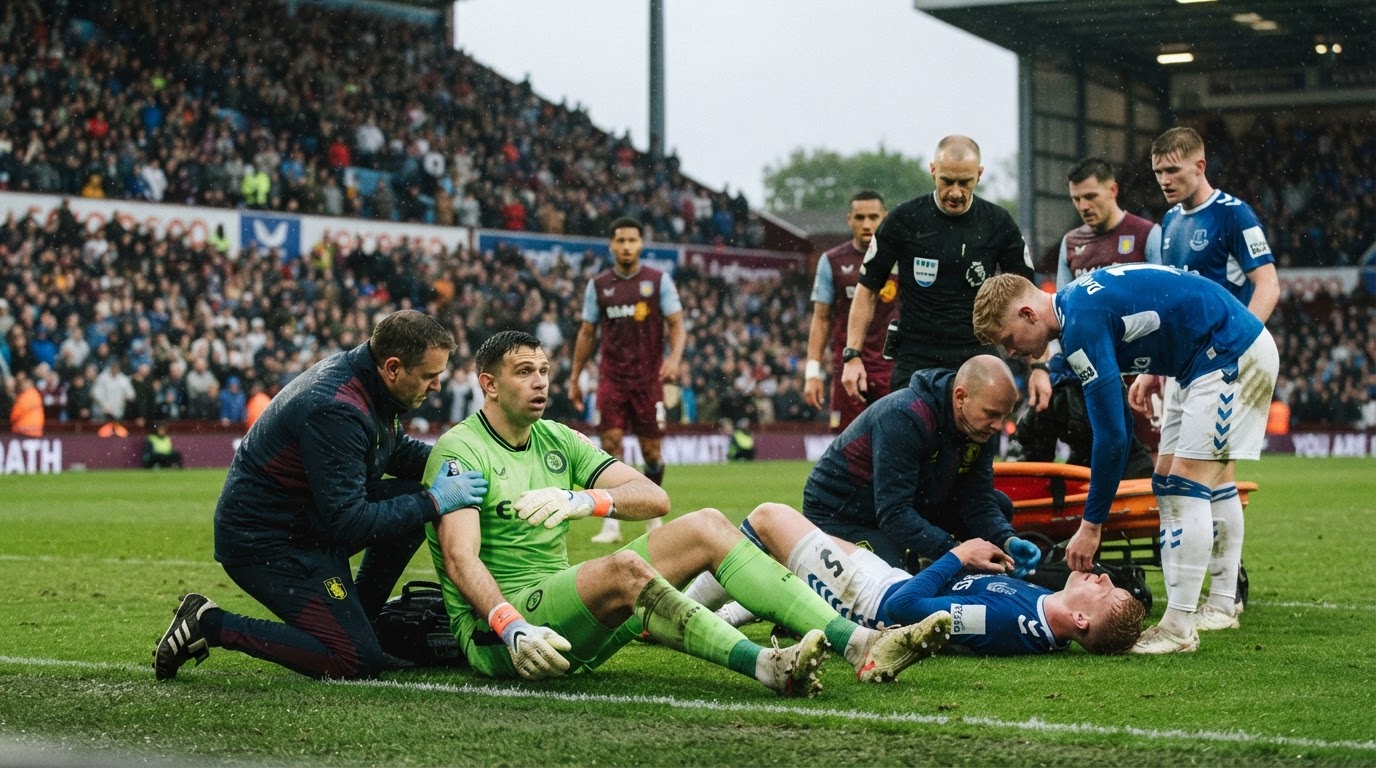
Elite professional football rarely pauses for long when a goalkeeper is carried off the grass on a stretcher. On October 17, 2026, during a Premier League fixture at Hill Dickinson Stadium in Liverpool, Chelsea goalkeeper Emiliano Martinez collided heavily with Everton defender Jarrad Branthwaite. Both men hit the turf immediately. While two goals from Neto eventually delivered an away victory for Chelsea, manager Alonso confirmed after the match that Martinez had suffered a concussion. Play resumed, points were awarded, and the global broadcast moved smoothly to its post-match analysis.
That sequence of events underlines a persistent institutional reality. While governing bodies maintain detailed concussion guidelines, the sport routinely treats acute brain trauma as manageable operational friction. League administrators face intense public scrutiny regarding athlete welfare, yet the commercial imperative to complete fixtures and maintain broadcast schedules remains dominant. When a goalkeeper requires emergency immobilisation, the spectacle absorbs the shock, recalibrates, and continues.
Governance and Physical Risk
Historically, top-tier English football categorised severe goalmouth collisions as standard occupational hazards inherent to elite competition. Goalkeepers were expected to accept direct physical contact during defensive aerial duels as an ordinary condition of their trade. In recent years, that traditional tolerance has formally yielded to structured concussion protocols, requiring immediate clinical evaluations and mandatory removals whenever traumatic head impacts occur.
The incident at Hill Dickinson Stadium indicates that reactive pitch-side protocols fail to resolve the core incentives that drive players into catastrophic contact.
Yet the evidence from Liverpool shows how narrow those medical interventions remain in practice. Even though Martinez was stretchered off and properly substituted under current directives, the incident itself arose from systemic pressures built into high-stakes domestic football. Club managers face unrelenting demands to secure defensive stability, while athletes are rewarded for physical abandon in contested territory. Neurological injuries cannot be evaluated through the same lens as standard muscular strains, because brain trauma involves compounding physical risks that standard recovery periods cannot reliably mitigate.
The Export Market and Athlete Safety
For international markets across the Asia-Pacific that consume the Premier League as a premium media commodity, these physical incidents arrive stripped of their industrial context. Domestic matches are packaged for satellite distributors and streaming platforms as high-intensity entertainment, where defensive collisions are frequently framed as heroic commitment. Viewers in Tokyo, Singapore, or Sydney watch the resulting medical extraction through high-definition television feeds, separated by thousands of miles from the physical consequences borne by the concussed worker.
This commercial distribution creates a visible ethical divergence. Domestic sporting leagues generate enormous overseas broadcast revenues by marketing unyielding competitive speed, yet the regulatory burden of protecting players from irreversible head trauma remains strictly confined to local match-day administration. While league executives point to existing medical assessment protocols as evidence of responsible governance, those measures intervene only after acute injury has already taken place.
The concussion suffered by Martinez at Hill Dickinson Stadium highlights an institutional boundary that football authorities have yet to cross. Until competitive rules actively discourage high-velocity aerial contact or impose mandatory, multi-week recovery windows following diagnosed concussions, the sport will continue to treat brain trauma as an acceptable cost of doing business. That unresolved tension between operational profit and physical preservation remains elite football's most intractable problem.
Sources
Newsletter
Pacific Daily
A curated briefing from Thailand, Asia-Pacific and the world.