Hanoi Flooding: A Recurring Interruption to Regional Infrastructure Resilience
The consistent incapacitation of Vietnam's capital by seasonal rains underscores a broader, unaddressed vulnerability across Southeast Asia.
HANOI
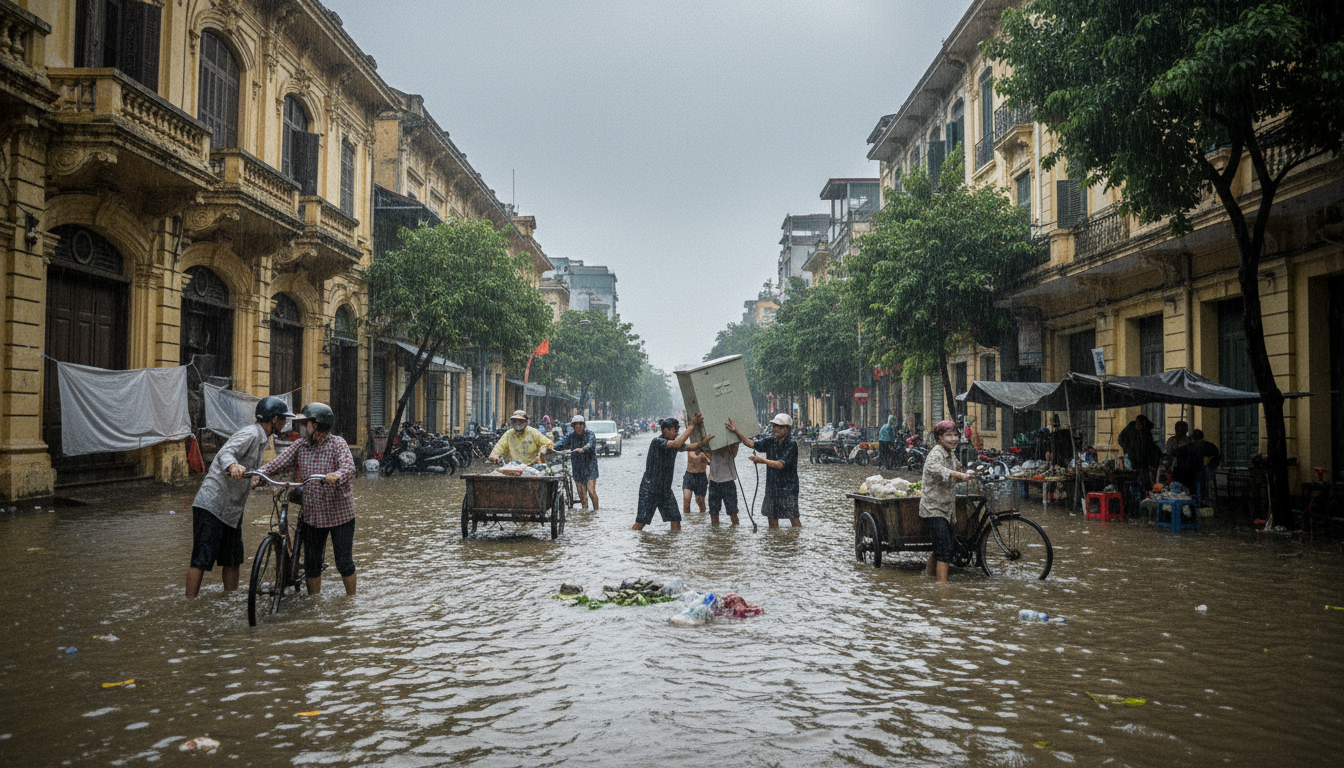
The report of Hanoi streets inundated by over 150 mm of overnight rain on September 17, 2026, forcing residents to navigate meter-deep waters, marks not an isolated incident but a pattern of systemic vulnerability. While the immediate focus is often on the local disruption – a young man ferrying commuters for VND50,000, or individuals wading through water to deliver food – the recurrence of such events reveals a persistent challenge to urban infrastructure and regional stability.
Historically, cities across Southeast Asia have developed along waterways, a pattern that once facilitated trade and sustenance. However, this historical advantage has evolved into a structural liability as urbanisation outpaces drainage and flood control investments. The frequent paralysis of Hanoi by heavy downpours, including previous instances where residents resorted to boats and rafts in waist-deep floods, suggests that existing mitigation strategies are insufficient to manage the current hydrological stresses. These events are not unprecedented; Typhoon Yagi, for instance, prompted thousands to flee Hanoi as recently as September 2024. The regularity with which these events occur indicates that the underlying capabilities to manage water flow in rapidly expanding urban centers have not demonstrably improved, despite the visible disruptions.
The broader regional implication is significant. As Vietnam integrates deeper into global supply chains and becomes a critical manufacturing hub, the consistent incapacitation of its capital city by seasonal weather poses a tangible risk to economic continuity. Investment decisions are increasingly sensitive to operational disruptions. When a major urban center faces repeated paralysis, it prompts questions regarding the resilience of its logistical networks and labor force. The tragic electrocution of two children in a flooded Hanoi park in October 2025 further highlights the failure of public safety infrastructure during these events, eroding public confidence and potentially deterring foreign direct investment reliant on a stable operating environment.
While some might argue that these events are merely seasonal, unavoidable consequences of monsoon climates, this perspective overlooks the demonstrable improvements seen in other regional metropolises that have invested heavily in sophisticated flood management systems. The continued struggle in Hanoi, therefore, represents a failure to adapt infrastructure capabilities to changing environmental realities. This recurring vulnerability in a strategically important regional economy suggests that the perceived stability of Southeast Asia's urban centers, critical for regional growth projections, remains constrained by foundational infrastructure deficits. The issue extends beyond immediate traffic woes; it implicates national economic resilience and, by extension, regional economic integration.
Sources
Newsletter
Pacific Daily
A curated briefing from Thailand, Asia-Pacific and the world.