Guam Grid Realities Reveal the Hard Limits of Island Preparedness
As Category 4 Typhoon Champi tests civil defence shelters, Pacific infrastructure vulnerability outpaces emergency mandates.
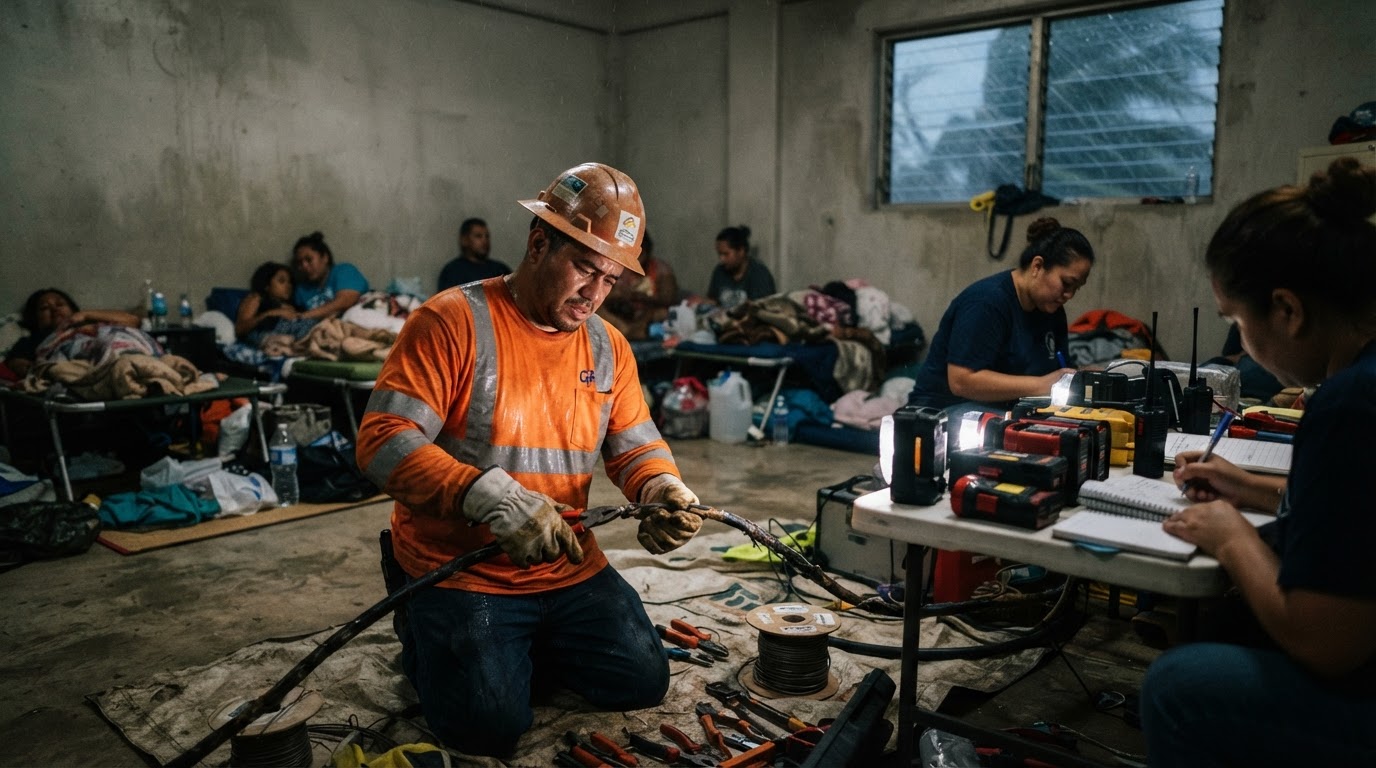
Civil defence doctrines across the western Pacific assume that administrative discipline can substitute for physical reinforcement when severe cyclonic systems make landfall. The approach relies heavily on precise civic rationing, structured shelter intake, and orderly shutdowns of civilian activity. That governance model faces an acute operational stress test across the Marianas as Category 4 Typhoon Champi advances across southern waters.
Local authorities placed Guam under Condition of Readiness 1 at 1pm Saturday, requiring non-essential personnel to stay off municipal roads and mandating that residents remain indoors until the declaration of Condition of Readiness 4. Forecast track data from the US National Weather service indicated sustained winds reaching 140mph, or approximately 225km/h, threatening severe damage to overhead distribution lines and coastal communities. Emergency personnel coordinated shelter operations across public education facilities, including Astumbo Elementary School, Machananao Elementary School, Ulloa Elementary School, Inarajan Middle School, Talofofo Elementary School, and George Washington High School. Six primary facilities absorbed displaced households as peripheral feeder bands arrived.
Structural Friction
Administrative alerts operate under established protocols, yet their effectiveness remains constrained by the legacy mechanics of insular utilities. The Guam Joint Information Center noted that Champi was expected to track directly over or just south of southern Guam into Sunday morning. While early warnings afford families time to secure domestic dwellings, they cannot prevent systemic failures across unhardened distribution networks. Pre-storm planning documents often treat power interruptions as temporary civic inconveniences. In practice, long-duration blackouts compromise cold storage, deactivate water pumps, and isolate remote village councils.
Grid operators such as the Guam Power Authority face physical thresholds beyond which structural preservation overrides delivery. Sustained winds near 200 to 225km/h regularly snap utility poles and strip high-voltage lines, creating multi-week backlogs for maintenance crews. When critical infrastructure relies on vulnerable aerial networks, civil warnings merely manage the timing of an unavoidable operational collapse. Emergency declarations clear public highways, but they cannot shelter exposed transmission assets from kinetic wind shear.
Regional Exposure
Across the wider Pacific basin, similar physical vulnerabilities govern remote island territories tied to mainland governance frameworks. Guam functions as a pivotal maritime and military node for the United States, yet municipal systems serving the civilian population share the fragile characteristics of smaller regional island economies. While disaster aid from federal partners eventually finances physical reconstruction, municipal rehabilitation cycles frequently stretch across seasons. Structural recovery in insular communities consistently lags the rapid pace of seasonal storm generation.
Physical transmission networks remain vulnerable to atmospheric shear regardless of shelter management.
Shelter management demonstrates administrative competence, but managing displaced families inside school gyms highlights a persistent policy contradiction. Astumbo Elementary School and Talofofo Elementary School can protect vulnerable residents through immediate wind impacts, yet prolonged regional isolation tests municipal self-reliance once the immediate meteorological hazard departs. Relief coordination across peripheral archipelagos demands substantial logistics capacity that local treasuries struggle to maintain independently.
Regional planning bodies frequently recommend undergrounding key utility corridors to blunt the impact of severe tropical systems. Such capital projects encounter severe fiscal limits, leaving insular authorities dependent on cyclic repair budgets rather than preventive engineering. Typhoon Champi underscores this structural division between emergency response capabilities and physical network durability. Island governments can issue timely evacuation orders and coordinate secondary shelters, yet they remain vulnerable to the fragile utility grids that govern post-storm survival.
Sources
Newsletter
Pacific Daily
A curated briefing from Thailand, Asia-Pacific and the world.