Engineering the Arctic in Singapore
Gardens by the Bay turns Finnish seasonal folklore into municipal infrastructure, revealing how equatorial hubs import climate spectacle to anchor domestic leisure
SINGAPORE
Equatorial urban centers have consistently relied on artificial environmental barriers to orchestrate seasonal consumer activity. In Singapore, where equatorial humidity precludes natural winter conditions, the staging of a high-latitude aesthetic operates through heavily engineered indoor enclosures rather than atmospheric shifts. The annual Christmas installation inside the Flower Dome at Gardens by the Bay, opening on Friday as the Christmas Train Show, demonstrates how municipal leisure destinations convert distant cultural geography into localized public programming.
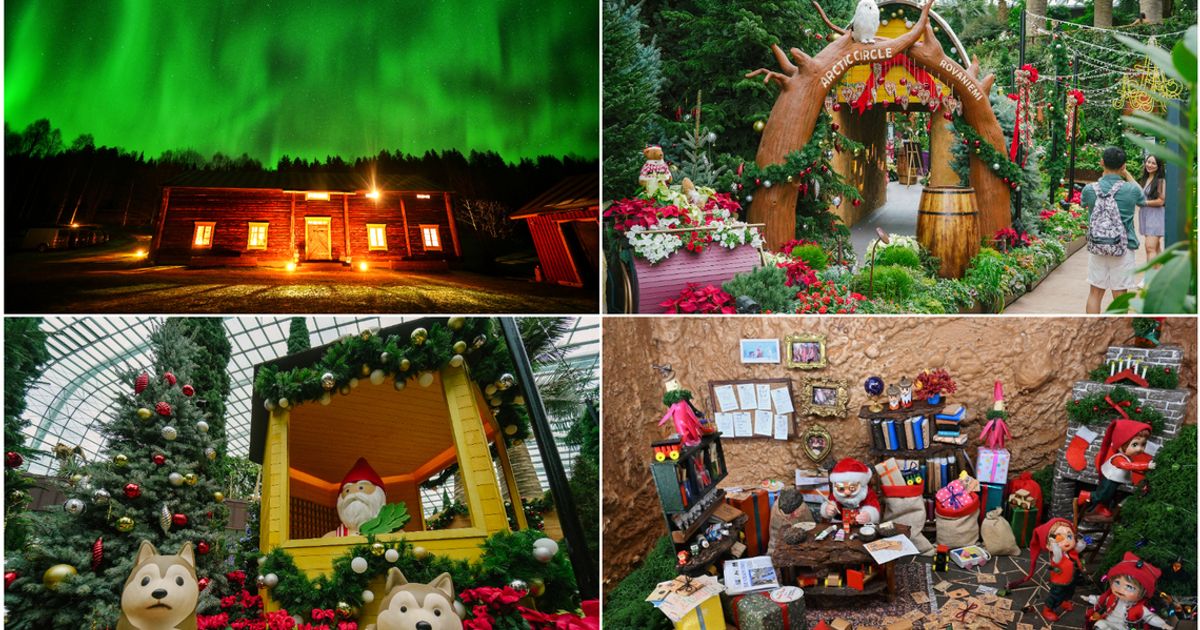
This year, the attraction recreates an explicit Finnish Arctic motif centered on Rovaniemi, recognized as the official hometown of Santa. The installation deploys Lapland log houses, a simulated sauna setting, and a ceiling projection recreating the Northern Lights observed above Raanupirtti, an accommodation venue in Finland. Surrounding these architectural displays are more than 6,000 plants, an inventory that incorporates 2,500 poinsettias managed within the temperature-controlled dome. The presentation also integrates miniature transit models across 11 train tracks, displaying rolling stock designs representing Finland, the United States, and Singapore through SMRT patterns.
The Economics of Climate Simulation
Public horticulture of this scale serves an economic function distinct from conservation. While the floral collection aggregates 2,500 poinsettias alongside thousands of other specimens, the programmatic focus rests entirely on imported cultural narrative. For equatorial visitors who face significant financial and geographical hurdles to reach the Arctic Circle, the Flower Dome provides a controlled visual proxy. The venue packages Finnish folklore, reindeer traditions, and subpolar lighting phenomena within a walkable perimeter, minimizing the logistical friction of long-haul travel.
The enclosure functions as an engineered substitute for subpolar geography, substituting physical travel with simulated visual markers.
Yet this arrangement highlights a broader pattern across consumer hubs in Southeast Asia. Destinations routinely borrow temperate and subpolar signifiers to mark the final quarter of the fiscal year, regardless of ecological reality. By incorporating model trains from America alongside local SMRT carriages and Finnish rolling stock, the exhibition frames domestic mass transit within an international leisure circuit. The municipal operator is not merely decorating a greenhouse; it is positioning local infrastructure within a global fantasy of holiday logistics.
Limits of Imported Pageantry
Skeptics could observe that such exhibitions provide accessible cross-cultural education, exposing urban families to Finnish community links and subpolar realities that would otherwise remain abstract textbook concepts. The inclusion of authentic architectural references like Rovaniemi log dwellings and Raanupirtti sky phenomena suggests institutional coordination rather than superficial retail staging. Furthermore, housing fragile temperate flora within a dedicated conservatory protects botanical specimens that could never survive ambient Singapore conditions.
That educational defense, however, encounters firm operational boundaries. An indoor simulation featuring Santa in a sauna juxtaposed with 11 train tracks remains fundamentally an exercise in managed commerce. The display presents a sanitised interpretation of the Arctic, stripped of environmental volatility, seasonal hardship, and geographic isolation. What remains is a consumable tableau designed to anchor domestic footfall within a paid municipal precinct.
Ultimately, the exhibition illustrates how wealthy equatorial city-states manage their climatic constraints. Rather than adapting year-end civic rituals to indigenous tropical environments, institutions expend substantial capital recreating foreign winter conditions under glass. The ongoing reliance on Arctic simulations leaves unresolved whether tropical public spaces can establish authentic, self-sustaining seasonal traditions that do not depend on perpetual refrigeration and imported folklore.
Sources
Newsletter
Pacific Daily
A curated briefing from Thailand, Asia-Pacific and the world.