Corporate Seeds and the Limits of Kitchen Politics
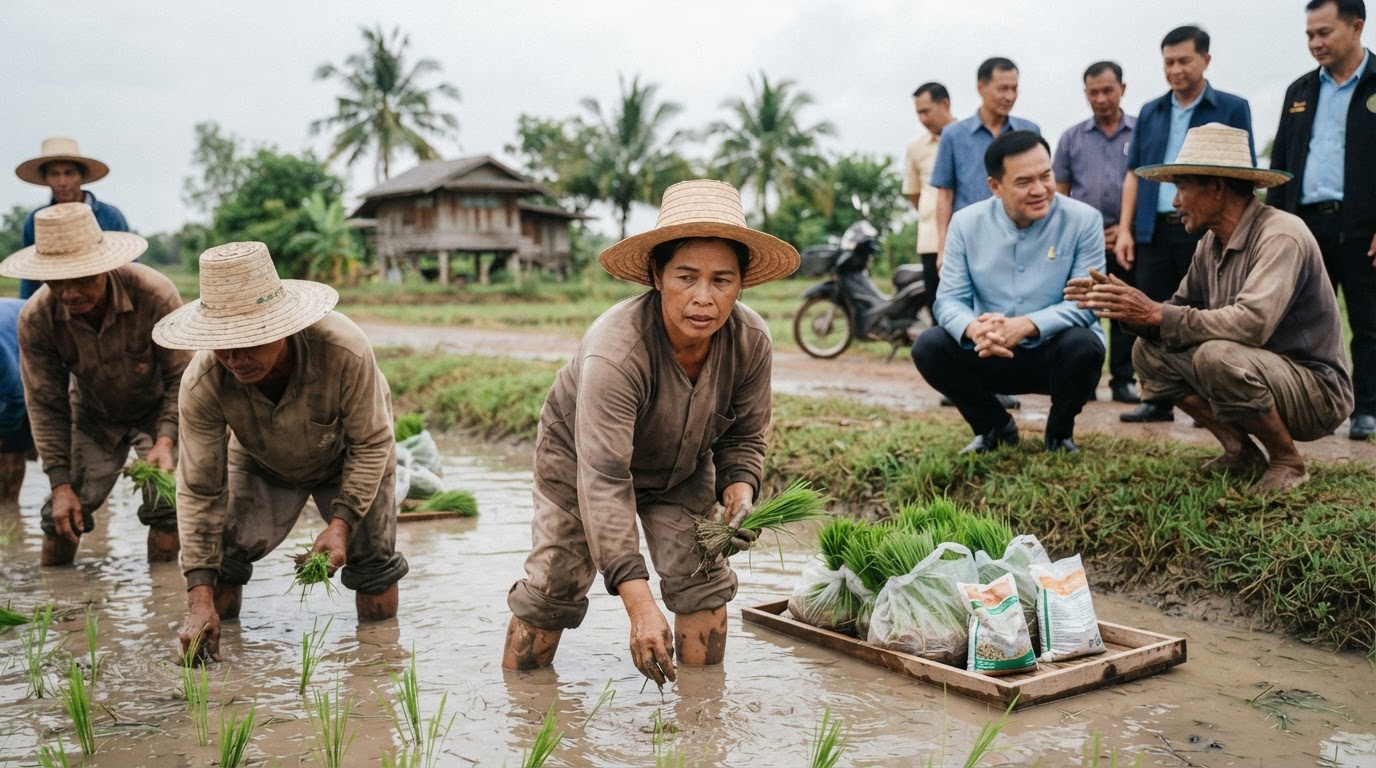
Prime Minister Anutin Charnvirakul moved swiftly to calm growers, but agricultural patents always touch household margins.
SINGAPORE
A vegetable vendor arranging fresh holy basil across a wooden stall at a market in Phimai district does not calculate patent law before sunrise. Fresh green bundles arrive from nearby fields to be cleaned, bundled and sold to neighborhood cooks before breakfast. When news broke that protection rights had been granted over four varieties of the staple herb, anxiety cut directly into the working routines of growers and sellers in Nakhon Ratchasima. Prime Minister Anutin Charnvirakul stepped into the dispute in Bangkok, moving to calm public concern over kitchen supplies. Speaking after farmers and consumers raised alarms regarding seed use and cultivation, Anutin assured the public that plant rights granted to ready-to-eat food producer MARPC would never prevent ordinary citizens from growing or selling the herb for their livelihoods.
The controversy exposes how quickly corporate agriculture can unsettle household commerce across Thailand. According to the government, the legal safeguards cover strictly the four commercial lines bred by MARPC, leaving existing traditional varieties entirely unencumbered in village plots and open markets. That distinction makes neat sense on paper, but out in provincial markets, legal nuance tends to evaporate under commercial pressure. When agricultural developers register claims on kitchen essentials, smallholders immediately wonder whether saving seeds from yesterday's harvest could expose them to penalties or regulatory disputes tomorrow.
The boundary between lab and stall
Street-level food stalls operate on razor-thin cash margins where even slight cost shifts ripple into family budgets. A roadside cook purchasing fresh green bunches every morning in Phimai cannot easily absorb wholesale swings, nor can an informal grower verify botanical parentage without laboratory access. Corporate plant breeding certainly demands capital investment and extended research timelines, which explains why commercial developers like MARPC seek legal shielding for proprietary varieties designed for packaged food manufacturing. Proponents maintain that granting statutory protection simply rewards technical investment, expanding commercial options without seizing the public plant commons that feed ordinary neighborhoods.
The protection rights applied only to varieties developed by the company and would not affect ordinary livelihoods.
Field realities rarely follow corporate flowcharts. No market vendor sorting leaves under a damp morning tarpaulin carries botanical documentation proving that a local harvest shares no genetic lineage with patented industrial strains. If commercial buyers or agricultural inspectors ever begin policing seed origins, small growers fear that licensing enforcement will inevitably spill into informal wholesale markets. Even the distant threat of legal liability can alter commercial behavior, nudging wary smallholders away from open seed sharing and toward licensed seed distributors who charge a premium for certified compliance.
Enforcing political promises
Anutin understood that public unease over everyday kitchen staples carries immediate political hazards. Offering personal reassurances in Bangkok was an effort to draw an absolute line between corporate laboratory breeding and the open agricultural economy. The official position assumes that modern industrial ready-to-eat processing chains can run parallel to village markets without friction, crossing neither regulatory boundaries nor traditional supply routes.
Delivering on that balance will ultimately test administrative practice rather than high-level rhetoric. If regulatory authorities or commercial litigators interpret plant protections broadly, informal trading networks will shoulder the costs through higher wholesale prices and defensive buying habits. Should enforcement remain strictly confined to private corporate contracts, ordinary growers will continue harvesting without interference. For market vendors unpacking fragrant basil bundles in Nakhon Ratchasima, long-term security will not stem from verbal assurances given in Bangkok, but from whether everyday cultivation remains completely unpoliced in the soil.
Sources
Newsletter
Pacific Daily
A curated briefing from Thailand, Asia-Pacific and the world.