Aviation’s Operational Ceiling in Southeast Asia: Medical Diversions and Regional Resilience
Singapore Airlines’ recent long-haul return underscores the persistent operational constraints for ambitious air routes.
SINGAPORE
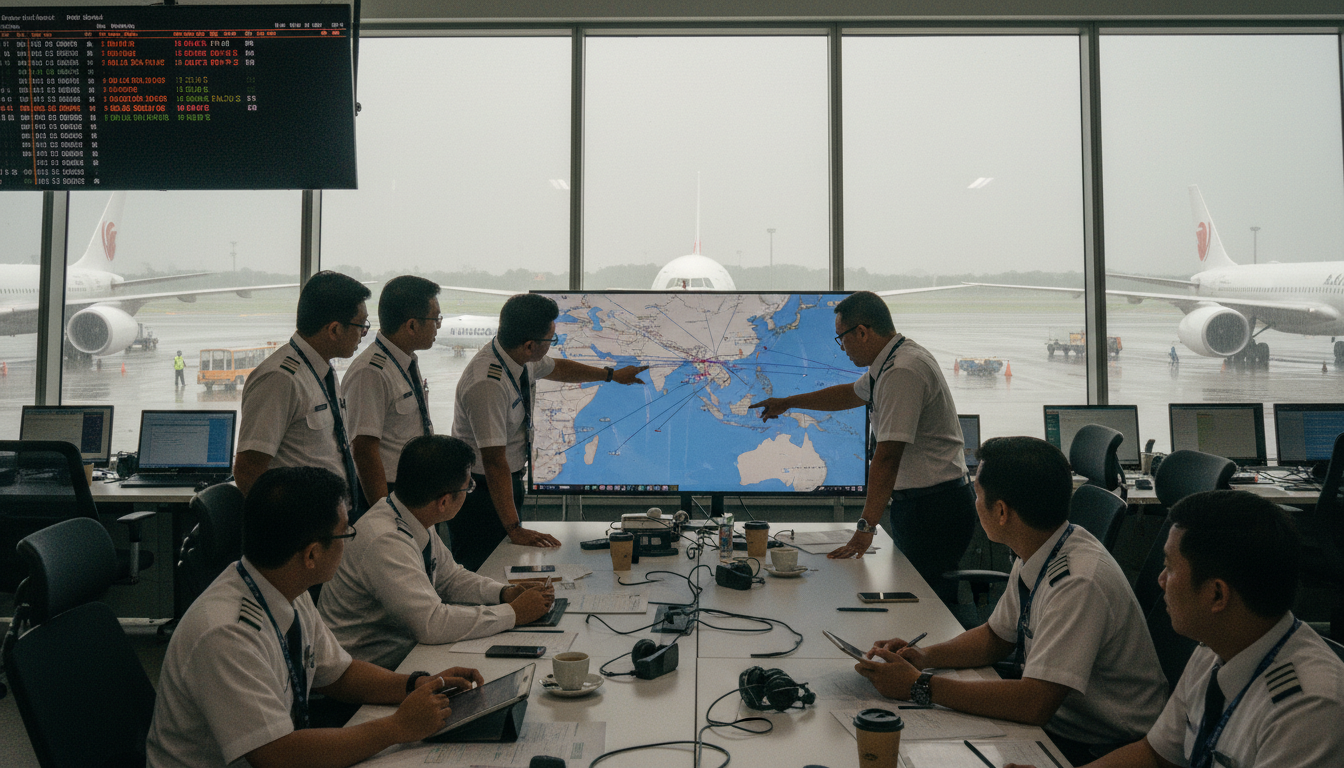
The Singapore Airlines flight’s return to Changi Airport on September 15, 2026, after nearly nine hours en route to New York, illustrates a recurring challenge in global aviation. A medical emergency, the stated reason for the diversion, forced a nearly nine-hour journey to conclude at its origin. This event, while specific, points to a broader pattern of operational limitations in Southeast Asian air travel.
Such incidents are not isolated anomalies but predictable outcomes in an environment where even minor disruptions can cascade. Hong Kong airport experienced 2,000 passengers stranded overnight due to Typhoon Noul in July 2026, and another Singapore Airlines flight returned to Japan in January 2026, leaving passengers onboard for hours. While the immediate cause varies—from weather to medical necessity—the consequence is a diversion of resources and a re-evaluation of capacity, particularly for long-haul routes that push the boundaries of operational endurance. These events test the robustness of regional aviation infrastructure and airline protocols.
### The Regional Preparedness Imperative
The capability to manage in-flight emergencies, especially on ultra-long-haul routes, is a critical component of regional aviation strategy. The decision to return a flight after nearly half its intended duration implies a lack of adequate alternative diversion points or, more likely, a calculated assessment that the medical situation necessitated a return to a hub with superior facilities. This highlights the inherent risks of extending flight durations without corresponding advancements in mid-route emergency support. The region, while expanding its airport infrastructure, such as Ho Chi Minh City's planned $1 billion metro link to Tan Son Nhat and Long Thanh airports, must simultaneously enhance its immediate response mechanisms for airborne crises.
The capacity of Singapore’s Changi Airport to absorb and manage such a return, effectively handling a disrupted ultra-long-haul operation, reflects its established role as a regional aviation nexus. However, reliance on a limited number of highly capable hubs for emergency diversions poses a systemic vulnerability. For Thailand and other Southeast Asian nations with aspirations to deepen their connectivity, the incident serves as a reminder that strategic air route development extends beyond aircraft technology and passenger demand. It requires a robust, distributed network of emergency capabilities. The unresolved tension lies in balancing the commercial imperative for ultra-long-haul routes with the practical, often under-resourced, reality of unforeseen operational exigencies across the vast Asia-Pacific expanse.
Sources
Newsletter
Pacific Daily
A curated briefing from Thailand, Asia-Pacific and the world.