Auckland Council Overruled as Piha Domain Balances Flooding Risk Against Summer Access
The unanimous vote by the Waitakere Ranges local board exposes the friction between regional technical assessments and localized site management.
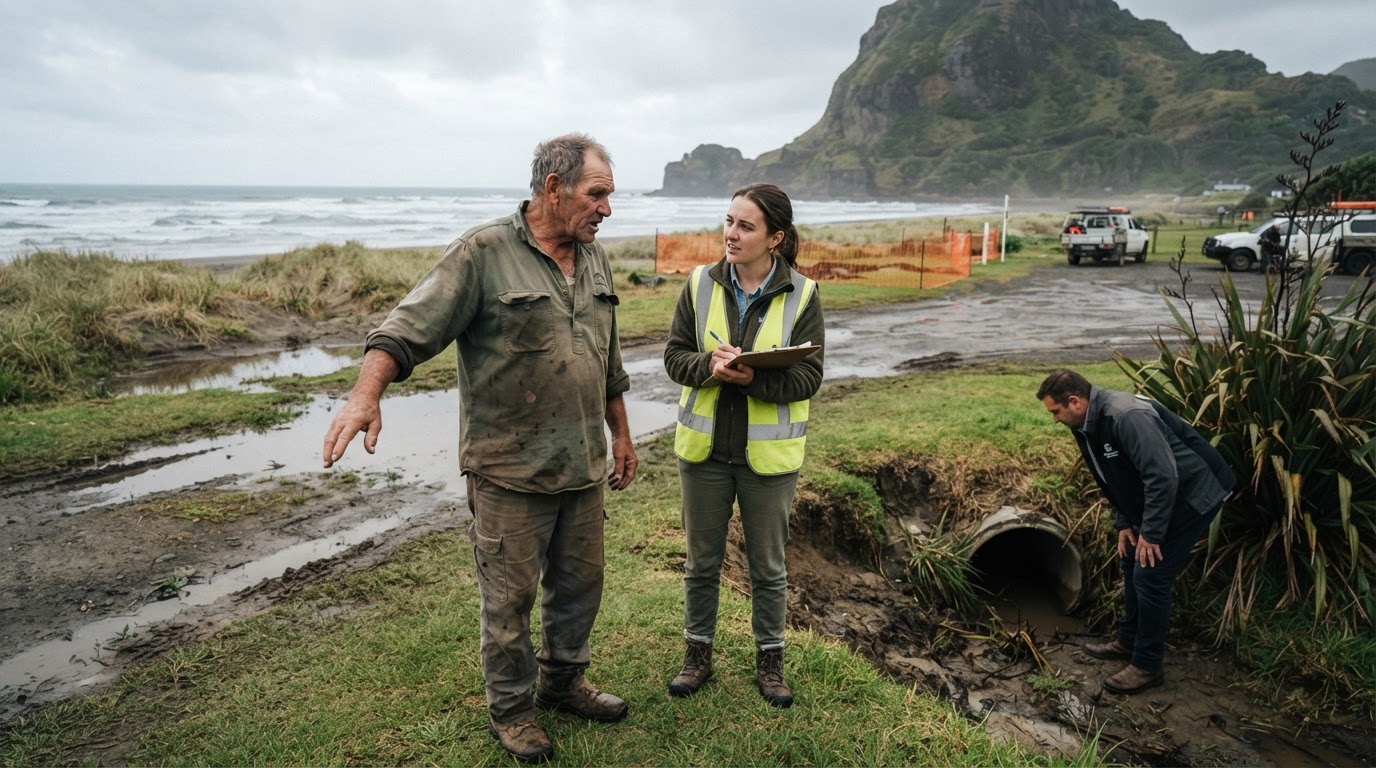
Municipal hazard policy collided directly with local administrative authority when elected officials cleared Piha domain to resume operations. After remaining shut for almost 5 months due to flooding concerns, the coastal Auckland camping ground secured clearance to receive visitors again on Monday. That outcome arrived despite explicit guidance from Auckland Council staff, who formally advised against permitting overnight stays.
Thursday evening saw the Waitakere Ranges local board vote unanimously to reject the bureaucratic recommendation. The elected members opted instead to back an operational reopening for the approaching summer. In doing so, the board established a test case for how low-lying public reserves negotiate water hazards under regulatory scrutiny.
Operational responsibility now shifts to administrative procedures negotiated on paper. Camp manager Fiona Anderson framed the return of visitors around an audited protocol rather than infrastructural alterations to the terrain.
"I've done my TARP (trigger action response plan). I've had it independently reviewed by a health and safety lawyer and she informs me we're good to go."
Local governance and technical liability
Site evacuation models frequently diverge from regional hazard projections. Technical staff within Auckland Council evaluated the domain through the lens of systematic environmental exposure, where drainage constraints and surface water present recurring structural threats. From an engineering standpoint, prolonged closures minimize exposure to acute weather events and insulate the regional authority from civil liability.
Local boards operate under different immediate pressures. Elected representatives face direct demand from seasonal visitors and community operators who treat the warmer months as an economic baseline. By overriding professional staff advice, the Waitakere Ranges members accepted direct political ownership of future emergency responses.
Legal clearance provides administrative cover without altering the physical floodplain. Engaging external legal counsel to review a trigger action response plan confirms statutory compliance with workplace safety rules. Such compliance verifies that a protocol exists on file, though it cannot alter catchment hydrology or divert rapid water accumulation.
The operational test of trigger response
Dynamic evacuation schemes depend entirely on warning thresholds functioning under severe pressure. A trigger action response plan establishes graduated actions tied to weather forecasts, creek levels, and ground saturation. When conditions hit defined thresholds, staff must clear pitches, coordinate vehicular movement, and secure utility connections before access routes become impassable.
The logistical friction of moving campers during sudden deluges remains high. Tents, caravans, and non-resident motorists do not clear coastal reserves with industrial efficiency. Anderson faces the challenge of translating legal paperwork into rapid, orderly site evacuations during unpredicted weather spikes.
Supporters of the reopening argue that total closures disproportionately penalize domestic recreation while ignoring management capabilities. A managed risk profile backed by legal review allows public assets to function rather than sit dormant behind indefinite administrative restrictions. If emergency triggers are observed rigorously, early intervention can theoretically avert the perils identified by council specialists.
Yet the structural exposure at Piha domain has not been eliminated. Seasonal dry spells may ease water tables temporarily, but coastal drainage profiles remain unaltered. The survival of the domain as an overnight camping venue now depends on whether administrative trigger thresholds can outpace incoming floodwaters when wet weather returns.
Sources
Newsletter
Pacific Daily
A curated briefing from Thailand, Asia-Pacific and the world.