A Small Device, A Large Question for Asia's Connected Lives
The Nokia 300 Charge offers a stark, practical simplicity, revealing an unexpected reliance on constant power in the region.
SINGAPORE
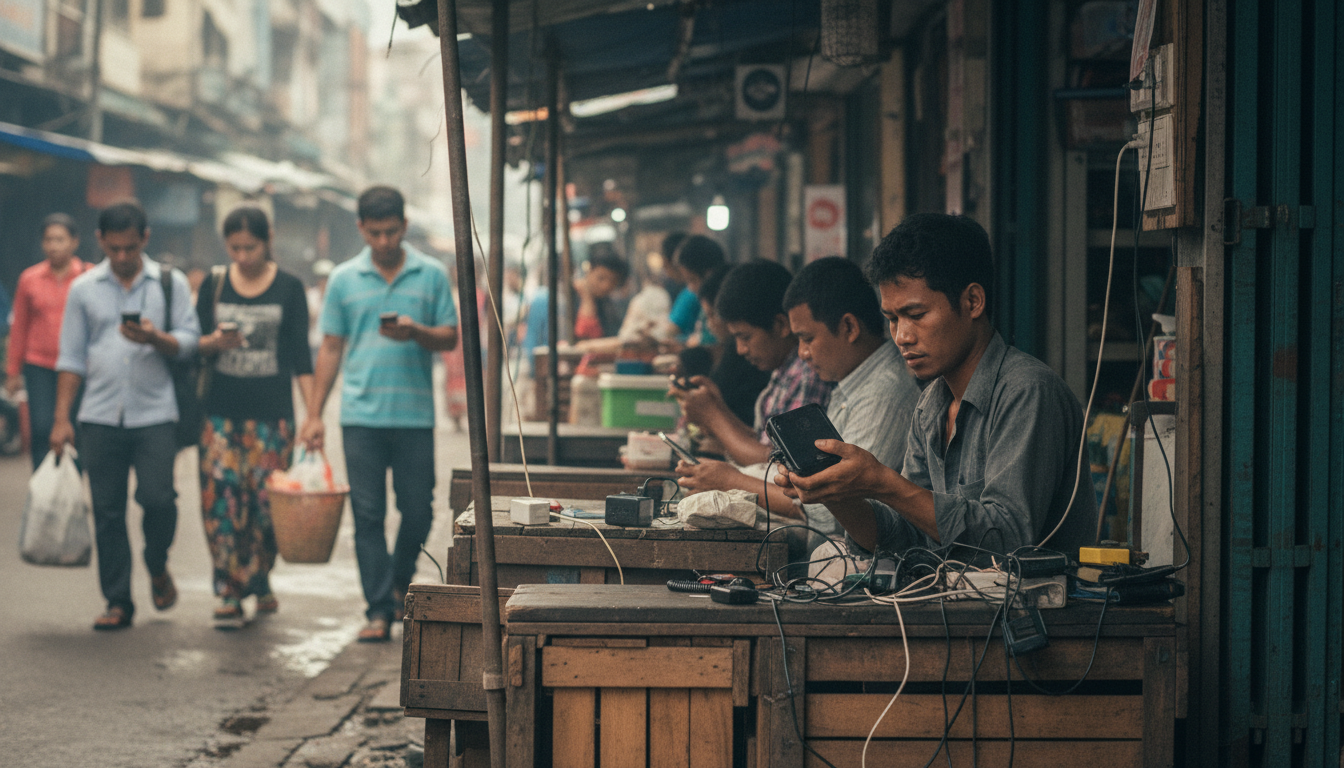
In the markets of Southeast Asia, a phone is rarely just a phone. It is a conduit, a payment system, a camera, a navigational tool, and often, the primary connection to an increasingly digital world. This dense integration means that its cessation, even temporarily, can interrupt daily commerce, communication, and navigation. The announced Nokia 300 Charge, with its dual function as a communication device and a portable power bank, steps into this landscape not with a splash of innovation, but with a quiet, almost understated utility.
The device, featuring a removable 3,700mAh battery—HMD Global states this is the largest it has fitted into a Nokia-branded feature phone—can deliver up to 10W of reverse charging. It includes a 4-in-1 cable supporting USB-C, Micro USB, and USB-A connections, a comprehensive solution for disparate charging needs. This is not a phone designed for digital natives, but for environments where power access is intermittent, or where one’s primary smartphone is drained by the relentless demands of a connected existence. Its stated 37 hours of talk time and 40 days of standby power speak to a different rhythm of life, one less tethered to the next available outlet.
What does this offer to the people who arrive in, or reside across, Asia-Pacific? It acknowledges a critical vulnerability: the smartphone, for all its capabilities, is profoundly dependent on its charge. Without it, the sophisticated becomes inert. HMD Global’s offering directly addresses this by providing an auxiliary power source that also functions as a highly resilient communication backup. The Nokia 300 Charge, with its LED flashlight, described by HMD as four times brighter than the one on the Nokia 105, reinforces this utilitarian approach, serving fundamental needs over digital bells and whistles.
Yet, this practicality also highlights a subtle tension. The very existence of a phone designed primarily to charge another phone underscores a wider, often unacknowledged problem of digital dependency. It suggests that, for many, the 'smart' device has become so indispensable that a secondary, simpler device is now needed purely to sustain its operation. The convenience of a dedicated ‘Out’ button for power bank mode and its robust battery life serve as a quiet commentary on the fragility of our always-on expectations. The Nokia 300 Charge doesn't just offer power; it asks whether our constant connectivity comes at the cost of genuine independence from the wall socket.
Sources
Newsletter
Pacific Daily
A curated briefing from Thailand, Asia-Pacific and the world.