Why Border Seizures in Isan Fail to Solve Thailand's Illicit Vape Trade
A three-million-baht customs haul ahead of Halloween exposes the mathematical imbalance between episodic highway interdictions and wholesale supply lines.
SINGAPORE
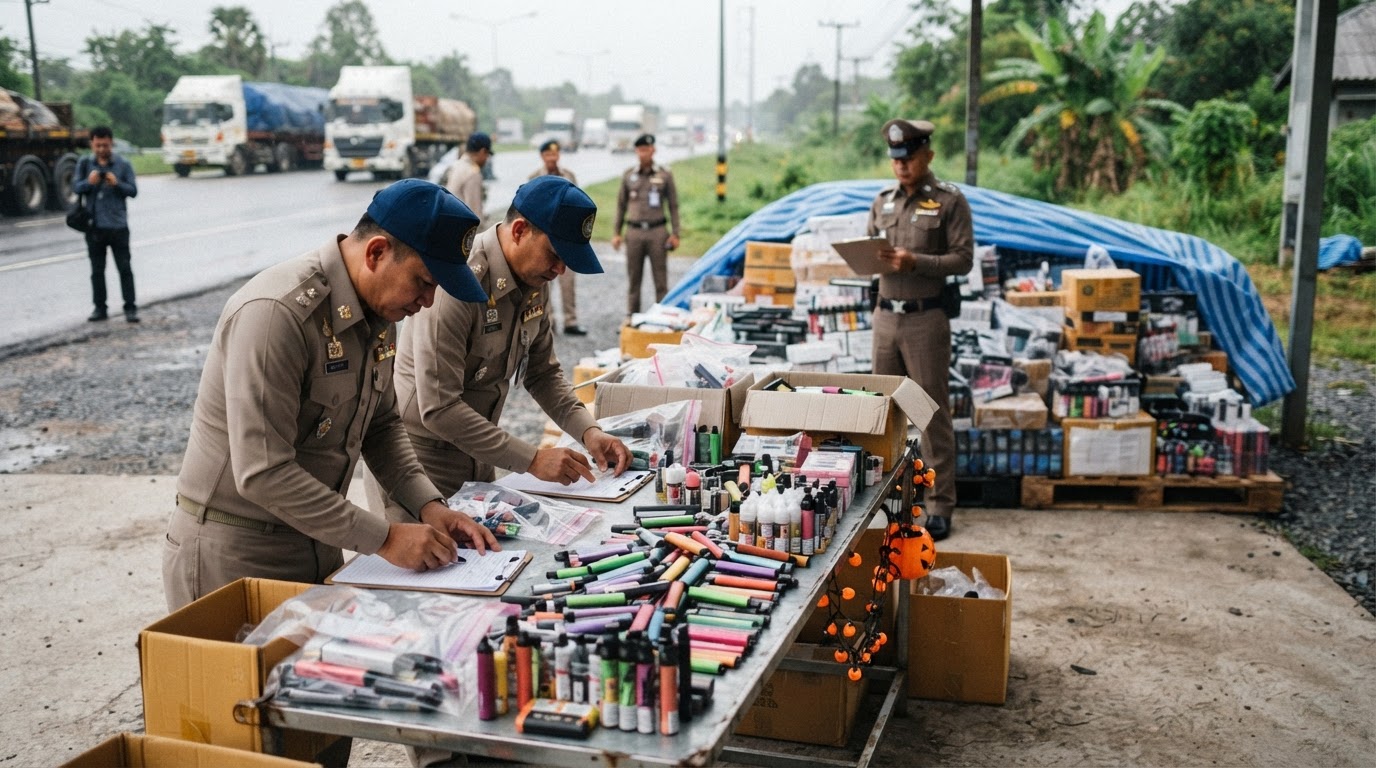
A single customs interception rarely alters the economics of illicit commerce. When officers from the Chong Chom Customs House announced on Saturday that they had seized more than 3,000 electronic cigarettes and zombie pods in Surin, the valuation attached to the cargo was nearly 3 million baht. Prasit Deechongcharoen, chief of the Chong Chom Customs House, presented the sweep as a preemptive strike against supply networks preparing for Halloween celebrations. Testing the official narrative against the arithmetic of the seizure, however, reveals an enforcement model that captures marginal inventory while leaving the underlying logistics intact.
The initial numbers reveal the commercial mechanics of the shipment. Dividing an aggregate valuation of nearly 3 million baht across more than 3,000 confiscated units establishes an average street value approaching 1,000 baht per item. That price point indicates the consignment comprised premium hardware, catalogued by investigators as K-pods and related specialised systems, rather than low-margin disposable stock. Wholesale margins on specialised devices easily absorb intermittent transport write-offs. For organised distribution rings, losing several thousand units represents an expected operating friction rather than a structural crisis.
Contraband arithmetic consistently favours the distributor over the border guard.
The Southern Transit Problem
The documented path of the cargo exposes clear administrative friction points. According to reports from the Chong Chom Customs House, which oversees Nakhon Ratchasima, Buri Ram and Surin provinces, the confiscated pods were freighted from southern Thailand before entering the Northeast. That geographical route means bulk illicit cargo crossed peninsular Thailand without detection by arterial checkpoints along primary national highways. Interceptions recorded at transit hubs like the Nakhon Ratchasima Mail Centre confirm that underground syndicates treat civilian postal infrastructure as an effective domestic conduit into Isan.
Advocates of tactical interdiction maintain that holiday crackdowns materially restrict illicit commerce. Their argument assumes that timed enforcement sweeps ahead of Halloween celebrations constrict immediate stock, raise carrying costs for regional couriers, and deter retail vendors. Concentrated road inspections and enhanced monitoring can certainly produce discrete operational results when actionable intelligence tracks specific vehicular movements across provincial boundaries.
Yet this enforcement thesis misjudges how distributed inventory works. Once contraband navigates the long transit route from southern entry points to northeastern sorting facilities, regulatory intervention occurs at the point of consumption rather than the point of origin. Seizing assembled parcels across Surin or Buri Ram burdens provincial customs houses with policing maritime and border spillover that bypassed southern maritime and highway patrols entirely.
High margins across specialised consumer products absorb transport confiscations with minimal balance-sheet damage to organized distributors.
Limits of Event-Driven Policing
Event-driven policing creates an optical distraction. Logging targeted seizures ahead of scheduled civic festivities offers administrative visibility, but it reflects an episodic posture against continuous commercial supply chains. Commercial smuggling syndicates calculate logistics according to predictable calendar cycles, factoring in transient law enforcement surges that subside once targeted holidays conclude. Intermittent crackdowns create brief regional supply pauses, but they do not eliminate the wholesale syndicates coordinating bulk transport from the south.
Resolving the imbalance requires moving enforcement focus from freight corridors to capital tracing. Until intelligence agencies intercept the bulk importation routes that funnel high-value hardware into domestic mail streams, regional confiscations in Isan will remain little more than occasional supply frictions. The market presence of illicit nicotine in Thailand will not depend on holiday checkpoints, but on whether authorities dismantle the interprovincial transit chains that make bulk transport economically viable.
Sources
Newsletter
Pacific Daily
A curated briefing from Thailand, Asia-Pacific and the world.