The Prestige Gangster Drama Recycles British Screen Royalty for Global Streamers
Pierce Brosnan and Helen Mirren find late-career reinvention in Guy Ritchie's MobLand, exposing how streaming television relies on familiar personas to anchor volatile productions
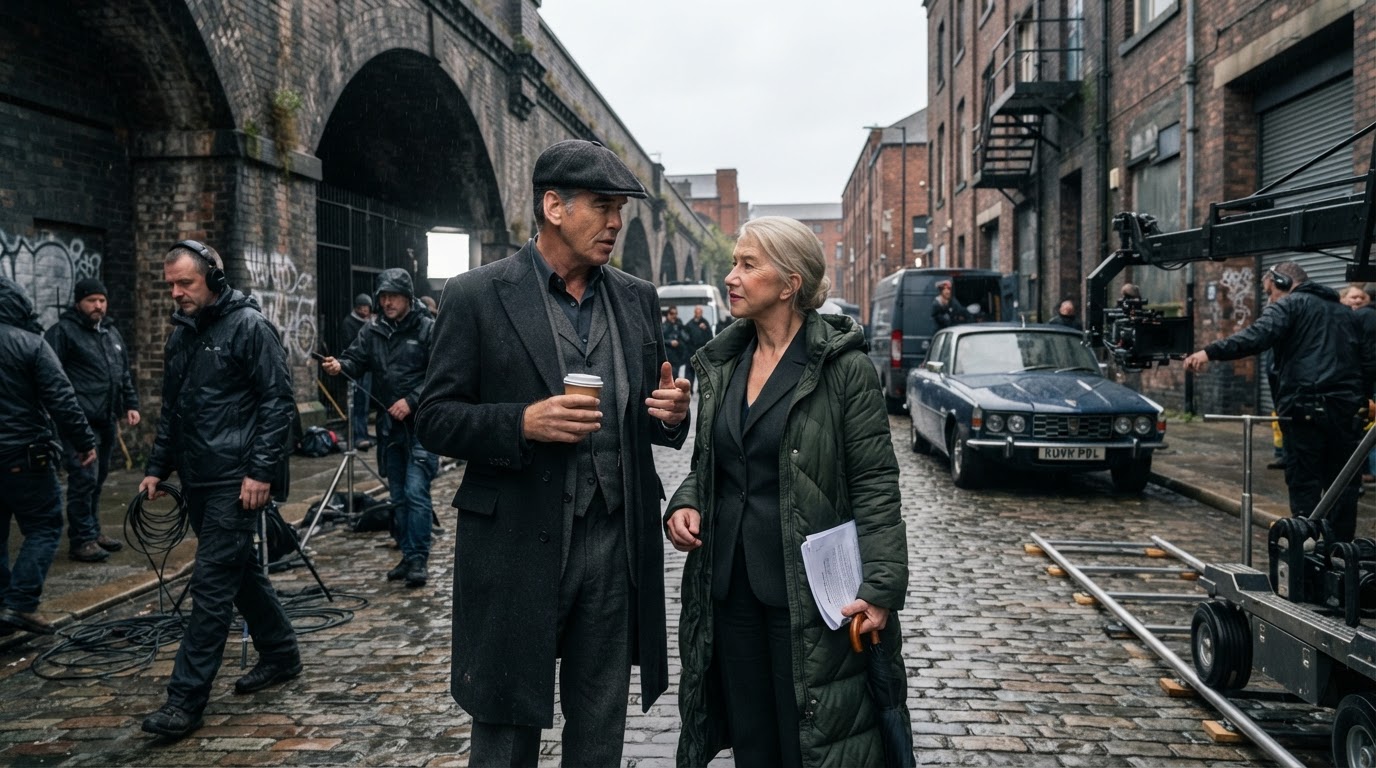
Sound stages under production lights operate on a quiet economy of borrowed memory. When veteran actors step into the tailored silhouettes of organised crime, they bring accumulated public affection into rooms arranged for synthetic menace. The television production ecosystem in Los Angeles depends heavily on this trade. In MobLand, which premiered in September, Pierce Brosnan and Helen Mirren assume the roles of Conrad and Maeve Harrigan, criminal patriarch and matriarch facing domestic rupture alongside predatory external rivals.
Commercial drama across global distribution networks has turned toward established British film performers to give instant weight to expansive streaming serials. Brosnan, long identified with his tenure as James Bond, trades the composure of state-sanctioned espionage for an impulsive crime boss confronting personal mortality after receiving a brain condition diagnosis. Alongside him, Mirren lends austere authority to Maeve, establishing a domestic centre around which the violence turns.
The Architecture of Borrowed Persona
Behind the polished publicity of late-career enthusiasm sits a deliberate commercial calculus. Co-director Guy Ritchie constructs the production not merely through criminal confrontation, but by dismantling and reassembling the specific cinematic histories of his leads. Speaking to Agence France-Presse, Brosnan observed how Ritchie directs through personal excavation rather than pure invention.
He kind of picks elements of you, or your performance from the past, and uses it within the context of the drama.
That observation cuts directly to the operational logic of contemporary prestige television. The appeal of Conrad Harrigan does not rest solely on the written dialogue or the pacing of Ritchie's set pieces. It draws sustenance from residual audience memory of Brosnan's earlier cinematic composure, now deliberately fractured by physical frailty and reckless vulnerability. When an actor who once epitomised imperial competence portrays an ageing syndicate leader confronting physical decline, the pathos registers because viewers already know the persona being dismantled.
Tension Behind the Screen
Production machinery, however, rarely matches the effortless pleasure described during promotional interviews. Brosnan told Agence France-Presse that he was having the time of his life on set, yet international press coverage surrounding the production revealed friction within the television manufacture. Reporting from The Guardian and Forbes detailed scheduling disputes and friction involving co-star Tom Hardy, generating public scrutiny that the principal cast later noted left them blindsided.
These tensions demonstrate the fragile balance governing prestige ensemble television. High-profile casting delivers immediate cultural gravity and commands audience attention across disparate television markets, including English-language streaming consumers throughout the Pacific Rim. Yet managing disparate creative forces within demanding episodic production schedules presents continuous hazards for television studios and creative leads.
What emerges from this dynamic is an industry relying on legacy star power to steady increasingly volatile formats. Streaming networks face intensifying competition and shorter subscriber attention spans, conditions under which unfamiliar casting carries measurable commercial hazard. Placing established performers like Mirren and Brosnan at the head of a syndicate offers an immediate emotional shorthand that algorithmic recommendations cannot manufacture independently.
Those sound stages in Los Angeles ultimately function as sorting houses where cinematic heritage is repackaged into episodic television for export across world markets. The Harrigans' domestic power struggle makes for polished television drama, but its fundamental engine remains the deliberate harvest of reputations built across an entire cinematic career. Returning to the familiar silhouettes of its past, the medium invites viewers to mistake the nostalgia of borrowed prestige for the arrival of something new.
Sources
Newsletter
Pacific Daily
A curated briefing from Thailand, Asia-Pacific and the world.