The Corporate Atrium and the Structured Civics of Raffles Place
Lunchtime performances by the Singapore Chinese Orchestra expose the operational boundaries of Singapore's commercial commons
SINGAPORE
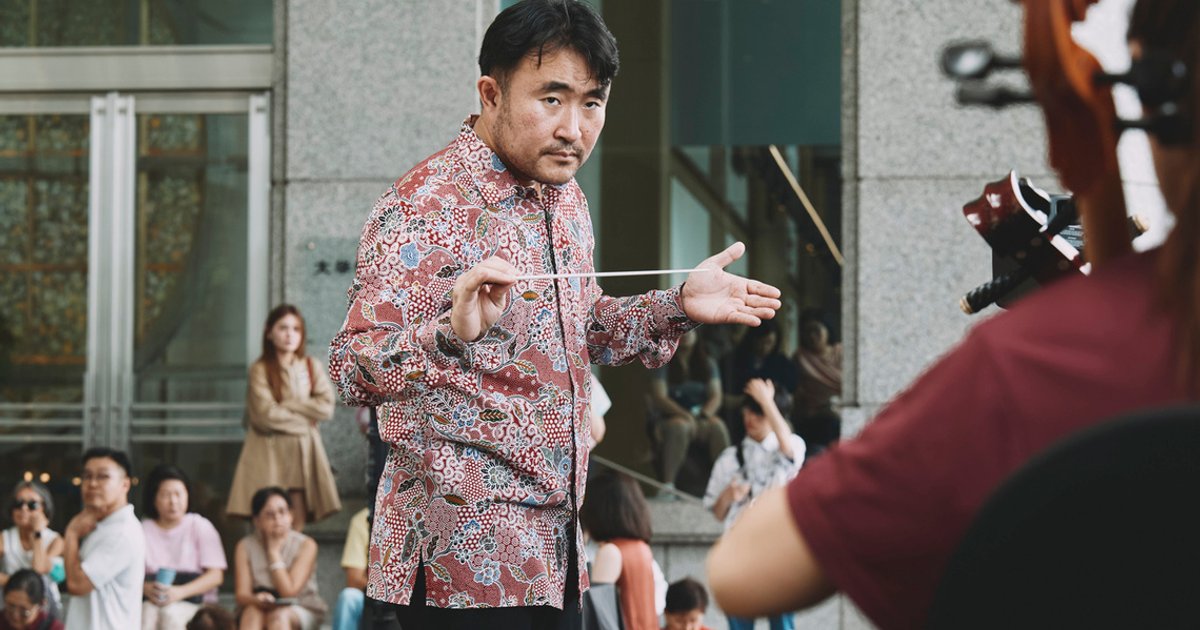
Corporate architecture in commercial plazas operates on the quiet assumption that pedestrian movement must never coagulate into stillness. At UOB Plaza Atrium in Raffles Place, the floor plates and circulation channels are engineered to expel lingering bodies toward lifts, escalators, and transit concourses. Hard stone surfaces signal transactional transit rather than sustained civic assembly. When the Singapore Chinese Orchestra occupied those steps for an open-air concert, the architectural script of the CBD briefly fractured.
Office workers descended from vertical towers, trading indoor desks for outdoor atrium steps. Assistant conductor Lien Boon Hua led the ensemble through its Musical Bento Box repertoire, projecting arrangements of Mandopop melodies, nostalgic classics, and hits by Mavis Hee and JJ Lin across the perimeter. Spectators arranged themselves across the tiered steps, balanced takeaway meals, and inhabited the threshold between corporate lobby and open pavement. The gathering suggested an unprogrammed reclamation of private financial ground. It was fleeting.
That intervention was anything but spontaneous. The performance belonged to an organised Lunchtime Series supported by the institutional mechanics of the National Arts Council. It represented a strictly calibrated civic concession within private commercial property, permitted precisely because its temporal boundaries were non-negotiable. At the conclusion of the midday hour, the music stops, the steps clear, and the concourse resumes its primary function as an artery for white-collar circulation. Commercial architecture in Raffles Place permits gathering only when that gathering possesses an explicit expiration timestamp.
The Permitted Commons
Corporate atriums across Asia-Pacific metropolises increasingly rely on scheduled cultural programming to soften their austere perimeters. The trade-off is structural. By providing temporary cultural amenities, commercial property owners legitimise the private management of urban ground, offering periodic spectacle while withholding genuine civic autonomy. The corporate atrium refuses permanence. It will house an orchestral performance of classic melodies or contemporary popular tracks, but it will not tolerate unscheduled assembly, informal trade, or open-ended rest.
This operational discipline reflects the broader urban condition of Singapore. Public space here is rarely accidental; it is designated, programmed, and monitored. When the Singapore Chinese Orchestra introduces traditional instrumentation into a corporate atrium, the acoustic clash against curtain walls and glazed canopies provides an index of the surrounding authority. Sound reverberates against bank towers whose sheer faces are designed to deflect collective occupation.
The corporate atrium refuses permanence, offering brief cultural spectacle while withholding genuine civic autonomy.
Such programming also exposes the domestic appetite for communal experience within heavily engineered financial districts. Salaried employees do not crowd stone steps simply for novelty. They inhabit these terraces because dense commercial environments routinely starve the working day of unmeasured time. The melodic resonance of familiar popular songs creates a transient commons, temporarily transforming transactional floor space into an amphitheatre.
Limits of the Midday Truce
Advocates of institutional arts programming argue that these events humanise corporate environments, delivering live music directly to people who rarely enter formal auditoriums. That perspective has merit. Bringing orchestral repertoire into a lunchtime concourse democratises acoustic access, stripping away the dress codes and ticketing hurdles of traditional concert venues. The performance provides an accessible aesthetic pause during a demanding working day.
That civic benefit does not erase the underlying contradiction. When the final notes of the JJ Lin mashup fade, the spatial hierarchy reasserts itself without delay. Security personnel monitor lingering clusters, custodial staff clear the steps, and employees stream back through security turnstiles into upper-level offices. The building has yielded nothing permanent. It remains a fortress of transactional capital that briefly leases its threshold to art, ensuring the surrounding order remains entirely intact.
Sources
Newsletter
Pacific Daily
A curated briefing from Thailand, Asia-Pacific and the world.