Set-Piece Resilience and the Geometry of Attrition
Andy Farrell frames Ireland's narrow Nations Championship victory over South Africa as structural progress rather than a solved contest
SINGAPORE
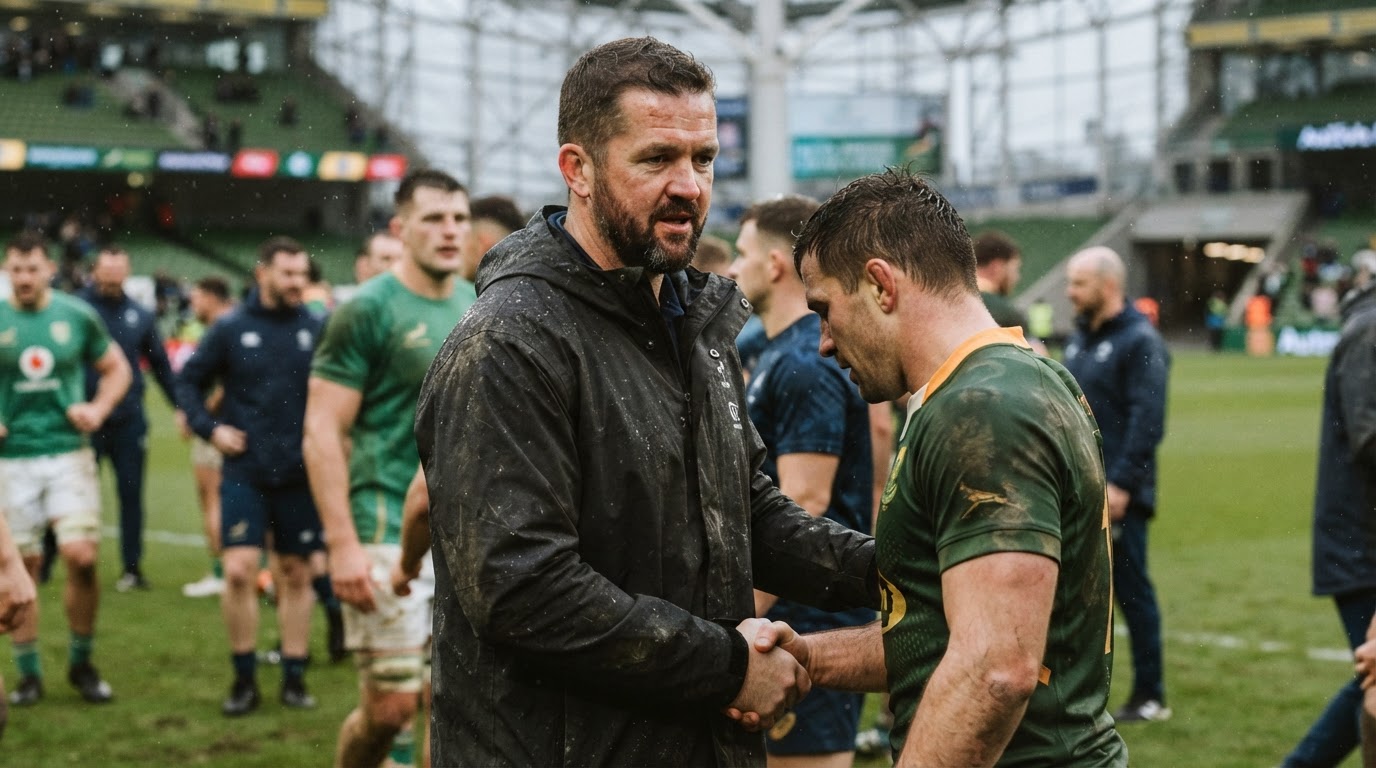
Systemic vulnerability in elite competition rarely disappears through tactical enthusiasm alone; it yields only when underlying mechanical failure is directly corrected under pressure. Twelve months after South Africa's pack dismantled the Irish scrum in Dublin, reducing the hosts to twelve men through repeated disciplinary sanctions during a 24-13 defeat, Saturday's rematch at Aviva Stadium tested whether that structural imbalance had shifted. Ireland's 20-17 victory over the Springboks on November 21, 2026, demonstrated measurable physical stabilisation, even as the narrow three-point differential highlighted how tight the margin between containment and collapse remains.
According to Ireland coach Andy Farrell, the recovery at the set-piece served as the primary indicator of squad development ahead of next year's World Cup. Farrell argued that confronting South Africa's primary physical weapon, rather than evading it through loose play, validated the tactical overhaul undertaken since their previous meeting. That assessment treats scrum stability not as an isolated technical statistic, but as the foundational platform upon which all broader territory and phase management depends.
Structural Adaptation Under Pressure
The historical record from Dublin twelve months prior provided a clear baseline of tactical failure. In that contest, an accumulation of yellow cards fractured Ireland's defensive system, leaving the side exposed to South Africa's territorial dominance. When a forward pack concedes immediate physical leverage at the scrum, the tactical consequence extends far beyond the restart itself, steadily compounding disciplinary stress across the remaining eighty minutes.
During Saturday's Nations Championship encounter, direct confrontations involving Ireland's Dan Sheehan and Jamison Gibson-Park alongside South Africa's Kurt-Lee Arendse reflected a markedly altered mechanical contest. Rather than yielding ground or conceding the penalties that previously unravelled their defensive shape, Ireland absorbed the initial engagement and secured parity at the set-piece. In practical terms, that resistance prevented the Springboks from executing the territory-driven blueprint that dictated the 2025 fixture, ultimately preserving Ireland's 20-17 margin through the closing phases.
The turnaround in the scrum from being decimated last year to standing up in the win epitomised the squad's progress.
Yet technical resilience during an individual home test does not establish permanent structural parity. While Farrell interpreted the performance as tangible proof of progress toward the World Cup, the Springboks retain the forward depth and tactical consistency to challenge that parity across multi-week tournament campaigns. Sustaining mechanical discipline against South Africa demands severe physical expenditure, where a single personnel loss or minor lapse in binding immediately restores the prior tactical imbalance.
Strategic Constraints and Tournament Cycles
Farrell's forward-looking optimism rests on the inference that technical repair achieved in November can endure the operational fatigue of tournament rugby next year. That projection faces significant physical constraints. Set-piece mechanics are intensely vulnerable to accumulated fatigue and defensive counter-analysis, particularly against Tier 1 opponents who systematically target front-row cohesion.
The three-point victory at Aviva Stadium demonstrated that Ireland has answered a specific historical vulnerability that previously broke its system. What remains fundamentally unresolved is whether that mechanical correction can survive the sustained physical friction of a World Cup campaign, or whether the Springboks' forward power will once again expose the narrow boundaries of Irish containment.
Sources
Newsletter
Pacific Daily
A curated briefing from Thailand, Asia-Pacific and the world.