Urban Infrastructure: Disruptions Define Progress in Southeast Asia
Ho Chi Minh City's metro construction delays reflect a regional tension between ambitious development and immediate urban reality.
SINGAPORE
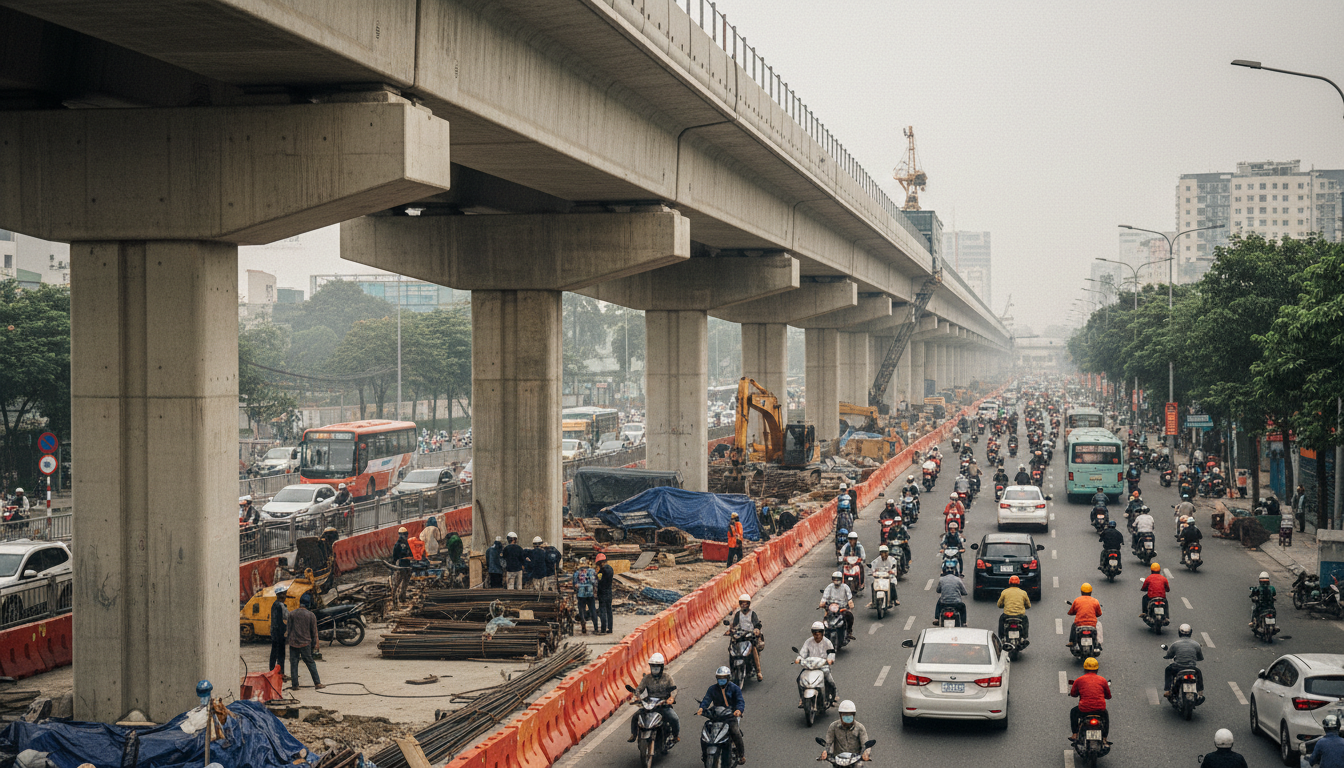
The gridlock observed at Tan Son Nhat airport in Ho Chi Minh City on September 16, 2026, where a three-kilometer traffic jam formed due to road closures for Metro Line 2 construction, illustrates a recurring tension across Southeast Asia. The incident, centered around the Tham Luong Bridge to the Truong Chinh-Cong Hoa junction, reflects the immediate disruption inherent in large-scale infrastructure projects. This is not an isolated event for HCMC; similar tunnel construction in February 2024 also caused month-long traffic disruptions, according to VnExpress International.
Such episodes suggest that while governments pursue ambitious transit solutions, the on-the-ground reality often involves significant urban dislocation. The current disruption in HCMC, impacting routes like Truong Chinh, Tan Ky Tan Quy, and Huynh Van Gam streets for the ST9 (Ba Queo) Station, reveals the challenge of building complex systems within already densely populated and traffic-heavy environments. Tan Son Nhat is Vietnam's busiest airport, and its proximity to major arterial roads makes the area prone to congestion, particularly from the An Suong area towards the city center during morning commutes.
This pattern resonates beyond Vietnam's borders. Manila, for instance, has long grappled with infrastructure deficits despite significant investments. While the specifics differ, the common thread is the often-protracted period between project conception and operational impact, during which daily life for millions is complicated by construction. The Philippine experience with major infrastructure, including challenges with 5G deployment, indicates a systemic difficulty in translating investment into seamless urban function.
The investment landscape itself indicates regional confidence in future growth, even amid present-day challenges. Metro Pacific, a Philippine company, alongside GIC, announced a $1 billion stake in an Indonesian toll-road operator in July 2024. Mitsui had previously acquired a 5.6% stake in Metro Pacific in September 2023. These investments point to a long-term view of infrastructure as a critical asset, yet they do not resolve the immediate logistical and social costs. The financial commitments are made in anticipation of future returns, predicated on the eventual completion and functionality of these projects.
The Ho Chi Minh City incident therefore serves as a potent reminder of the inherent trade-offs in urban development across the region. The drive for improved connectivity and efficiency through projects like Metro Line 2 is undeniable, yet the process of achieving these goals is fraught with operational complexities and social friction. The challenge for regional strategists is to reconcile the imperative for modernization with the practicalities of implementation in environments where the existing infrastructure is already strained. This tension between long-term vision and short-term disruption remains a defining characteristic of Southeast Asia’s urbanization.
Sources
Newsletter
Pacific Daily
A curated briefing from Thailand, Asia-Pacific and the world.