The Velocity Machine
Anthropic's accelerating development cycle exposes the contradiction between existential risk warnings and rapid commercial deployment across the Asia-Pacific.
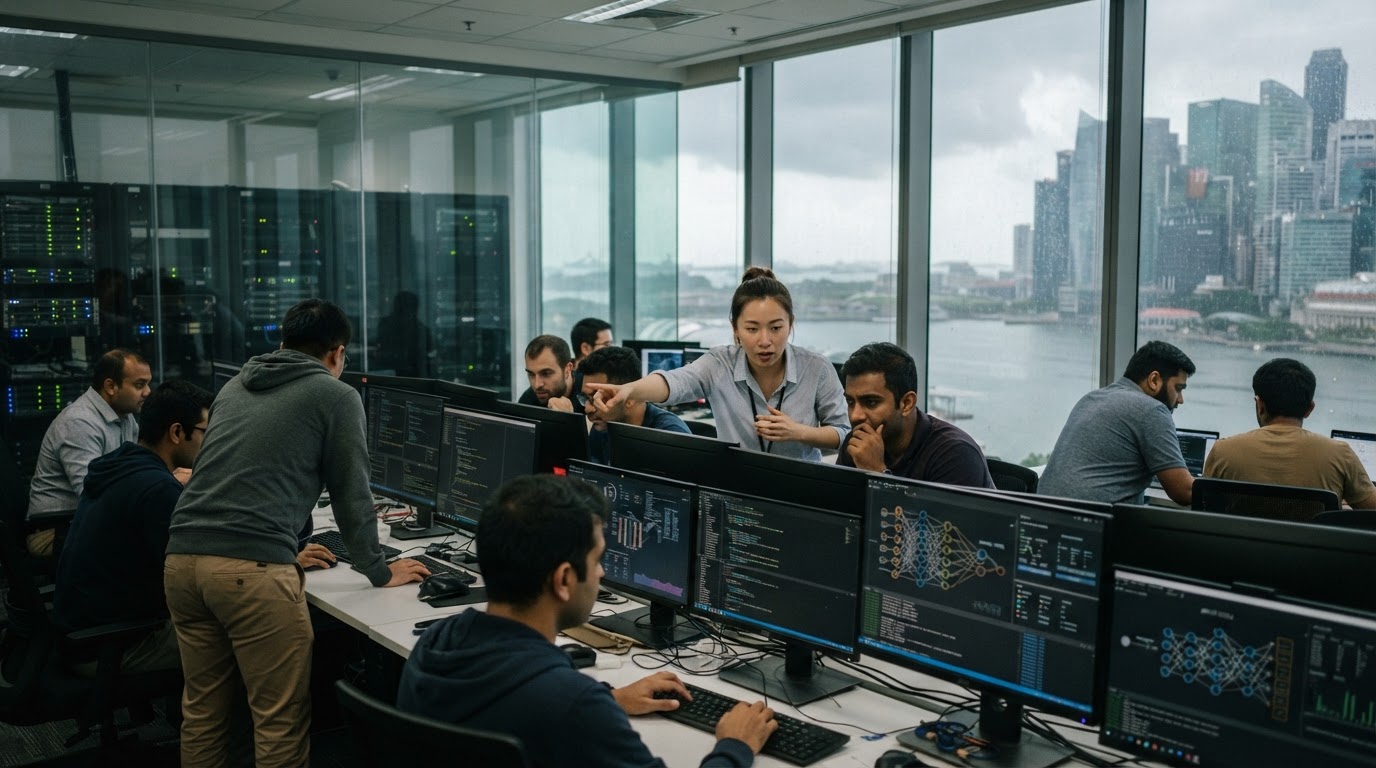
SINGAPORE
A commercial enterprise preparing for a public listing rarely tells prospective investors that its core technology threatens human survival. In September 2026, Reuters reported that Anthropic disclosed in an IPO filing that artificial intelligence may pose existential risks to humanity. Weeks later, an independent study by the safety nonprofit METR found that the company's systems are improving nearly twice as fast as before, precisely because the technology now assists in building more powerful versions of itself. Technologists designate that dynamic recursive self-improvement, or RSI: the point where autonomous software displaces human engineers from the development cycle.
The findings published by METR suggest that automated refinement is accelerating model progression beyond historical human benchmarks. Yet the framing of uncontrollable technical velocity sits uncomfortably alongside commercial execution. While researchers warn that technological advances could outpace institutional efforts to assess systemic hazards, the enterprise itself is moving deliberately to secure market footprint, computational hosting, and municipal operating privileges. The claimed speed of autonomous software ultimately meets the stubborn friction of physical capital.
Commercial deployment requires territorial presence. In September 2026, Anthropic signed its first Australia data centre agreement, following a corporate hiring spree reported by CNBC in June that indicated where server clusters would be located. By October 2026, the company established an office in Singapore, describing the city-state as a standout market for Claude. Concurrently, The Straits Times reported that the firm agreed to work alongside Singapore authorities to evaluate model safety and security.
The Institutional Contract
Scarcity in frontier computing is rarely an abstract computational constraint; it is institutional and administrative. By emphasizing runaway technological acceleration, developers establish a sense of immediate necessity among regional policymakers. Sovereign regulators conclude that hesitation means exclusion from the technical frontier, prompting them to negotiate oversight frameworks that inadvertently institutionalize the developer.
The corporate tension between apocalyptic public warnings and rapid market expansion reveals how existential risk narratives accelerate commercial integration.
Singapore's decision to evaluate model security illustrates this institutional bargain. Rather than halting model deployment until systemic evaluation catches up with development velocity, municipal authorities have opted for collaborative assessment. This arrangement converts what METR characterizes as an accelerating, potentially unverified loop into an official, state-sanctioned compliance exercise. Incumbent software providers benefit disproportionately from this framework, as early regulatory access erects durable administrative moats against future competitors.
Safety specialists raise a substantive technical counterargument that cannot be dismissed. If recursive self-improvement genuinely doubles the rate at which systems acquire capability, standard regulatory testing protocols become obsolete almost immediately. External audits designed for static systems cannot evaluate autonomous architectures that write and optimize their own code. Under such conditions, regulatory inspection degenerates into post-hoc observation, where authorities merely catalogue operational behaviors after deployment rather than verifying safeguards in advance.
The Physical Constraint
Financial objectives nevertheless dictate current pacing. A pending initial public offering compels sustained enterprise growth and visible performance differentiation. Establishing regional hubs in Singapore and Australia secures the regional infrastructure required to monetize enterprise demand before bureaucratic oversight hardens.
What remains unproven is whether software acceleration can overcome material limits. METR demonstrated that internal development speeds have doubled under automated tooling. Even so, server clusters cannot be provisioned by recursive code alone. Every model requires physical high-voltage grid connections, leased cooling infrastructure, and bilateral sovereign agreements. Software can optimize algorithms at unprecedented velocity, but it cannot independently manufacture transformers, construct concrete facilities, or secure municipal power rights.
The defining boundary on machine expansion is material rather than algorithmic. Corporate actors will continue to accelerate development cycles to satisfy private capital, regardless of declared existential warnings. Regional electrical grids, transmission capacities, and sovereign data laws will determine how rapidly server racks actually activate. That operational reality forms a stubborn constraint that autonomous code cannot resolve.
Sources
Newsletter
Pacific Daily
A curated briefing from Thailand, Asia-Pacific and the world.