The Enduring Machinery of Elite Tennis
Alexander Zverev’s routine victory over debutant Rafael Jodar in Turin demonstrates how institutional stability continues to blunt generational disruption.
SINGAPORE
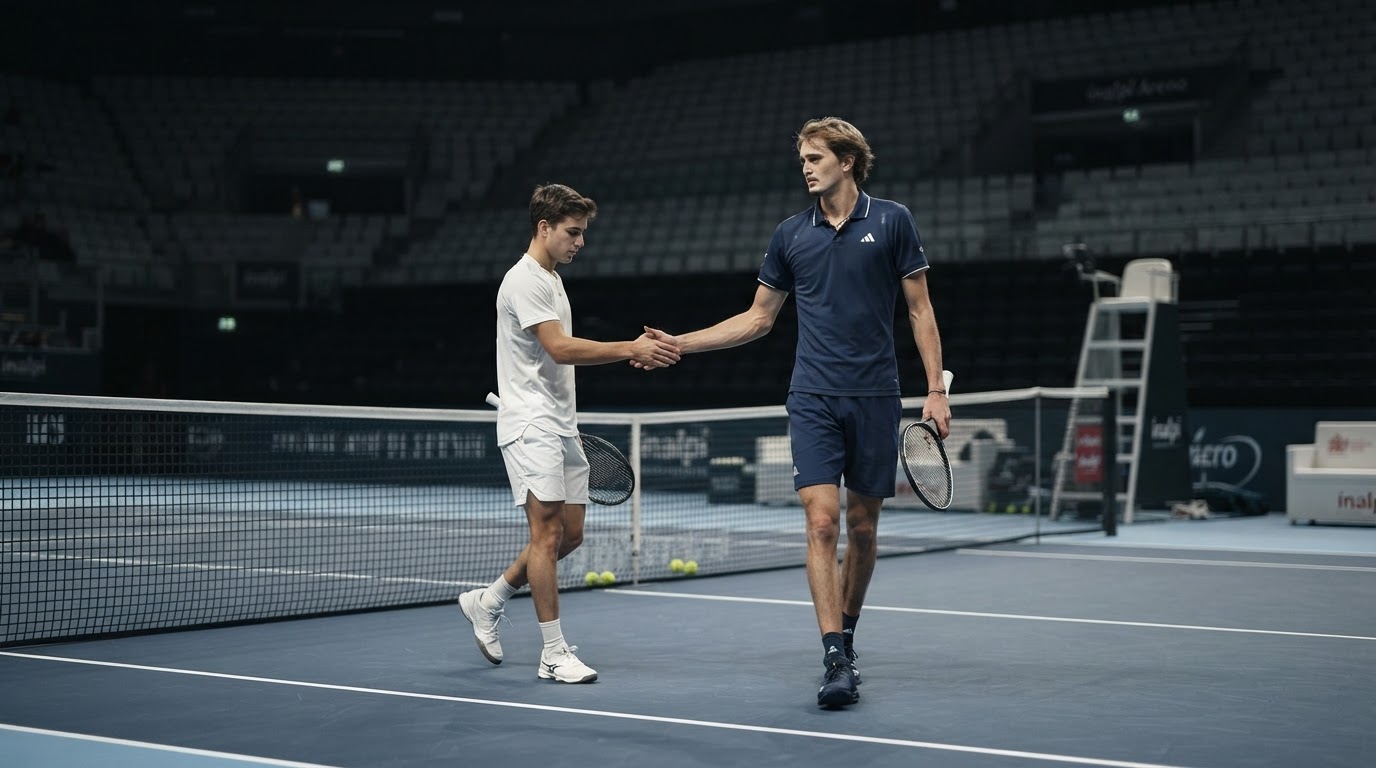
Men’s championship tennis presents an enduring institutional paradox. The sport markets itself on the romance of sudden breakthrough, yet its crowning indoor tournament remains governed by an unyielding structural hierarchy. When Germany’s Alexander Zverev met Spanish debutant Rafael Jodar at the Palasport Olimpico in Turin on November 15, 2026, the contest concluded in the exact manner that the tournament’s competitive architecture anticipated. Zverev secured an opening group stage victory, turning aside an emergent challenger without surrendering operational control.
On the surface, an opening match at the ATP Finals in Italy appears to be a simple ledger of athletic performance. Fundamentally, it exposes how veteran competitors manage pressure against newcomers who arrive unburdened by tournament pedigree. Jodar entered as a debutant, facing an opponent long accustomed to the enclosed environment and high-stakes rhythms of the year-end championship. The resulting outcome was less a dramatic conquest than an illustration of accumulated experience methodically absorbing youthful initiative.
Experience as a Competitive Moat
Elite sporting institutions rarely yield easily to new entrants. The qualification mechanism for Turin demands sustained performance across an entire calendar year, meaning anyone who reaches the group stage has already demonstrated exceptional capability. Yet once inside the arena, the disparity in tournament familiarity asserts itself immediately. An established competitor understands how to navigate the specific atmospheric and psychological pressures of an eight-man format, while a first-time participant must calibrate those demands in real time.
The outcome was less a dramatic conquest than an illustration of accumulated experience methodically absorbing youthful initiative.
The counterargument suggests that fresh qualifiers represent an existential threat to seasoned veterans precisely because they arrive with tactical unpredictability and nothing to lose. A debutant can play with uninhibited ambition, unencumbered by past disappointments or defensive ranking obligations. In practice, however, that initial burst of freedom often founders against the technical discipline of an opponent who treats opening group fixtures as methodical exercises in tournament progression rather than solitary, decisive battles.
The Commercial Pull of Stability
For regional broadcast audiences watching international tennis, the tension between familiar figures and incoming challengers carries significant economic weight. Global sporting circuits depend on recognizable names to anchor commercial visibility, particularly in expanding viewing markets across Asia and the broader Pacific where tournament loyalty is frequently tethered to established individuals. A decisive victory by a veteran like Zverev maintains continuity for organizers, even as fans scan the horizon for fresh narratives of disruption.
Yet this very predictability carries its own long-term cost. When experienced contenders consistently neutralize debutants in round-robin fixtures, the broader circuit reinforces its own insularity. Jodar’s presence in Turin signals that European development systems continue to produce elite technical prospects, but entry into the final tier remains heavily policed by those who have already held court for years.
As the group stage in Turin unfolds, the opening encounter leaves behind an unresolved structural question. Established authority has reasserted its baseline, leaving the challenger to absorb the harsh education of an elite debut. Whether such routine authority sustains the sport’s competitive vitality, or merely postpones an inevitable generational reckoning, remains an open calculation.
Sources
Newsletter
Pacific Daily
A curated briefing from Thailand, Asia-Pacific and the world.