The Domestic Appliance as an Instrument of Public Reckoning
A kitchen appliance plugged into an administrative hallway exposes how state infrastructure demands compliance while withholding basic service.
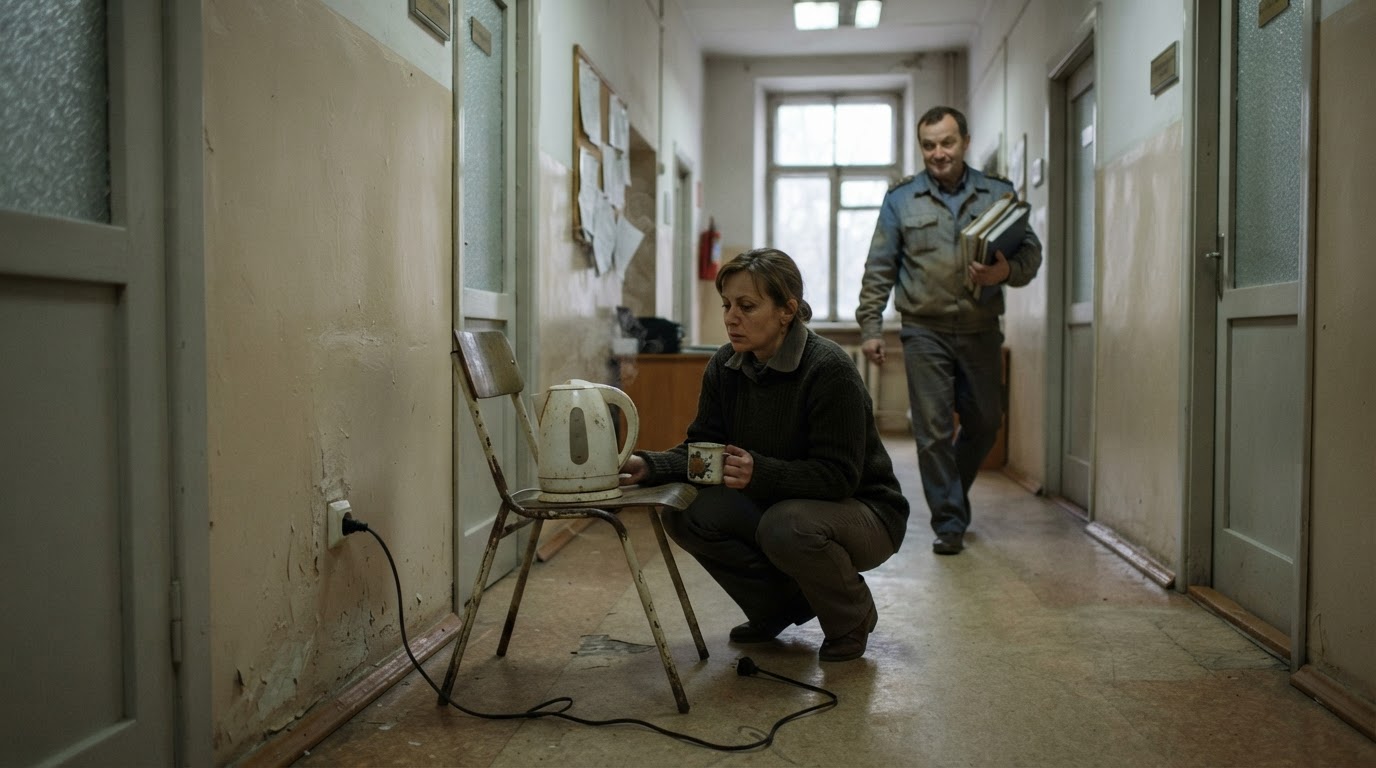
Administrative power asserts itself most quietly through the architecture of municipal waiting rooms. When public infrastructure falters, the disruption is expected to remain concealed behind domestic walls, quietly absorbed through household patience and ruined provisions. That standard civic choreography collapsed in Baja California Sur when a resident of La Paz carried a kitchen blender past the entrance of the Federal Electricity Commission, found a functional socket in the hallway, and began blending salsa in full view of administrative staff.
The demonstration followed three weeks of domestic blackout. According to accounts documented by Mexico News Daily, the unnamed resident reported having paid his utility bill and submitted formal paperwork without securing the return of his residential power. Dispatched without remedy after repeated complaints, he chose to bring the physical chore of domestic food preparation directly into the institution responsible for the failure. As he observed to witnesses during the demonstration, the federally owned operator, known as CFE, exhibits a distinct institutional asymmetry: “They’re good at cutting off the power,” he noted, “but when it comes to turning it back on...” The resident warned utility staff that he would return the following morning with a washing machine to do his laundry in the lobby if service remained disconnected.
Bureaucracy as a One-Way Circuit
Public utilities govern municipal life through structural leverage. When a bill lapses, mechanical disconnection arrives with industrial speed, yet reciprocal accountability dissolves into procedural friction whenever the error belongs to the state. In La Paz, where administrative records and local history reflect frequent and lengthy power cutoffs, households are customarily conditioned to treat electrical precariousness as an individual burden. Families absorb the cost of spoiled food, invest in backup provisions, and wait for field crews on timelines decided entirely by the state monopoly.
By taking an ordinary food preparation ritual into an administrative corridor, the demonstrator inverted that civic geography. Current flowed through the utility's commercial baseboards while residential lines stood idle. Operating a domestic appliance on official premises was not merely an act of visible exasperation; it was a calibrated refusal to let infrastructural malfunction remain an isolated private crisis. The performance transformed a bureaucratic hallway into an impromptu kitchen counter, forcing the agency to witness the domestic routine its administrative inertia had halted.
The Fragility of Quiet Compliance
One can reasonably argue that street-level theatre alters very little inside a sprawling state energy monopoly. Reports confirm that the man left the office without an immediate reconnection, and no state agency reshuffles its capital expenditure because an appliance whirred beside a customer service desk. Public administrators routinely treat these disruptions as minor public order disturbances rather than evidence of systemic failure, confident that bureaucratic procedure will outlast civilian outrage.
Yet that institutional confidence rests on a brittle assumption. It presumes that public acquiescence is an inexhaustible resource. Across the Pacific rim, civic trust does not typically fracture through organized political revolts, but through the cumulative wear of small, persistent administrative negligences. The resident plugged his cord into the lobby wall because receipts and formal dispute channels had ceased to function as a currency of mutual obligation. Whether the agency restored his connection remains unrecorded, but the image of an appliance running on institutional current leaves an uncomfortable question: how long can public utilities command absolute procedural compliance from communities whose basic switches produce only darkness?
Sources
Newsletter
Pacific Daily
A curated briefing from Thailand, Asia-Pacific and the world.