Thai royal visit in Vietnam signals cautious strategic alignment
Beyond religious diplomacy, the state visit indicates a nuanced approach to regional influence, weighing historical context and future economic ties.
SINGAPORE
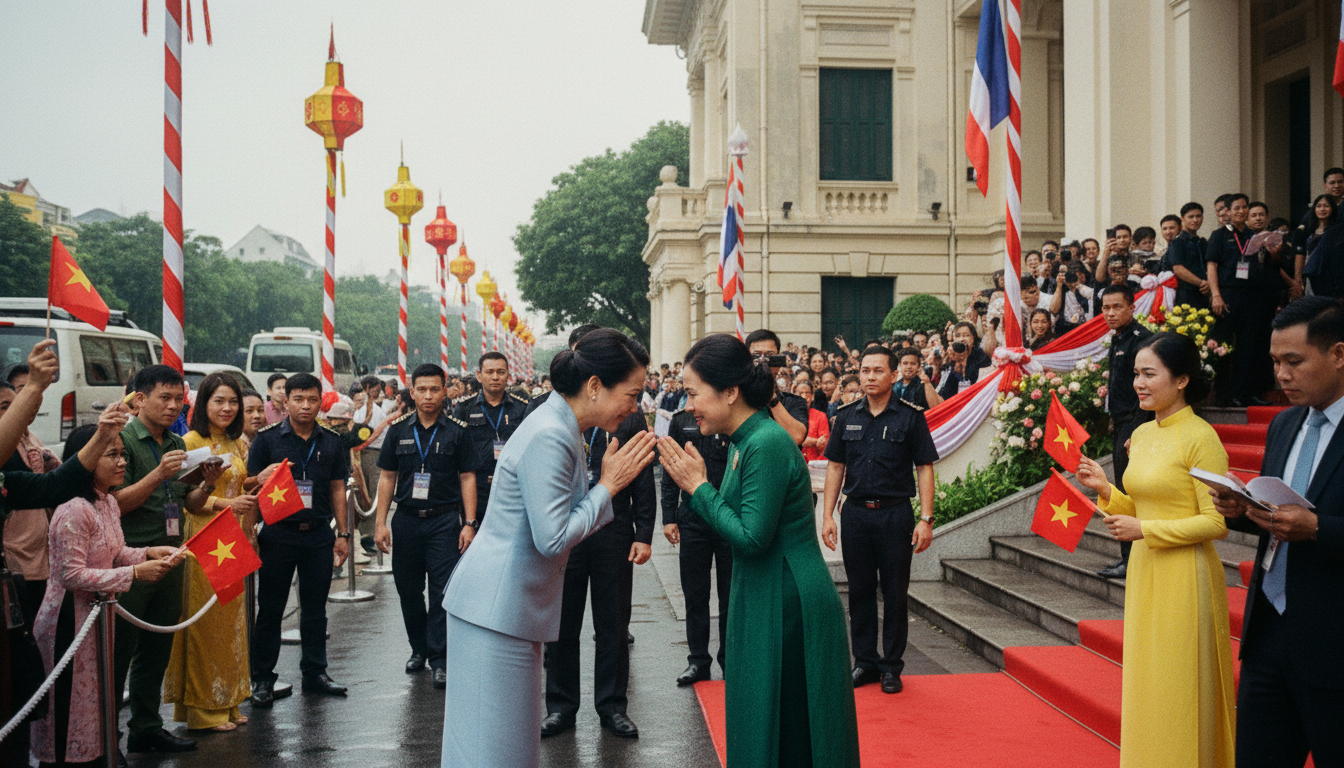
The state visit by Thai King Maha Vajiralongkorn Phra Vajiraklaochaoyuhua and Queen Suthida to Vietnam, concluding with a prayer ceremony at Hanoi’s Quan Su Pagoda on Wednesday, represents more than ceremonial diplomacy. While the homage to the Buddha and prayers for peace resonate with cultural and religious commonalities, the visit’s broader implications involve strategic recalibrations in Southeast Asia. This engagement occurs against a backdrop of complex historical dynamics and evolving economic necessities.
Thai royal visits, particularly those involving religious institutions, often serve to underscore shared cultural heritage, a fact evident in the reception by Most Venerable Thich Thanh Nhieu and the attendance of high-level Vietnamese officials like Le Khanh Hai, chairman of the Office of the President. The presence of Thai Prime Minister Anutin Charnvirakul, serving as minister-in-attendance, further elevates the political weight of these exchanges. This type of engagement can be interpreted as a soft power projection, aiming to reinforce bonds that might otherwise be strained by economic competition or geopolitical maneuvers. For Thailand, cultivating closer ties with Vietnam offers a counter-balance to the influence of other major regional actors, including China, whose regional image, as documented by the Pew Research Center, faces varying perceptions across the Asia-Pacific.
The historical trajectory of mainland Southeast Asia has frequently seen states navigating between larger powers. In this context, a visible strengthening of bilateral ties between Bangkok and Hanoi, exemplified by events like the King honoring President Ho Chi Minh, is not merely symbolic. It suggests a pragmatic recognition of mutual benefit, potentially diversifying supply chains and security partnerships. Both nations possess distinct economic growth models and strategic priorities, making direct comparisons of their market responses challenging, yet their combined economic weight forms a significant regional bloc. The establishment of new regional hubs, such as Var Group’s cybersecurity expansion in Bangkok, indicates a broader regional interconnectedness that such state visits aim to leverage.
However, the extent to which such visits translate into substantive policy shifts remains to be fully measured. While the imagery of royal diplomacy projects stability and goodwill, the underlying economic and security interests that drive national policy persist. The immediate impact of a state visit, though significant in optics, may not directly address deeper structural challenges or fully recalibrate existing alliances. The real test of this engagement will lie in the subsequent policy actions and economic cooperation initiatives that emerge, beyond the formal pronouncements and religious observances. The visit primarily serves to open diplomatic channels and signal intent, rather than concluding definitive agreements.
Sources
Newsletter
Pacific Daily
A curated briefing from Thailand, Asia-Pacific and the world.