Suriname Cyanide Mining Inquiry Underscores Regulatory Gaps Beyond Borders
Allegations of illicit chemical use in Surinamese mining operations highlight the consistent challenge of state oversight in resource extraction, a pattern that extends to marine industries and the Asia-Pacific.
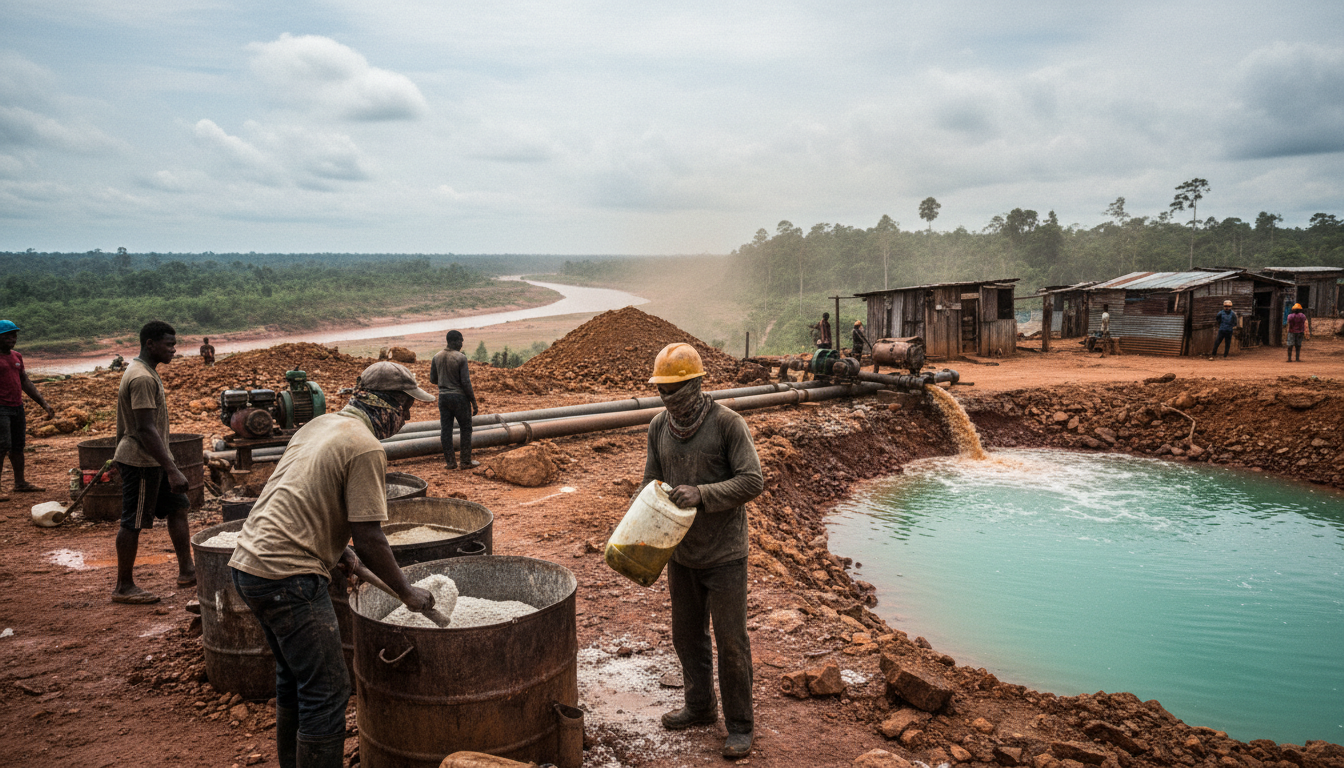
Lawmakers in Suriname are calling for a formal investigation into mining activity near Kwakoegron that allegedly uses heavily restricted chemicals like cyanide. This development, reported by Mongabay Asia on October 9, 2026, concerns the risks of runoff and pollution in the surrounding ecosystem. On Sept. 19, members of the National Assembly, Rabindre Parmessar and Michael Marengo, visited an area in Pelin Bergi. They stated they discovered “substantial” mining activity, prompting questions about permitting and control.
The situation in Suriname, while geographically distant from the Asia-Pacific, reflects a recurring issue in resource-rich regions: the discrepancy between stated regulatory frameworks and actual enforcement on the ground. Mining operations, particularly those involving hazardous substances like cyanide, require stringent oversight to prevent environmental degradation. The unattributed statement, “The situation on-site raises fundamental questions about the nature, duration, permitting, oversight and the fiscal and environmental controls on these activities,” indicates a significant breakdown in state capacity or will.
Such challenges are not confined to terrestrial mining. Marine industries, from deep-sea mining exploration to aquaculture, often face similar policy implementation gaps. The application of regulations for vessel emissions or waste discharge, for example, can prove inconsistent across vast maritime territories or within jurisdictions with limited enforcement resources. This creates vulnerabilities for sensitive marine ecosystems, where the long-term impact of unchecked activities is complex and costly to remediate.
Lawmakers are calling for President Jennifer Geerlings-Simons to launch an immediate investigation and temporarily halt all mining activity in the area, suggesting perceived urgency regarding potential non-compliance. Another unattributed quote, “[It’s] necessary to establish how activities of this scale have been able to take place over an extended period and to what extent the state’s interests and revenues have been protected in the process,” implies a dual concern for environmental impact and economic accountability.
For Asia-Pacific nations, where marine resources are vital for economies and livelihoods, the Surinamese case provides a relevant lesson. While specific regulations on cyanide use in marine contexts might differ, the fundamental issue of ensuring compliance with environmental and fiscal controls remains. Governments across the region routinely implement policies for fishing quotas, offshore drilling, and coastal development. However, translating these policies into regulated practice is a constant test.
One might argue that the political will of lawmakers in a democratic assembly, as seen in Suriname, provides a mechanism for accountability that can compel executive action. This internal pressure is crucial for identifying and addressing regulatory failures. Such interventions, however, often occur reactively, after substantial activity has already transpired, rather than through proactive monitoring and prevention. The emphasis on “how activities of this scale have been able to take place over an extended period” points to a systemic failure that may not be easily resolved by a single investigation.
The effectiveness of investigations and temporary halts, even when initiated by concerned legislative bodies, relies on the underlying strength of judicial and enforcement institutions. Without robust mechanisms to follow through on findings, address impunity, and implement lasting reforms, such interventions risk being symbolic. The central unresolved constraint remains the persistent gap between policy formulation and its consistent, enforceable application in resource extraction sectors globally, affecting both land and sea.
Sources
Newsletter
Pacific Daily
A curated briefing from Thailand, Asia-Pacific and the world.