Specialisation Carries Severe Ecological Costs for Australia’s Ballista Spider
A newly documented silk catapult targeting a single ant species tests the limits of extreme biological investment.
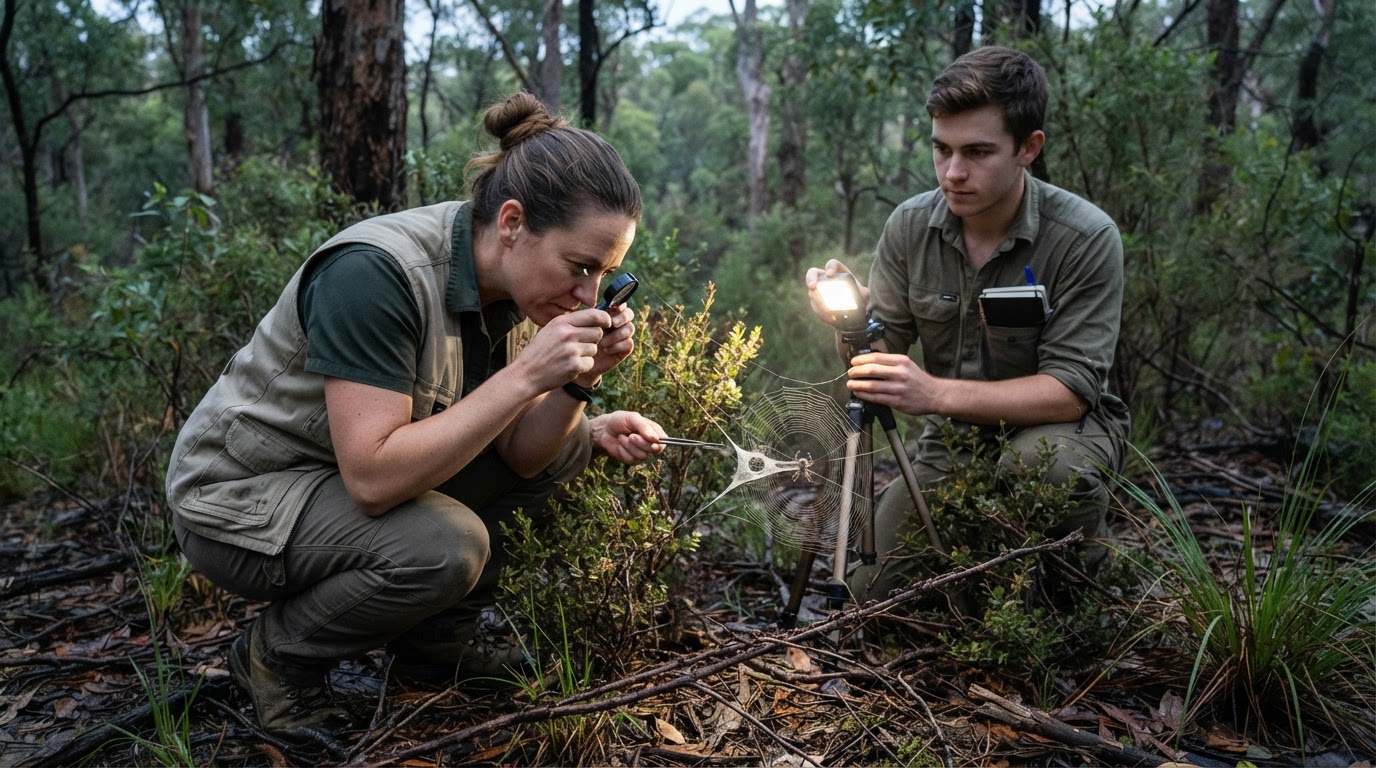
Ecological returns rarely justify absolute physical specialization. In Australia, field findings reported by Mongabay Asia and the BBC describe an extreme departure from generalist foraging: a newly discovered ballista spider that builds a spring-loaded silk snare engineered around a single prey species, the green tree ant. Rather than deploying passive webbing to intercept random traffic, this predator relies on the ant itself to strike the trigger mechanism, discharging a high-speed silk catapult that flings the quarry into capture. It represents the first documented arachnid trap designed exclusively for one target organism and activated entirely by the victim.
The operational claim sounds formidable. Yet mechanical specialization always demands a rigorous audit of costs.
Snare mechanics require precise structural calibration. According to reporting from The New York Times and BBC Wildlife Magazine, the spider constructs a silk apparatus that stores mechanical potential energy until an aggressive worker ant attacks it. Scientists theorize the spider may deliberately lure the insect into striking the threshold. That dynamic inverts ordinary foraging economics: the trap produces zero yield against passive insects that bump against silk threads without biting. South China Morning Post previously reported kinetic catapult actions used by other spider species to escape sexual cannibalism post-mating, proving that rapid elastic release exists in arachnid biology. Here, kinetic silk is repurposed not for flight or defense, but as a mandatory dietary supply line.
The snare marks the first known web designed for one prey species and activated entirely by the quarry.
Hunting an aggressive social hymenopteran carries extreme energetic and mortal downside risks. Green tree ants command organized chemical recruitment and crushing mandibles capable of destroying solitary arthropods. A mechanical failure during trap release does not simply mean a missed meal; it triggers an immediate retaliatory assault.
The Vulnerability of Single-Prey Architecture
Monopolizing a dangerous food source offers clear short-term advantages. Because competing generalist predators routinely avoid green tree ants to escape retaliatory injuries, the ballista spider secures an isolated nutritional pool free from direct resource competition.
However, this commercial exclusivity creates structural brittleness. Sinking cumulative energetic investment into a single-species interface binds the predator entirely to local ant colony density, foraging schedules and seasonal microclimates. If colony distributions contract or rainfall alters surface activity, the ballista spider cannot simply retool its strike threshold to snag soft-bodied flies that drift past without biting. Mechanical precision becomes an unhedged operational liability the moment external variables shift.
Unresolved Physical Parameters
Field data on mechanical failure rates across changing microclimates remains incomplete. Laboratory and seasonal surveys have not yet quantified how humidity swings, heavy precipitation or silk degradation compromise catapult tension under non-ideal weather conditions. The evolutionary narrative asserts that specialized kinetic trapping pays for itself through unshared caloric gains. Until systematic long-term survival figures verify that dividend against the cost of mechanical failure, the ballista spider remains an unresolved case study in the perilous mathematics of biological over-specialization.
Sources
Newsletter
Pacific Daily
A curated briefing from Thailand, Asia-Pacific and the world.