Regional Implications of Singapore’s Athletics Trajectory: Beyond the Track
Shanti Pereira's continued performance raises questions about the allocation of resources in Asia-Pacific sports development.
SINGAPORE
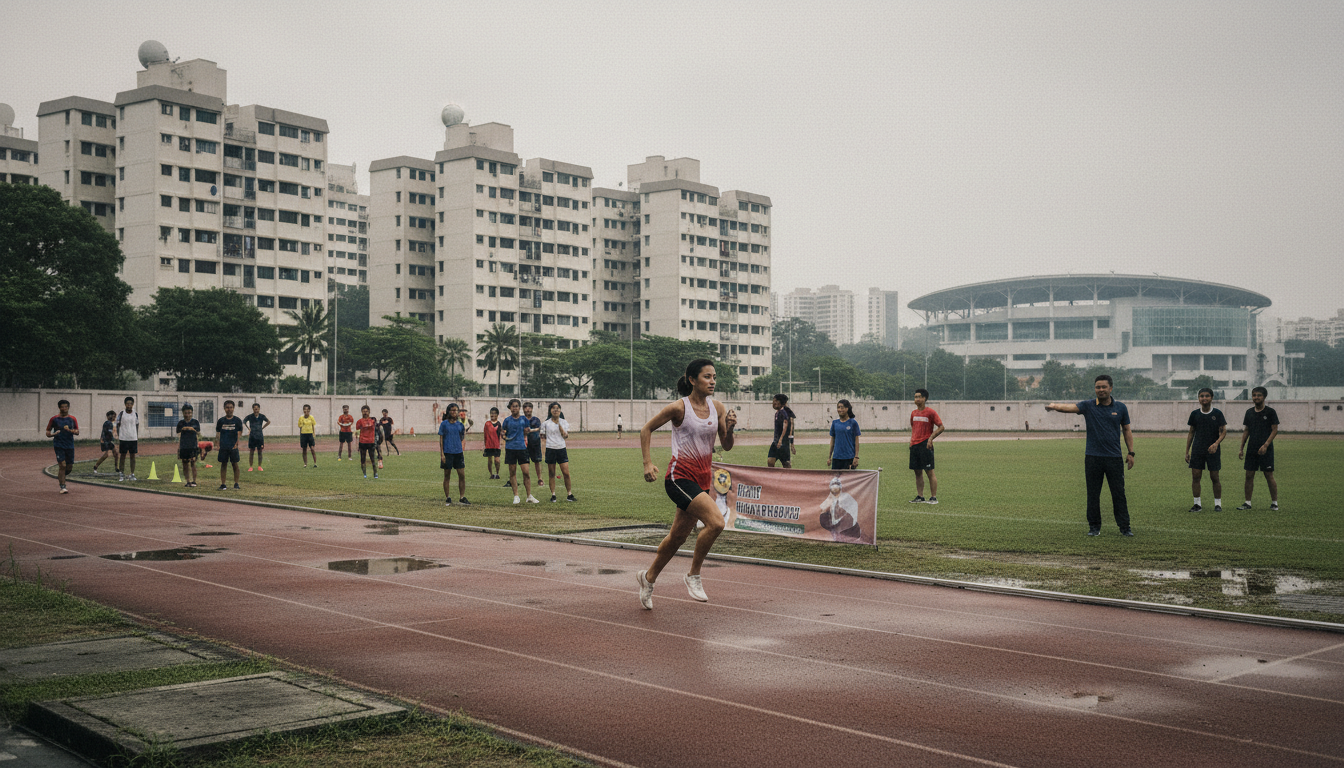
Shanti Pereira's qualification as the fastest runner in the 100m semi-final at the Aichi-Nagoya Asian Games, clocking 11.28 seconds, is a data point in Southeast Asian athletics. This performance places her ahead of competitors like Bahrain’s Edidiong Odiong, who ran 11.33 seconds, and Thailand’s Jirapat Khanonta. The event itself, held at Nagoya City Mizuho Park Athletic Stadium, saw Pereira, at 30, continue a pattern of reaching international finals; she qualified for the 200m final at the Commonwealth Games in July 2026, for example.
Historically, Singapore has not been a regional powerhouse in track and field, particularly when compared to nations with larger populations or a longer tradition of dedicated athletics infrastructure. Pereira's consistent presence in competitive final heats suggests a re-evaluation of what drives athletic success in smaller, urbanized economies. Singapore’s approach appears to prioritize specific talent development, potentially in contrast to a broader, more diffuse investment observed in some larger regional neighbours. While the provided facts do not detail specific government or institutional support, the outcome indicates a focused strategy is yielding results.
For a market like Thailand, the question is not about replicating Singapore’s exact model, but understanding the disproportionate impact of targeted investment. Thailand's Jirapat Khanonta competed in the same semi-final, which indicates the nation possesses competitive talent. The challenge appears to lie in translating individual potential into consistent, high-level regional and international performance across a broader spectrum of sports. The data point of a single athlete's success for Singapore stands in contrast to the diverse athletic landscape across the Asia-Pacific, where different nations apply varied strategies to sports funding and talent identification.
The consequence of such focused success is multifaceted. It elevates the profile of an individual athlete and, by extension, the national sporting narrative. However, it also highlights a potential regional imbalance in the distribution of resources and strategic planning for sports development. This is not to diminish the achievement of any athlete, but to consider the broader economic and policy choices that enable or constrain such performances. The unresolved tension remains how regional athletic bodies can foster broad-based excellence while still celebrating and supporting individual high-achievers in diverse market contexts.
Sources
Newsletter
Pacific Daily
A curated briefing from Thailand, Asia-Pacific and the world.