Plastic waste shifts the structural burden to Southeast Asian fishers
While global aquatic production sees records, the direct economic cost of marine plastic pollution falls disproportionately on small-scale fishing operations, challenging regional economic stability.
SINGAPORE
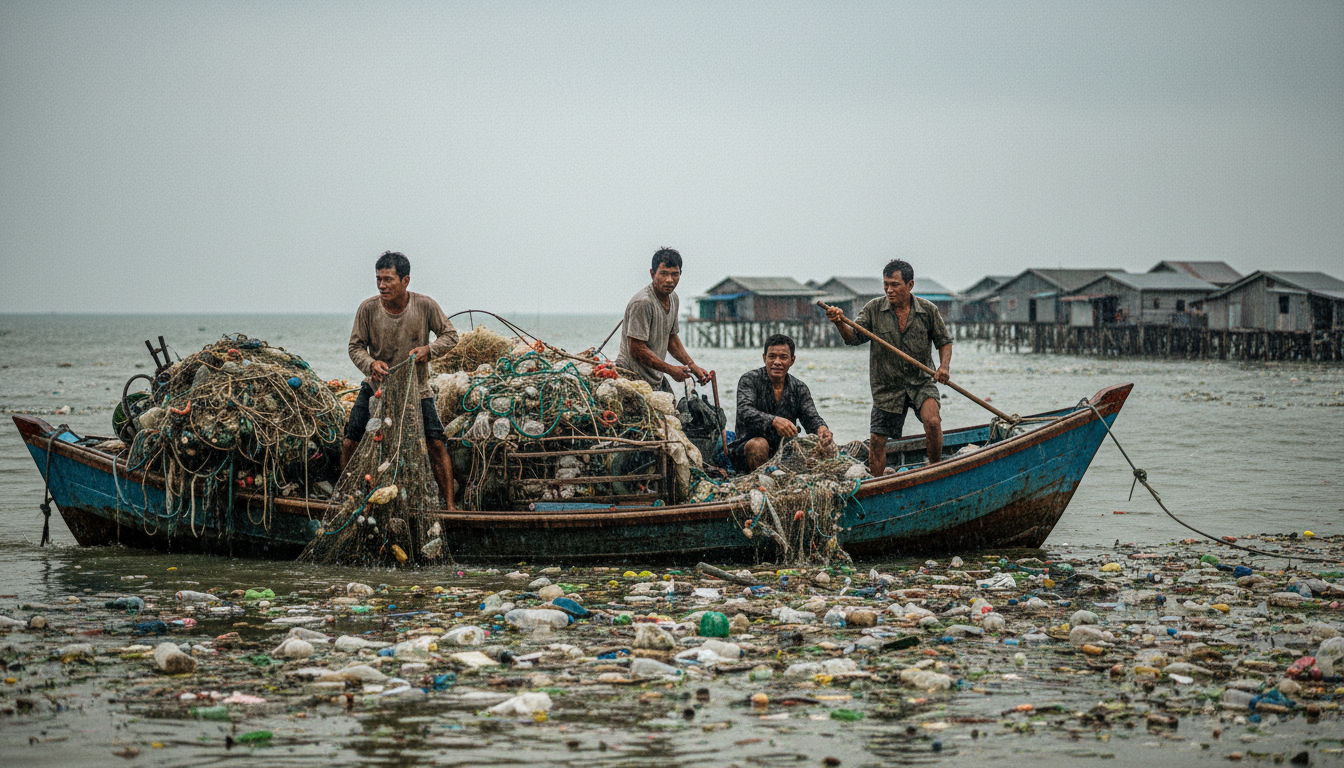
Global aquatic production has reached record highs, driven by expansion in Asia. However, this growth narrative overlooks a structural shift in economic burden for a critical segment of the sector: small-scale fishers in Southeast Asia. A recent study in Vietnam found that plastic waste causes an average loss of $3,421 per vessel annually for these fishers, stemming from lost fishing time, reduced catch efficiency, and damaged gear. This represents a 10-25% reduction in their annual income. Such figures indicate that the costs of managing marine plastic are increasingly borne not by producers or regulators, but by the most vulnerable actors in the supply chain.
This immediate financial pressure on small-scale fishers is exacerbated by other systemic challenges. Southeast Asia's fishing communities face rising fuel costs, further squeezing operational margins. Additionally, geopolitical disputes, such as those in the South China Sea, continue to displace Philippine fishermen from traditional grounds, impacting their livelihoods. These compounding factors demonstrate a complex web of structural constraints that collectively undermine the resilience of coastal communities. The Asia-Pacific is also recognized as central to addressing overfishing, implying existing pressures on fish stocks that complicate economic recovery for fishers already struggling with plastic contamination.
One counterargument might suggest that fishers themselves contribute to marine plastic pollution through discarded gear and that empowering them could be part of the solution. The Vietnam study noted that interviewed fishers reported significantly increased efforts in waste removal, suggesting a willingness to participate in mitigation. While this perspective acknowledges fisher agency, it does not absolve the broader industrial and consumer ecosystems from their primary role in generating plastic waste. The financial burden quantified — thousands of dollars per vessel per year — is a direct consequence of a systemic problem, not solely a byproduct of fishing practices. Shifting the responsibility for cleanup and loss mitigation entirely to these small-scale operators without addressing upstream sources is not a sustainable solution.
The implication for regional policy is clear. As the Asia-Pacific continues to drive global aquatic production, the environmental externalities, particularly plastic pollution, are privatized as losses for individual operators. This structural transfer of costs undermines the economic viability of small-scale fisheries, which are vital for food security and employment in many coastal nations, including Thailand. Without targeted interventions that redistribute these costs or prevent pollution at its source, the decision-making power over the future of these fisheries increasingly rests with the forces that generate marine plastic, rather than with the communities directly dependent on healthy marine ecosystems.
Sources
Newsletter
Pacific Daily
A curated briefing from Thailand, Asia-Pacific and the world.