Monopolies, Grids, and the Institutional Limits of Post-Storm Recovery
A satirical dispatch from Baja California Sur underscores how distinct utility governance structures absorb extreme weather disruptions.
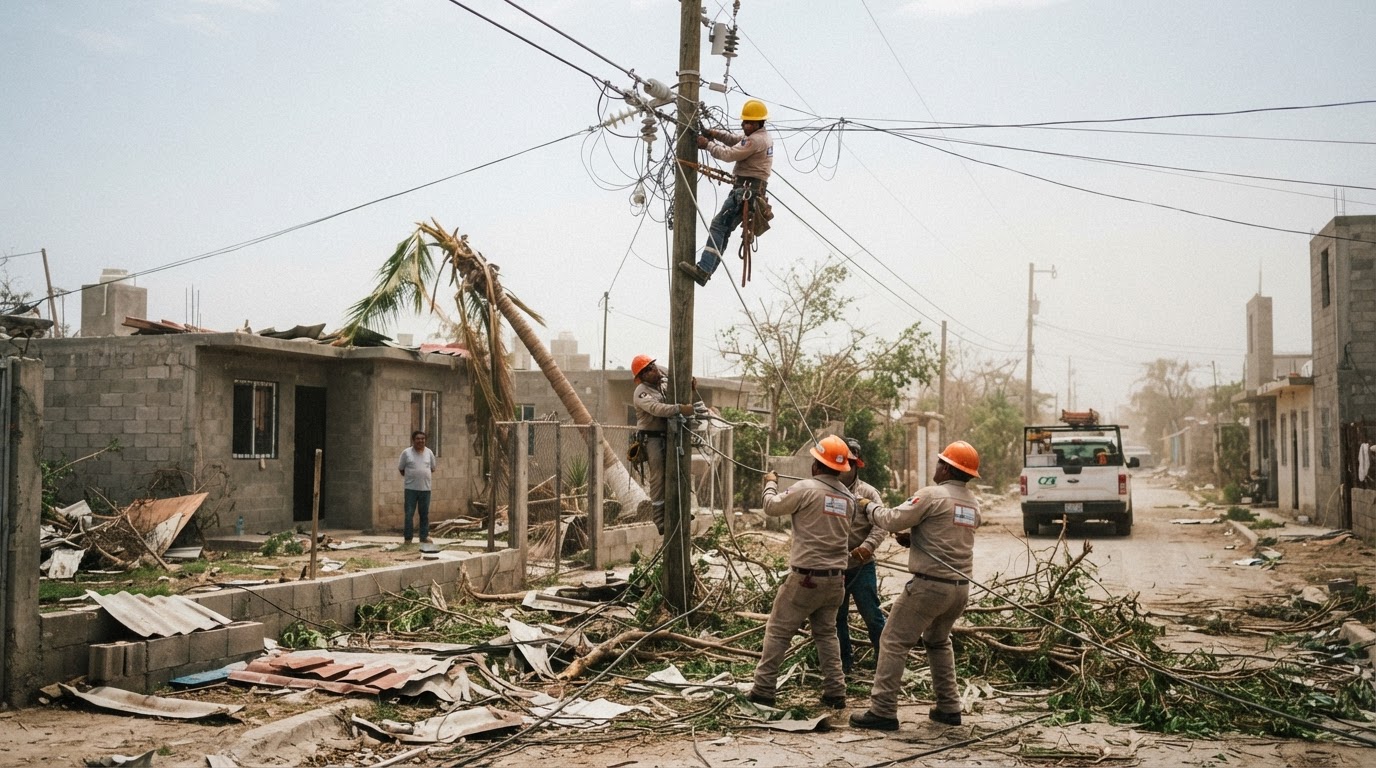
Centralized energy distribution across developing coastal zones has historically rested on an administrative compact: in exchange for statutory monopolies, state providers guarantee baseline resilience during climate disruptions. That operational premise faces immediate strain whenever severe tropical weather destroys transmission lines. When Mexico News Daily issued an account under its satirical El Jalapeño column depicting a La Paz resident operating a five-speed countertop blender from a utility customer lobby following a three-week power cut, the text was explicitly presented as satire. The structural grievance reflected in the parody, however, directly aligned with physical reality, coming weeks after Hurricane Polo brought destructive winds and flooding across Mexico's Baja.
Institutional records indicate that when Hurricane Polo hit the Pacific coast, transmission failures confronted the Federal Electricity Commission, known as CFE, with acute logistical hurdles. State-directed utilities typically respond to widespread damage by staging repairs sequentially, concentrating capital assets on administrative centers, emergency medical facilities, and primary transport corridors before dispatching crews to secondary residential lines. For domestic consumers stranded in outer neighborhoods, prolonged delays transform technical repair schedules into perceived administrative neglect.
Three Models of Grid Governance
Utility failures produce fundamentally different outcomes depending on market design. In a unified state monopoly such as CFE, residential consumers possess no alternative supplier, lack statutory avenues to contest distribution outages without jeopardizing service contracts, and must absorb household disruption without independent rate arbitration. Administrative service offices become the sole physical forum where citizens encounter the corporate entity governing essential domestic life.
Satirical defiance emerges where administrative grievance mechanisms offer consumers no formal leverage against a sovereign monopoly.
In unbundled commercial markets, regulatory frameworks mandate performance targets and levy operational penalties for delayed power restoration, which accelerates capital deployment toward repairs but frequently exposes residential consumers to severe post-storm tariff spikes. In hybrid models, where municipal distributors purchase bulk generation from sovereign providers, local authorities bear public outrage over prolonged blackouts while national ministries remain insulated from direct consumer accountability. Comparative analysis across coastal economies suggests that market design dictates where financial and political burdens fall when storms destroy physical lines.
The Unresolved Infrastructure Deficit
Weather monitoring records demonstrate that coastal distribution networks face recurring physical shocks from Pacific storm cycles. When severe wind destroys physical distribution infrastructure, repair sequences expose how central planning agencies allocate scarce maintenance capital among competing economic constituencies. Monopolies often operate on an assumption that household patience will outlast technical delays, prioritizing industrial export corridors over peripheral domestic neighborhoods.
Humor serves as a documented public response to structural impotence, yet civic parody cannot mend flooded transformers or stabilize localized grid currents. The satirical narrative of a residential customer claiming electricity at a CFE lobby counter in La Paz captured regional attention because it accurately illustrated the structural divide between utility managers and stranded consumers following a hurricane. The structural conflict between capital-constrained state utilities and vulnerable coastal populations remains intact across the Pacific Rim, leaving the basic issue of equitable grid restoration fundamentally unresolved.
Sources
Newsletter
Pacific Daily
A curated briefing from Thailand, Asia-Pacific and the world.