Hat Yai's Monorail Review Shows Transit Cannot Ignore Water
A decade-old transit plan confronts the reality of urban flooding as planners re-examine whether elevated rail serves commuter movement or civil defense
SINGAPORE
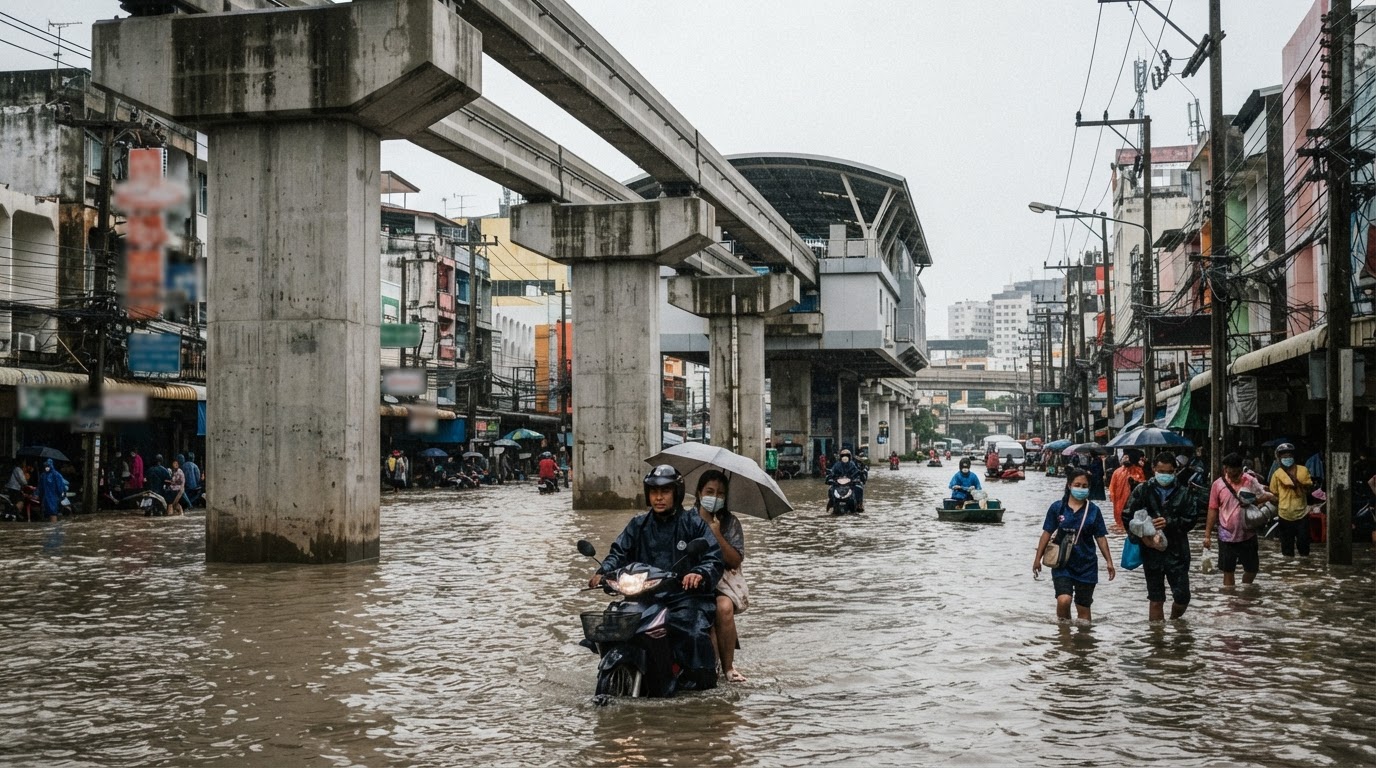
Transport planning in secondary regional hubs rarely fails because technical designs lack ambition. Failures accumulate instead when engineering blueprints treat municipal geography as an immovable, static surface. In southern Thailand, the Mass Rapid Transit Authority of Thailand, known as MRTA, has opted to halt its forward momentum and re-examine the proposed monorail system for Hat Yai. The state transit body plans to review the venture next year, taking a decade-old feasibility blueprint back to consultation desks. What prompts this reassessment is neither routine bureaucratic hesitation nor ordinary budgetary realignment. Planners are being forced to reckon directly with the catastrophic lessons left behind by the 2025 major floods.
Hat Yai operates as a dense economic crossroads, yet its concrete avenues sit exposed whenever monsoon runoffs overpower municipal drainage channels. For ten years, the prospect of an elevated monorail offered a familiar promise of metropolitan modernity, imported directly from Bangkok's elevated transit corridors. Constructing concrete pillars along choked commercial arteries was pitched as the standard prescription for traffic gridlock. That tidy division between transit logistics and environmental vulnerability vanished under deep water during the devastating 2025 inundations. When a transit corridor is submerged, a city does not simply lose vehicular flow. It loses the functional ability to move medicine, provision relief centres, or clear stranded residents from threatened neighbourhoods.
Rethinking Concrete Corridors
Returning a transit initiative to feasibility consultants carries an immediate municipal cost. Daily commuters in Hat Yai remain stranded in worsening road congestion while civil engineers re-evaluate structural elevations, drainage alignments, and power substation placement. Every year lost to project reviews is a year where shopkeepers, daily wage earners, and local couriers absorb the friction of gridlocked avenues. Yet pushing ahead with a decade-old design risks inflicting far more durable damage. Transport lines drawn before the 2025 floods were drafted under environmental assumptions that no longer correspond to southern weather realities.
When transport corridors flood, a city loses both civilian mobility and emergency access.
Advocates of accelerated construction argue that provincial commercial centres cannot afford prolonged administrative stalls. Hat Yai competes with regional hubs across Thailand, and delaying major transit infrastructure risks dampening private sector investment. In this view, engineering adaptations can simply be added as peripheral adjustments during active procurement rather than restarting baseline assessments. That argument, however, underestimates how catastrophic water flows interact with fixed civil works. Elevated piers anchored into waterlogged ground alter street-level hydrology. If passenger stations and power networks fail to account for record floodlines, expensive monorail assets risk turning into unusable concrete monuments during the precise hours when public transport is needed most.
The Price of Adaptation
The central dilemma facing the MRTA extends far beyond track layouts or rolling stock selection. Elevating platforms to clear future high-water marks and restructuring street basins demands substantial capital. When public transit authorities redesign municipal networks around disaster response, fiscal pressures tend to mount. If modernised resilience features drive up overall capital expenditure, the subsequent operational burden often trickles down. That burden surfaces either through escalated passenger fares that deter working-class riders or through diverted municipal maintenance budgets that leave secondary surface streets without basic drainage upkeep.
Transit systems across Southeast Asia can no longer function purely as instruments of peak-hour convenience. They must operate as functional infrastructure capable of surviving extreme seasonal shocks. The MRTA reassessment of the Hat Yai monorail demonstrates that the primary test of regional connectivity is no longer just passenger capacity. A more enduring test lies in whether public transit remains operational when the water rises.
Sources
Newsletter
Pacific Daily
A curated briefing from Thailand, Asia-Pacific and the world.