Hanoi flooding indicates broader infrastructure challenges for Southeast Asia
While localized heavy rainfall in Hanoi disrupts daily life, a pattern of increasing flood events across Vietnam signals a growing vulnerability that extends to other regional urban centers.
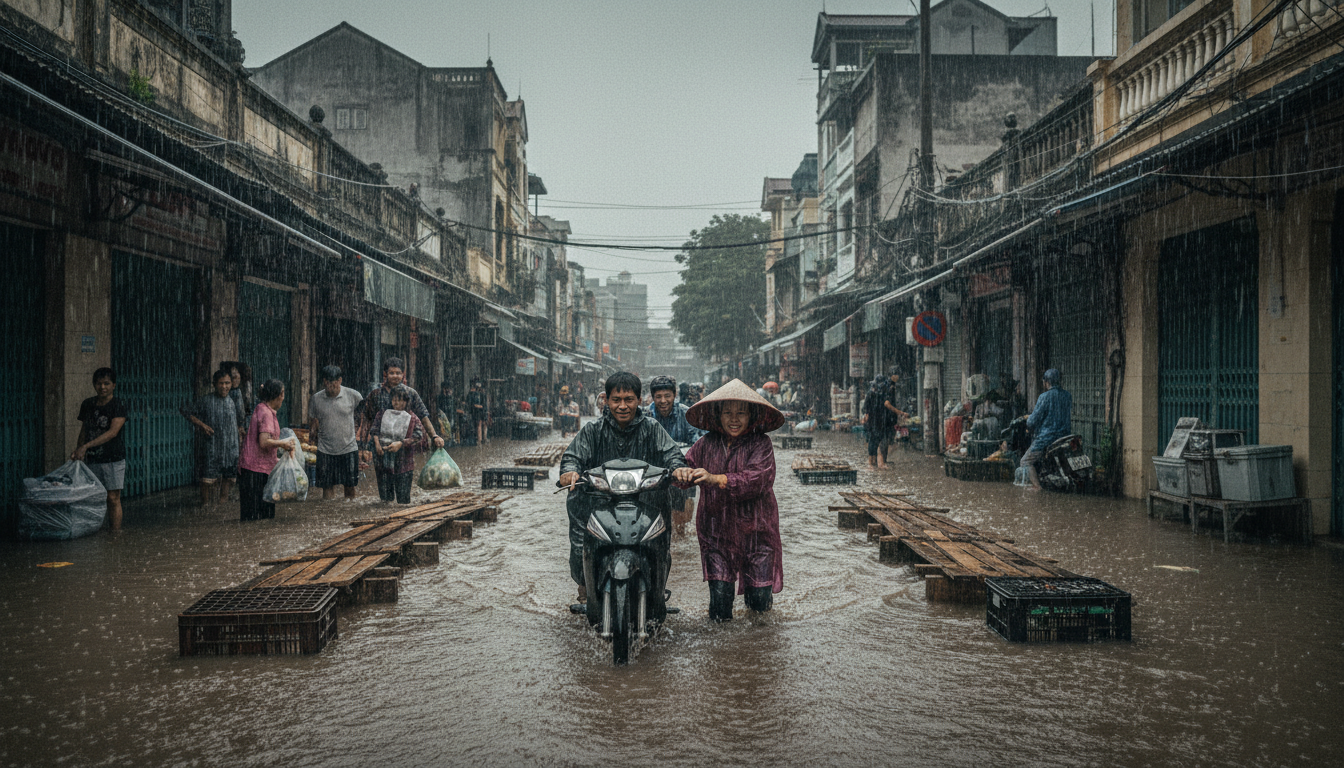
HANOI
Hanoi's recent rainfall exceeding 150 mm overnight, causing widespread flooding and prompting some schools to switch to online classes on September 17, 2026, represents more than a localized weather event. This instance, where Luong The Vinh Street in downtown Hanoi was flooded by 30-50 cm, with some areas reaching half a meter, highlights a recurrent challenge for urban infrastructure in Southeast Asia.
The volume of rainfall itself, exceeding 150 mm in several parts of the city, points to a significant meteorological event. However, the resulting disruption, from stalled vehicles to temporary school closures, suggests an underlying issue in the capacity of urban systems to manage such precipitation. This is not an isolated incident for Vietnam; 2025 saw significant flooding across the country. The New York Times reported on a typhoon intensifying fears of flooding in Central Vietnam in August 2025, followed by e.vnexpress.net detailing the region's continued struggle with historic flooding in November 2025. By December 2025, e.vnexpress.net characterized it as 'a year under water,' with record floods affecting areas from megacities to tourist hubs. This historical data establishes a pattern of increasing flood frequency and severity beyond Hanoi’s current situation.
The economic implications of such events are substantial. While specific figures for the September 2026 Hanoi flood are not available, the cumulative impact of repeated flooding on infrastructure, commerce, and public services can deter investment and impede economic growth. The need for schools to transition to online classes, for example, indicates a direct disruption to human capital development and productivity. The ongoing expenditure on recovery and adaptation, without addressing the root causes of urban vulnerability, diverts resources from other essential development areas.
While some might argue that these events are primarily a function of changing weather patterns, the critical factor for urban resilience lies in infrastructure design and maintenance. Cities like Bangkok and Jakarta, also located in GMT+7 and referenced alongside Hanoi in e.vnexpress.net reporting on flood events, face similar geographical and climatic pressures. Their capacity to manage intense rainfall events directly affects their economic stability and livability. The recurring nature of these floods in Vietnam suggests that existing drainage systems, urban planning, and flood mitigation strategies may be insufficient to handle current, let alone future, meteorological realities. This is a point of concern for regional urban planners and policymakers.
### Regional Vulnerability
The broader Asia-Pacific region, with many rapidly urbanizing coastal and riverine cities, shares this vulnerability. Investment in resilient infrastructure—including upgraded drainage, improved urban planning to limit impermeable surfaces, and early warning systems—is essential. The challenge is balancing the rapid pace of urban development with the slower, more costly process of building resilient systems. Without specific and publicly available data on the historical performance of Hanoi’s drainage infrastructure against rainfall intensity, a direct correlation between this event and systemic failure remains an inference, albeit one supported by the documented recurrence of severe flooding in Vietnam.
The long-term economic and social stability of these urban centers depends on their ability to adapt to increased rainfall intensity and frequency. The Hanoi event serves as a reminder that localized disruptions can be symptoms of a systemic regional vulnerability that requires a coordinated and data-driven response to infrastructure planning and climate adaptation. The critical question remains whether the pace of infrastructure adaptation can match the accelerating frequency and intensity of these meteorological events across the region.
Sources
Newsletter
Pacific Daily
A curated briefing from Thailand, Asia-Pacific and the world.