Autonomous Software Confronts Physical Governance Across the Pacific
Waymo recalls its fleet over manual traffic exceptions while relying on Chinese manufacturing hardware, revealing the limits of boundary-free mobility.
SINGAPORE
Automated transport models assume urban roadways operate under predictable, computable logic. That premise broke down again in California when Alphabet subsidiary Waymo initiated a recall of its self-driving vehicles following failures to correctly navigate closed freeway lanes and hand-signalled manual traffic control. The disruption occurred on American tarmac, yet its structural implications extend directly across trans-Pacific industrial corridors.
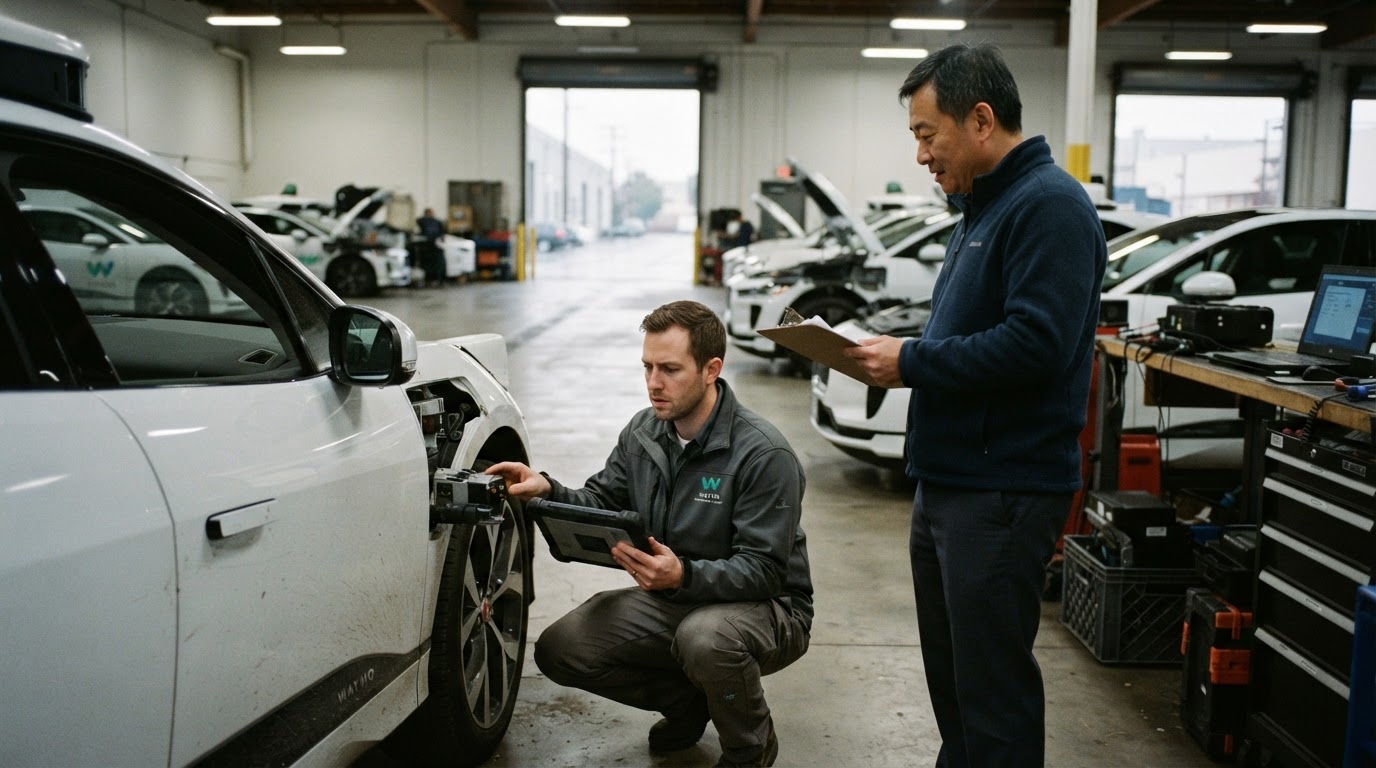
The vehicles anchoring this operational friction combine American algorithmic oversight with Chinese automotive hardware. Fleets deployed in Los Angeles during October 2026 and observed charging in San Diego in August 2026 feature the Waymo Ojai, an electric platform manufactured by Zeekr in China. This technical pairing represents an uneasy commercial compromise between Silicon Valley code architecture and Chinese industrial scale, colliding with the untidy realities of street-level municipal enforcement.
Algorithmic Assumptions Against Human Directives
Software models reliably process mapped geometry, standard lane markings, and programmed signage. They falter when emergency crews, construction personnel, or police officers override statutory road rules using hand gestures, improvised barriers, or temporary lane closures. When highway authorities close a freeway corridor and divert vehicles manually, human motorists read subtle physical cues, eye contact, and collective hesitation. Autonomous navigation systems, lacking human intuition, interpret these contradictory signals as edge-case exceptions.
Proponents of rapid autonomous deployment argue that algorithmic vehicles retain superior aggregate safety profiles over distracted human operators, suggesting that edge-case navigation errors diminish through iterative software patching. That defence assumes physical traffic management exists merely as an engineering hurdle awaiting higher processing speeds and denser sensor suites. Yet manual interventions during road closures are political and administrative exceptions, not orderly data points.
Manufacturing Interdependence Meets Regulatory Fractures
For policymakers evaluating automated transport across Asian transit hubs, the recall delivers a cautionary structural lesson. Municipal road networks from Singapore to Tokyo and Bangkok depend heavily on manual intervention by traffic marshals, informal lane sharing, and spontaneous roadside directions during monsoon flooding or infrastructure repairs. An operating model unable to reconcile manual traffic overrides on structured California freeways presents heightened regulatory liabilities when exported to mixed-use urban corridors.
The industrial supply chain complicates this regulatory dilemma. The deployment of Zeekr platforms manufactured in China beneath Western-developed software suites reveals deep commercial interdependence between Beijing's electric vehicle assembly lines and California's technological platforms. Even as geopolitical tensions mount, corporate planners continue binding United States autonomous networks to Chinese manufacturing ecosystems.
Technological progress cannot bypass the civic friction of municipal governance. A fleet dependent on continuous data streams struggles the moment an individual officer raises a hand to halt traffic on an open freeway. Until automated platforms resolve the authority of local human command over computational certainty, cross-border autonomous mobility will remain caught between sovereign street-level enforcement and global hardware supply chains.
Sources
Newsletter
Pacific Daily
A curated briefing from Thailand, Asia-Pacific and the world.