Ancient Maya apiary findings underscore value shifts in Yucatán's coastal economy
Archaeological discoveries near Tulum, while academically significant, illuminate the changing economic priorities along Mexico’s Riviera Maya, where tourism now dominates resources.
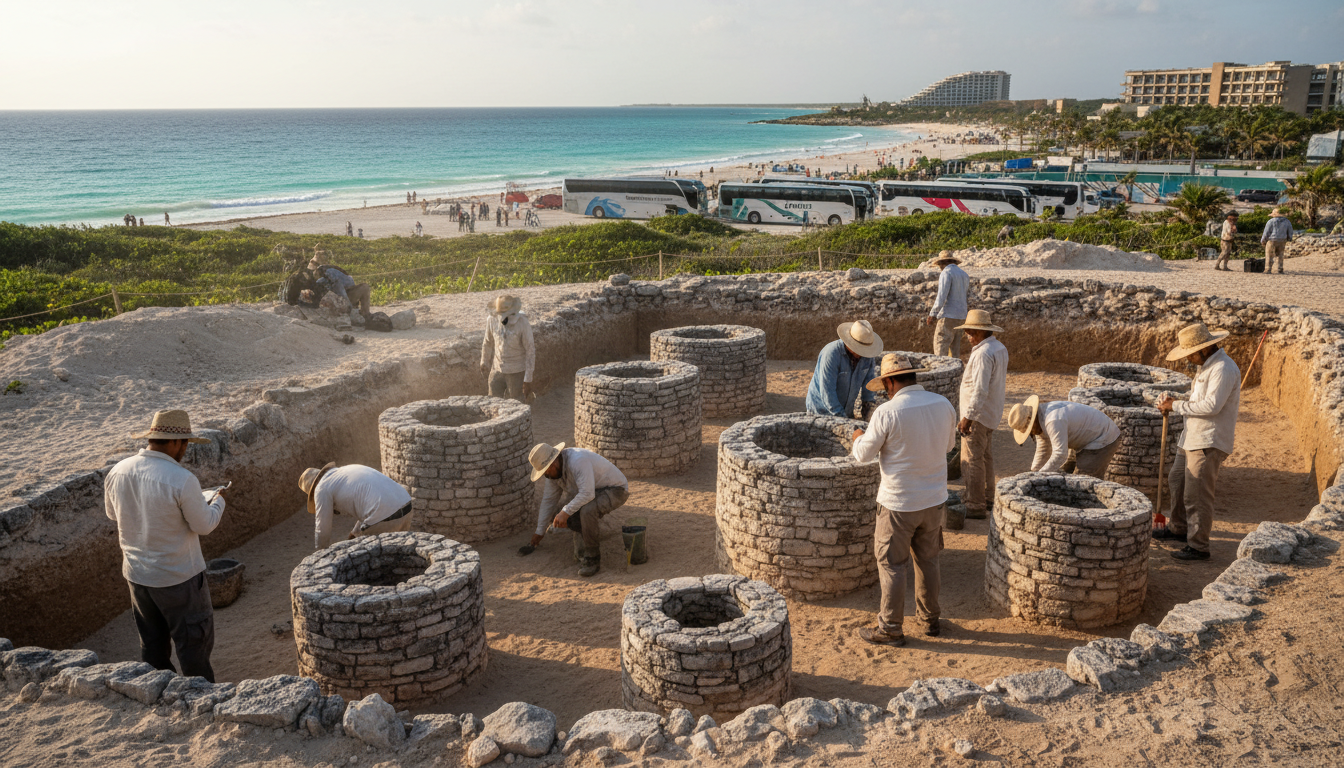
The recent announcement by Mexico News Daily, dated September 25, 2026, regarding an ancient Maya apiary near Tulum, highlights a historical method of honey production. Discovered in 2022 during the construction of the Maya Train, the National Institute of Anthropology and History (INAH) confirmed that the site, located near Aktun Chen Natural Park, about 16 kilometers north of Tulum, was likely used between 500 and 800 years ago to raise Melipona beecheii, a stingless native bee. The honey from these bees, known as melipona, continues to be valued in southeastern Mexico for both food and traditional remedies.
While the discovery offers a precise look into pre-Hispanic agricultural practices and resource management, its economic implications for the Asia-Pacific region are indirect. The primary signal from this information is the continued reorientation of coastal resources in the Yucatán Peninsula. The area around Tulum, once supporting diverse local economies including honey production, now faces significant infrastructural development driven by tourism. The Tulum airport, opened to U.S. flights by March 25, 2024, enables tourists to bypass Cancún, as reported by The Washington Post. This suggests a direct economic incentive for developers and the Mexican government to prioritize tourist infrastructure over other forms of land use.
Historically, the coastal regions sustained varied economic activities. Today, the local economy around Tulum is increasingly structured to accommodate international tourism, which includes the construction of projects like the Maya Train. The discovery of an ancient apiary, while historically rich, is situated within a broader pattern of land transformation. Who gains from these developments are the tourism sector stakeholders, including international airlines and resort developers. Who pays are potentially those whose livelihoods are displaced or whose access to traditional land use is curtailed by large-scale infrastructure projects. The natural environment also incurs costs; the prevalence of seaweed choking beaches, as reported by The New York Times on August 3, 2026, points to environmental pressures that affect the tourism product itself.
The findings do not alter the fundamental economic incentives driving development in the Riviera Maya. The archaeological discovery serves as a reminder of past resource allocation, contrasting with the current intense focus on tourism infrastructure. For Thailand and other Asia-Pacific economies with significant coastal tourism, this serves as a case study. The economic benefits of tourism can drive large-scale infrastructure projects, leading to shifts in land use and economic priorities. The preservation of cultural heritage and traditional practices then often becomes a secondary consideration or a feature to be integrated into the tourism product, rather than a primary economic activity.
The challenge for coastal economies remains how to balance the clear financial returns from tourism with the preservation of cultural practices and natural resources. The Tulum situation suggests that tourism often takes precedence, creating a dynamic where historical insights become points of interest rather than models for current economic activity. The ultimate outcome for the Yucatán region, and implicitly for other developing coastal tourism zones, depends on whether tourism-driven growth can sustainably coexist with the intrinsic value of its non-tourism resources, including historical sites and traditional livelihoods. This remains an unresolved constraint in many rapidly developing coastal areas.
Sources
Newsletter
Pacific Daily
A curated briefing from Thailand, Asia-Pacific and the world.