China’s new canal redirects trade routes, challenges existing regional dynamics
The Pinglu Canal's opening shifts maritime access for landlocked provinces, impacting established trade corridors across Southeast Asia.
SINGAPORE
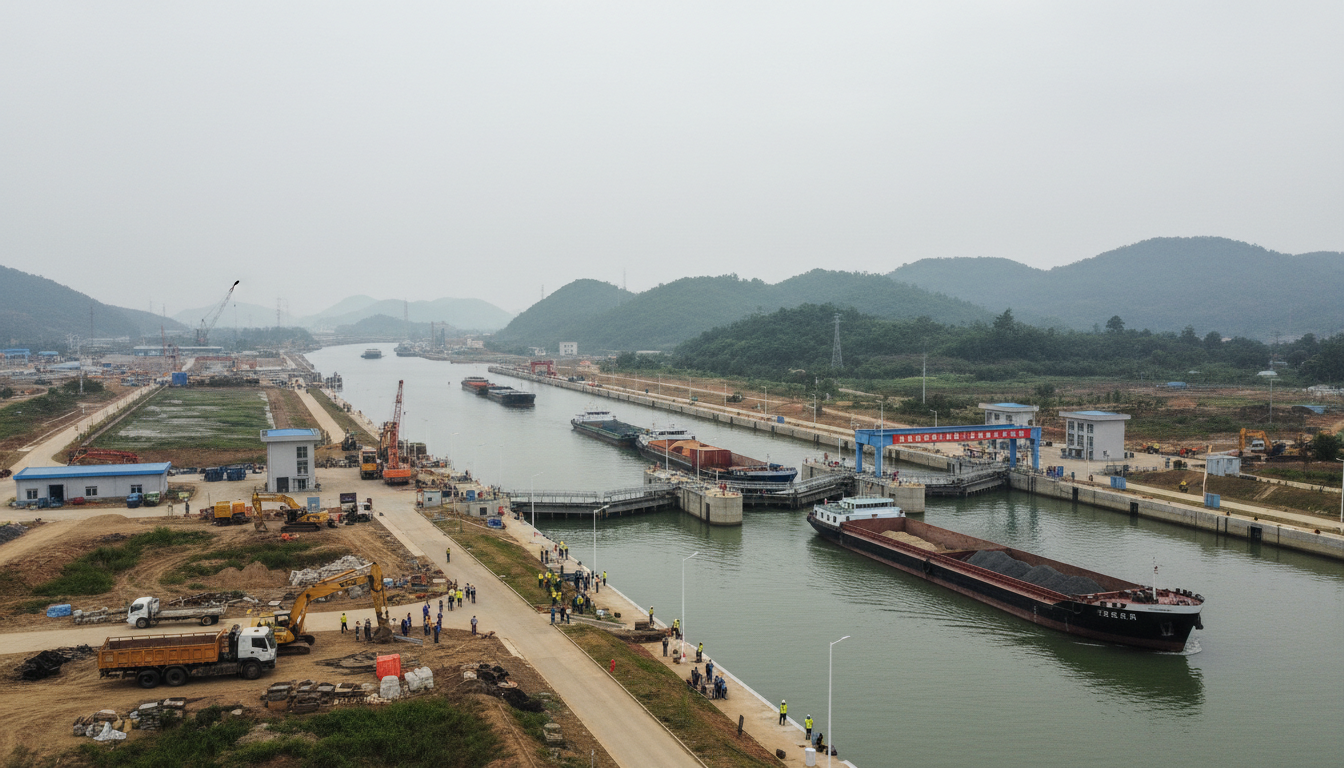
The People's Republic of China recently opened the Pinglu Canal, marking its first major river-to-sea canal construction since 1949. This $10.8 billion infrastructure project, announced by state media, provides a direct sea connection for landlocked areas within China, with the stated aim of bolstering trade ties with regional neighbors. The canal's operation is expected to reduce transport times and costs for Chinese goods moving into Southeast Asia.
Historically, maritime trade from China's interior has largely relied on established routes through coastal ports and the South China Sea, creating a predictable flow of goods through key chokepoints and hubs. The Pinglu Canal introduces a new geographic variable, offering an alternative that bypasses some of these traditional transit points. For Thailand, whose economic geography is deeply intertwined with established maritime shipping lanes and port infrastructure, this development presents a structural shift rather than a direct threat or immediate opportunity. The canal's primary effect is on China's internal logistics and its direct access to the Gulf of Tonkin, not on the fundamental shipping economics of major Pacific routes that serve Thailand.
While the canal offers a new conduit for Chinese trade, its impact on the broader regional supply chain requires close examination. Sources such as The Diplomatic Insight and The Star highlight the canal's role in strengthening trade links with Southeast Asia. This perspective, however, largely focuses on the advantages for China's internal and bilateral trade flows. The assertion that it creates a 'shortcut to Southeast Asia' overlooks the established and extensive shipping networks already in place, many of which are designed for high-volume, deep-water vessels that may not find optimal utility in a river-to-sea canal system. Such a system serves a different scale and strategic purpose compared to infrastructure designed for intercontinental maritime traffic.
The critical question for Thailand and other Southeast Asian economies involves the reorientation of cargo volumes. Will a significant proportion of goods destined for markets like Vietnam, Cambodia, or even parts of Malaysia divert through this new canal, thereby reducing traffic on existing routes? Or will the canal primarily serve to optimize trade from specific Chinese provinces, creating new, distinct trade patterns without fundamentally disrupting the main arteries of regional commerce? The canal's influence may be more pronounced on niche trade flows or specific industrial supply chains rather than on the overall maritime transport landscape. The immediate implication for Thailand is not a direct challenge to its ports, but a need to monitor shifting trade patterns and potential adjustments in bilateral logistics agreements as China diversifies its access to regional markets. The full economic consequences of this infrastructure on Southeast Asian trade balances and regional logistics competition remain an unresolved tension.
Regional Logistics Adjustments
The construction of the Pinglu Canal represents an investment in China's capacity to project trade influence more directly into its southern periphery. The South China Morning Post's report from September 16, 2026, underscored its role in 'slashing transit time' to Southeast Asia. This perceived efficiency gain, however, needs to be weighed against the existing infrastructure and logistical preferences of regional trading partners. Thai ports, for example, are integrated into global shipping consortiums and cater to a diverse array of origins and destinations. A new canal primarily benefiting Chinese internal transport to a specific part of the Gulf of Tonkin may optimize certain bilateral exchanges but does not automatically redefine multilateral trade architecture.
The canal's potential to alter regional trade patterns is contingent on several factors, including the type and volume of goods suitable for canal transit, the cost-effectiveness compared to established sea routes, and the willingness of regional partners to adapt their supply chains. The project's completion, as noted by VnExpress International on September 17, 2026, provides China with a new strategic egress. This development implies that while Thailand's core maritime trade infrastructure remains central to its economic activity, the competitive landscape for specific categories of goods and their logistical pathways within Southeast Asia may experience incremental adjustments. The ongoing evolution of regional trade necessitates continuous evaluation of such infrastructural changes, rather than assuming immediate, sweeping transformations of existing market dynamics.
Sources
Newsletter
Pacific Daily
A curated briefing from Thailand, Asia-Pacific and the world.