Capital Allocates to Physical Power Grids While Digital Premia Soften
WEG's 250 million dollar commitment in Hidalgo exposes the concrete industrial bottleneck behind artificial intelligence and nearshore relocation.
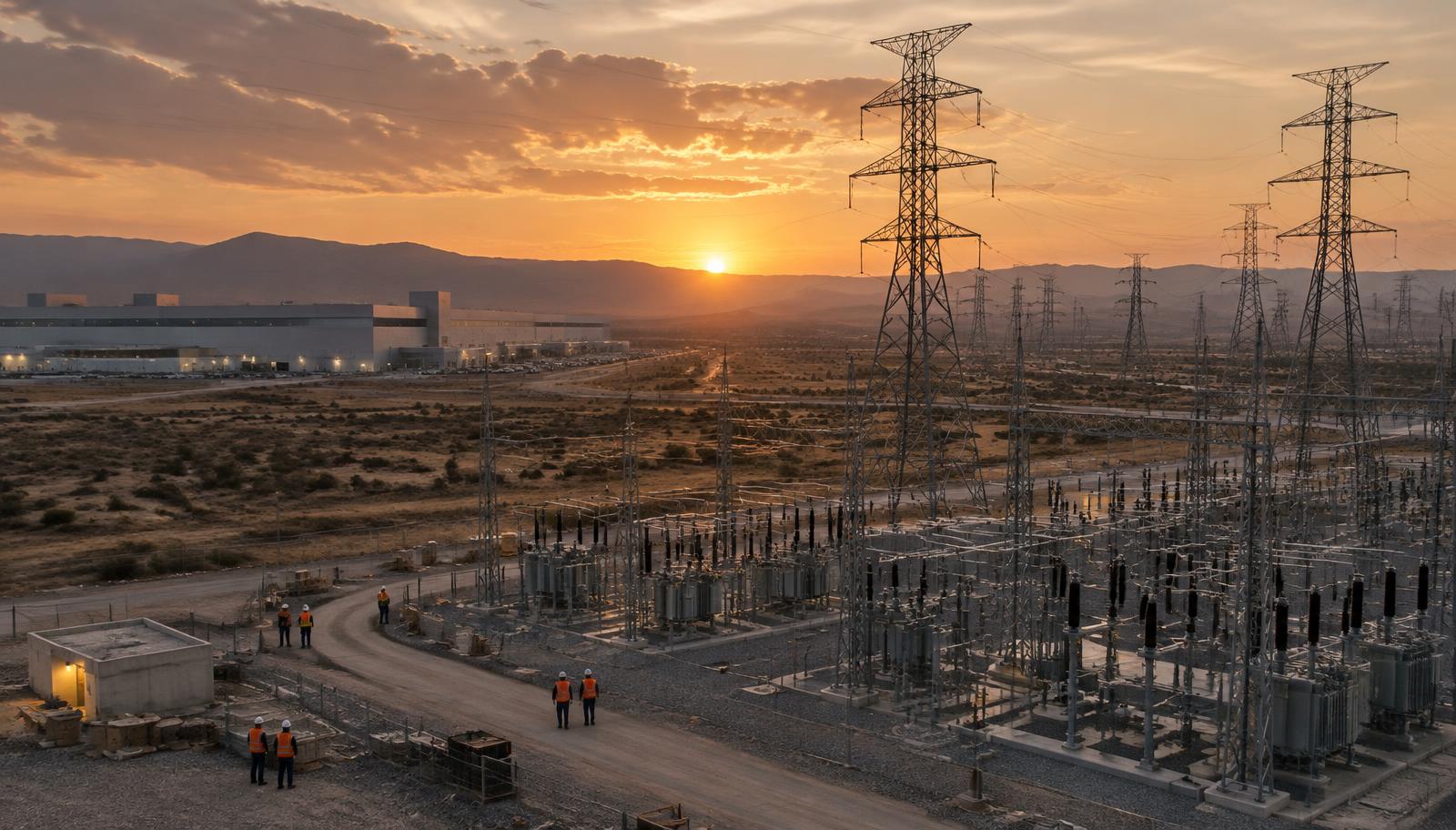
Industrial capital continues to chase physical capacity while market valuations debate the durability of software margins. Brazilian manufacturer WEG will direct 250000000 dollars to construct an electrical equipment facility in Hidalgo, adding more than 2000 jobs to a domestic footprint that already employs 6000 people. Economy Minister Marcelo Ebrard presented the project during President Claudia Sheinbaum’s Thursday press conference as part of Plan México, framing the timeline between 2027 and 2030 as proof of stability.
a sign of confidence and certainty for the country,
Ebrard termed the decision, speaking for an administration eager to anchor multinational industrial investment. The planned output centers on transformers, alternators and generators destined for data centers and power infrastructure, alongside technologies linked to artificial intelligence. For observers across the Pacific Rim, the transaction provides an unvarnished audit of where industrial leverage actually sits.
The Hardware Bottleneck
Corporate planners across the United States and Latin America frequently treat data processing capacity as an ethereal cloud asset. Physical realities tell a different story. High-density computing clusters require heavy electrical apparatus that cannot be conjured through software patches or financial engineering. Transformers and alternators represent long-lead industrial equipment, subject to severe delivery backlogs and tight manufacturing capacity.
By locating production in Hidalgo, WEG expands outward from its existing base in Huehuetoca, México state, where it has operated for more than a quarter century. The decision targets a genuine, unyielding physical constraint rather than a speculative market narrative. Digital networks cannot expand without grid hardware. Equipment makers hold structural pricing power over both tech conglomerates and state utilities because heavy machinery takes years to fabricate.
Yet the industrial balance sheet carries frictions that political rhetoric routinely glides over. A development schedule extending from 2027 through 2030 acknowledges that manufacturing complex electrical components requires extended construction cycles and specialised labour recruitment. While public officials celebrate the creation of 2000 positions, absorbing advanced technical roles into a new site demands operational discipline that cannot be accelerated by executive decree.
Shifting Continental Leverage
Export-oriented manufacturers in Southeast Asia, notably electronics assemblers in Thailand, should track this reallocation closely. Capital allocators are not merely diversifying away from concentrated Asian supply hubs; they are establishing regional manufacturing nodes directly adjacent to primary consumption markets. The geography of capital expenditure is being redrawn around secure utility interconnections and physical proximity.
Government ministers present these capital inflows as unequivocal validation of national policy. The underlying driver, however, is corporate risk mitigation against brittle transpacific maritime corridors and saturated utility grids. Equipment suppliers must deliver units within continental logistics perimeters if data center operators are to meet energized commissioning deadlines.
Whether Hidalgo delivers uninterrupted infrastructural support between 2027 and 2030 remains the pivotal operational variable. Capital commitments do not guarantee swift operational execution, particularly when local grid reliability remains contested across North American production zones. For all the political ceremony surrounding the announcement, the factory floor faces the stubborn mechanical reality that modern computing power cannot exist without iron, copper and high-voltage grid connections.
Sources
Newsletter
Pacific Daily
A curated briefing from Thailand, Asia-Pacific and the world.