The Silent Tax of the Atmosphere
Singapore's recurring encounter with haze speaks to a deeper regional interdependence, where air quality is a shared, vulnerable commodity.
SINGAPORE
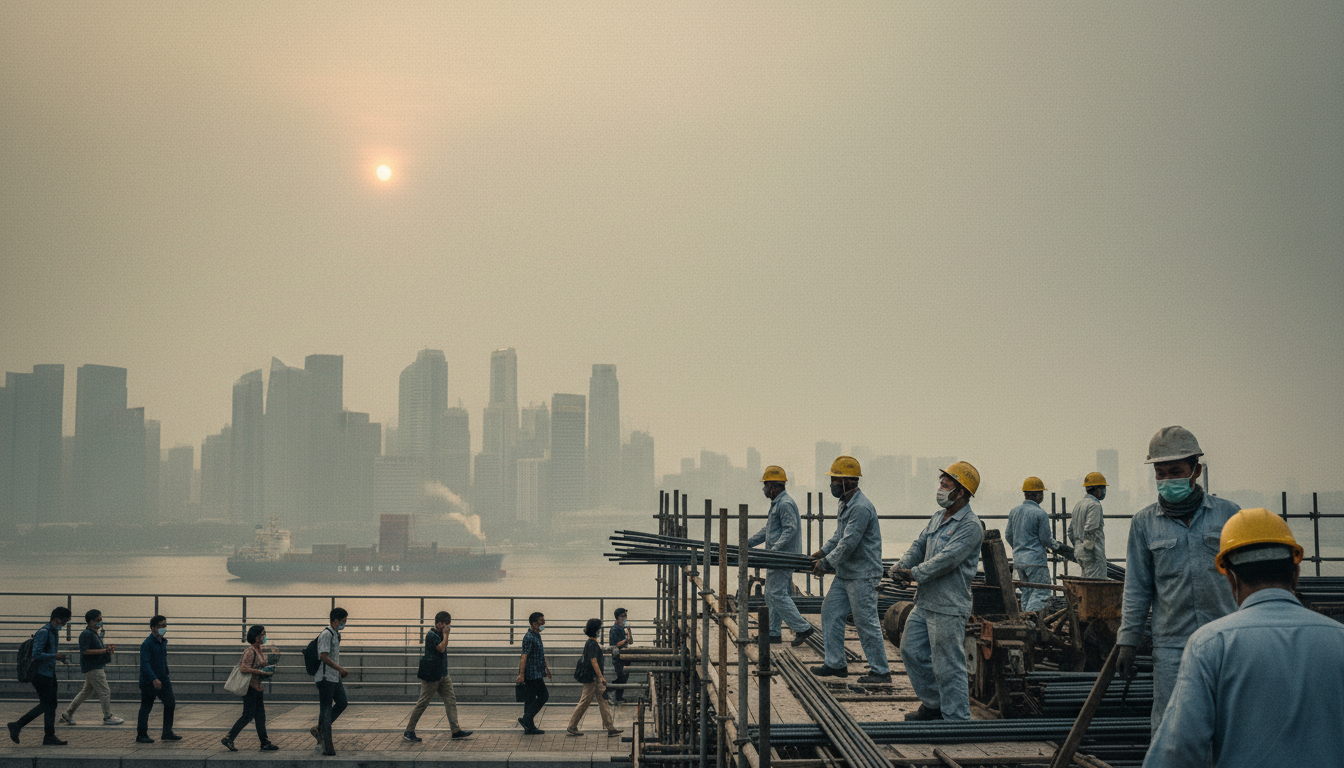
Figures walk along Sengkang East Way, near Sengkang Riverside Park, their forms indistinct against a skyline veiled in haze. This photograph, taken on September 19, 2026, captures an everyday street scene rendered extraordinary by the pervasive grey obscuring the horizon. People wear masks, a visible acknowledgment of an altered environment. This visual record is not an anomaly; it is a recurring tableau in Singapore, documenting an atmospheric condition that revisits the island nation.
Singapore, a city-state recognized for its meticulous planning, experiences a peculiar vulnerability. Its air quality, a fundamental measure for residents, is repeatedly compromised not by local factors, but by events occurring hundreds of kilometres away. Smoke from fires, originating geographically distant from Singapore's urban sprawl, travels on prevailing winds, eventually shrouding the city. CNA Lifestyle reported on September 22, 2026, that the time for this smoke to reach and disperse depends on wind conditions. This geographical displacement of cause and effect means the visible and olfactory signs of pollution do not always correspond with measured air quality readings, a point CNA raised on the same date. On September 9, 2026, central Singapore's air quality was in an unhealthy range as haze persisted, illustrating the phenomenon's intermittent but impactful presence.
The contradiction is subtle yet profound. Singapore maintains rigorous domestic environmental standards. Yet, its population breathes air influenced by land clearing and agricultural practices in other nations. The haze is more than an inconvenience; it represents an external imposition on the daily lives and long-term health of its residents, a silent tax levied by atmospheric currents. This external dependency transforms an environmental issue into a question of regional interconnectedness, highlighting shared responsibility without shared control. What does this place, Singapore, ask of those who arrive and live within its borders, when its most basic element — the air — is a shared commodity vulnerable to distant decisions?
This recurring pattern of distant smoke settling over the city suggests that the technical understanding of how haze reaches Singapore, and what air quality readings signify, while important for assessing immediate conditions, addresses only the mechanics. The conversation around PSI or PM2.5 measures, as discussed by The Straits Times, dissects symptoms. But the scene on Sengkang East Way, with its masked pedestrians and obscured skyline, points to a larger, unaddressed truth. The periodic arrival of haze is not merely a consequence of specific fires; it is an annual reminder of the shared atmospheric commons of Southeast Asia. It reveals the limitations of national sovereignty when confronted with transboundary environmental phenomena. The very air, an invisible, ubiquitous medium, becomes a tangible representation of how the actions of one region inevitably shape the experience of another. The mask, once a symbol of individual protection, transforms into a quiet acknowledgment of a collective vulnerability, connecting those walking on Sengkang East Way to distant lands, through the very air they breathe.
Sources
Newsletter
Pacific Daily
A curated briefing from Thailand, Asia-Pacific and the world.