The Friction of Scale at Amazon
A modest forecast shortfall reveals how transactional dominance ceases to protect cash reserves under heavy capital pressure.
SINGAPORE
Modern enterprise logistics operates on an enduring corporate paradox: the wider a distribution network stretches across geography, the less forgiving its underlying balance sheet becomes. Sheer transaction volume is routinely treated by financial markets as an impenetrable buffer against commercial volatility. When Amazon delivered its fourth-quarter revenue outlook from Seattle on Thursday, the reported metrics demonstrated how quickly vast physical breadth ceases to shield enterprise finances from investor scrutiny.
Financial markets responded with immediate skepticism. The company reported a substantial cash burn in the third quarter alongside holiday revenue projections that landed largely below consensus figures tracked on Wall Street. Equity prices fell 4.3 per cent during regular trading to close at $243.79, before sliding an additional 5 per cent in extended sessions.
Management expects net sales between $240.0 billion and $247.0 billion for the concluding quarter of 2026. Data compiled by LSEG placed the average projection of external analysts at $244.51 billion. While the forecast bracket technically encompasses that consensus benchmark at its higher boundary, the lower threshold reflects an unmistakable deceleration in operational momentum.
The Friction of Distribution
The central contradiction confronting modern logistics conglomerates is that gross volume cannot permanently compensate for structural outflows. Generating nearly a quarter of a trillion dollars across ninety days remains an astonishing operational assignment. Still, the reality of cash depletion in the third quarter indicates that the physical and digital machinery supporting this apparatus has grown increasingly expensive to maintain.
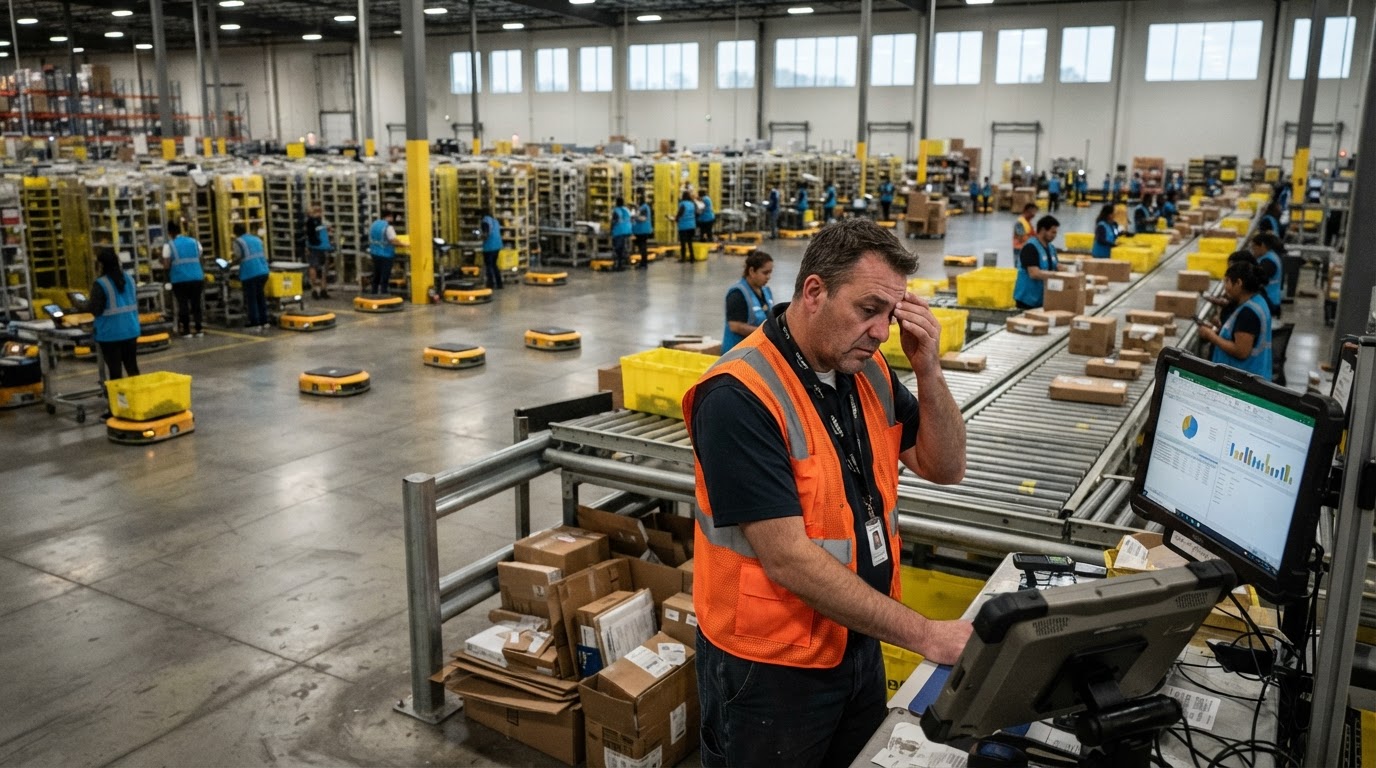
Every parcel dispatched through California corridors or international fulfillment routes requires relentless capital outlays. When aggregate demand decelerates even fractionally, fixed network commitments do not contract at an identical pace. Operating margins compress under the weight of sustained facility costs and systemic upkeep.
The assumption that market dominance guarantees self-funding expansion encounters clear mathematical boundaries when operational expenses accelerate faster than final intake.
Investors are no longer satisfied by the routine recitation of immense aggregate revenue. Two decades of digital commerce expansion conditioned capital allocators to reward top-line growth over near-term liquidity. Elevated baseline expenditure requirements now ensure that even fractional revisions to seasonal targets prompt sharp reassessments of underlying asset returns.
Capital Realignments
Defenders of the retailer will argue that consumer cautiousness is merely cyclical and that the holiday period inevitably restores operating cash balances. From this perspective, preparing logistics networks for peak seasonal flows naturally requires front-loaded expenditures that temporarily depress interim liquidity. The wider revenue range reaching up to $247.0 billion leaves substantial room for standard holiday outperformance.
Yet this argument glosses over the institutional friction evident across corporate balance sheets. Absorption of cash during peak operating periods indicates that network expansion costs are rising faster than incremental retail receipts. If baseline infrastructure absorption outpaces transactional yields during normal quarters, peak season surges simply amplify capital commitments rather than resolving structural margins.
Trade networks spanning Asia-Pacific export corridors watch these distribution projections closely. Thousands of commercial enterprises design seasonal production runs around the inventory requirements dictated by North American fulfillment centers. A downward recalibration of terminal expectations ripples through assembly hubs, warehousing agreements, and ocean transport manifests long before final checkout registers confirm the trend.
Amazon retains unmatched transactional scale across modern commerce. Whether an enterprise engineered around perpetual physical acceleration can preserve internal capital during slower demand cycles remains an unresolved systemic tension.
Sources
Newsletter
Pacific Daily
A curated briefing from Thailand, Asia-Pacific and the world.