The enduring cost of connection
Singapore’s North-South Corridor project, while ambitious, reveals the friction inherent in large-scale infrastructure.
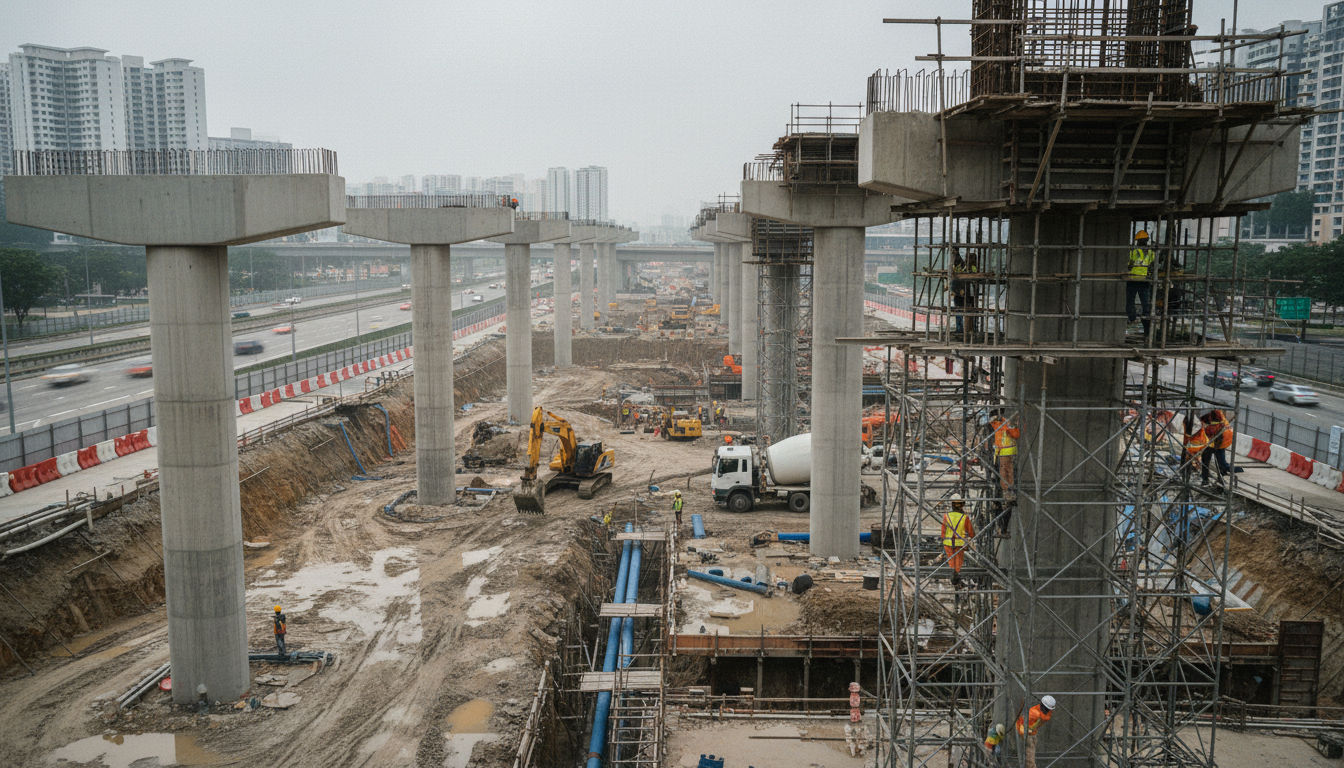
SINGAPORE
Across from Royal Square Medical Centre, in Novena, Singapore, the construction site of the North-South Corridor is a stark presence on September 17, 2026. This visible disruption marks a point of tension for the immediate locale. While the idea of a comprehensive corridor often suggests fluid movement and economic uplift, for those directly in its path, the reality is one of immediate burden.
The development of such corridors, whether America’s new South Caucasus Corridor, as reported by The Diplomat in August 2025, or Uzbekistan’s push for a West-South Transport Axis, detailed by the same publication in June 2025, generally signifies a broader ambition: to integrate regions, facilitate trade, or streamline urban transit. These projects are framed as pivotal for national or regional progress. However, the ground-level experience often contrasts sharply with this macro-narrative.
Businesses in Novena, according to a September 2026 CNA Lifestyle report, are considering closure. This indicates a direct commercial consequence that infrastructure planning frequently overlooks or discounts. The noise and dust that residents reportedly brace for are not mere inconveniences; they represent a degraded living environment for an indefinite period. Italy’s pledge of emergency funds to reopen a key Adriatic corridor after a landslide in April 2026, as reported by Reuters, illustrates how even completed infrastructure can be fragile, requiring constant vigilance and resource allocation.
The stated goal of the North-South Corridor in Singapore is to enhance connectivity within the city-state. Such projects are indeed crucial for managing the demands of urban density and economic activity. Yet, this pursuit of greater efficiency and speed invariably asks a profound question of those who live and work within the construction zone: what is the acceptable price for this collective benefit? The immediate cost is borne by local enterprises and residents, while the benefits are distributed across a wider, less directly affected populace. This disparity is a consistent feature of large-scale urban development.
As the work continues in Novena, the visual of the construction site across from Royal Square stands as a reminder that grand visions for connectivity are built not only on concrete and steel but also on the displaced livelihoods and daily concessions of those in its shadow. The true measure of such a corridor, therefore, is not just its eventual capacity, but the equity with which its passage is navigated for all involved.
Sources
Newsletter
Pacific Daily
A curated briefing from Thailand, Asia-Pacific and the world.