Suriname Evictions Draw a Boundary for Frontier Agribusiness
The deportation of Mennonite settlers signals an unexpected administrative limit on agricultural conversion across intact tropical forests
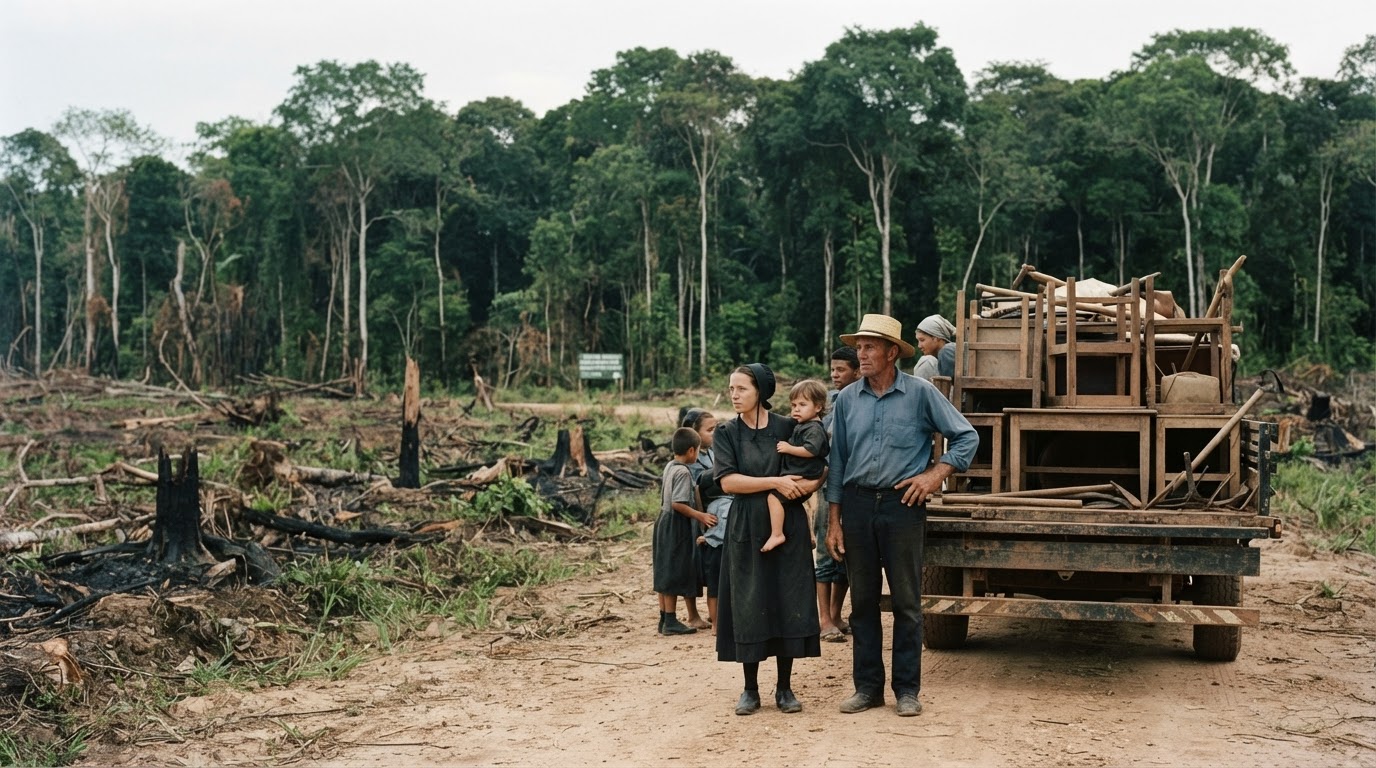
State authority over primary forest frontiers usually yields to commercial land clearance, particularly when sovereign debt pressures mount. Suriname reversed that expectation on Oct. 31 when authorities removed more than 50 Mennonites from state land in the southern Sipaliwini district and flew them to Bolivia. The group, members of a conservative Christian denomination that avoids modern technology, had arrived with intentions to establish large-scale agricultural colonies in the Amazon Rainforest. Their removal, executed on the grounds of expired residency permits, marks a decisive intervention against land-use conversion before industrial scale could be achieved.
Agricultural expansion across Latin America has long followed a predictable sequence of exploratory settlement, incremental title regularization, and eventual canopy clearance. Mennonite communities previously established extensive farming footholds in Belize, Bolivia, and the United States, utilizing uniform communal discipline to clear territory that state agencies struggled to govern. In Suriname, where forest cover accounts for roughly 93 percent of the national territory, agrarian ambitions intersected directly with high-canopy conservation. The presidency intervened before formal concession titles could solidify.
Sovereignty Against Sprawl
Tension surrounding the agrarian project gathered momentum through 2023 and 2024 as public scrutiny questioned the involvement of Suriname’s Ministry of Agriculture, also identified as LVV. Observers debated whether commercial food production justified the fragmentation of intact ecosystems. While proponents pointed toward domestic food security and economic diversification away from extractive commodities, the environmental balance of trade pointed toward long-term degradation.
The point is essentially that the primary Amazon Rainforest is not being cut down for large-scale agriculture. I am opposed to that,
Suriname President Jennifer Geerlings-Simons framed the intervention in unequivocal terms, prioritizing ecological continuity over the promise of frontier farm output. The legal lever employed was immigration status rather than an environmental injunction, yet the strategic outcome remains identical. Agricultural developers often rely on bureaucratic inertia to convert defacto occupation into recognized tenure. By enforcing deportation strictly against expired permits, the executive apparatus terminated that progression.
Lessons for Pacific Rim Forest Governance
For resource-rich economies along the Pacific Rim facing similar friction over agricultural concessions, the Paramaribo decision offers an instructive counterpoint. Developing administrations frequently argue that stopping agrarian settlement is impractical once capital and labor arrive in remote districts. The eviction in Sipaliwini shows that swift enforcement against irregular residency can prevent legal ambiguity from hardening into irreversible deforestation.
The unresolved constraint lies in external market demand for arable tracts, which halting one communal settlement leaves fundamentally intact. Across remote borderlands, land-use policy faces a persistent structural tension, balancing sovereign conservation priorities against the commercial agricultural interests that continue to seek new acreage.
Sources
Newsletter
Pacific Daily
A curated briefing from Thailand, Asia-Pacific and the world.