How QR Codes Rewired Singapore's Hawker Centres Without Losing Their Soul
Apps such as DBS PayLah! and the national SGQR standard made cashless payment ordinary at noodle stalls, but the hawker economy still runs on people.
SINGAPORE
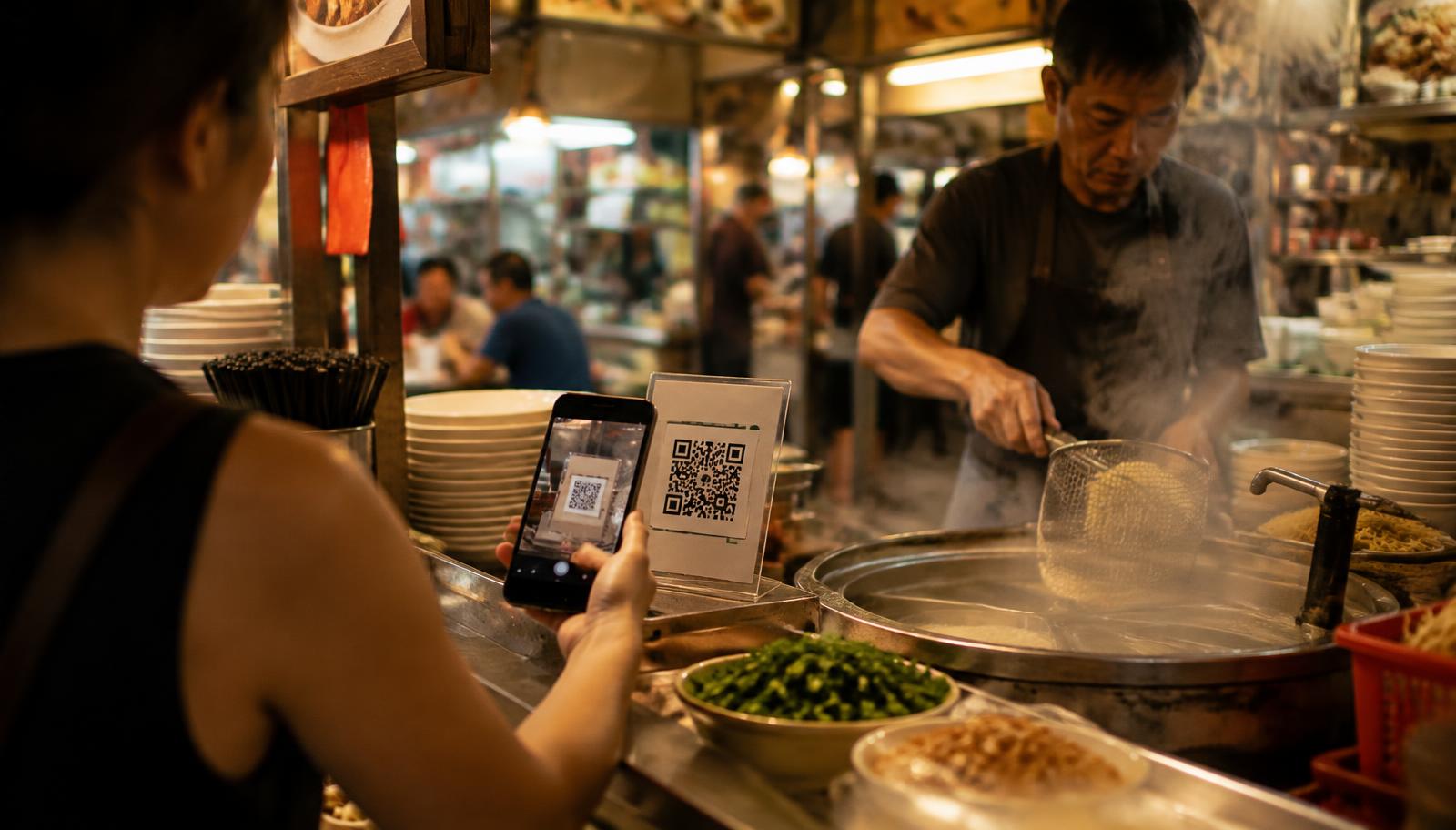
SINGAPORE — At a busy hawker centre at lunchtime, the soundtrack has changed. Alongside the clatter of woks and the calls of stallholders, there is a constant soft beep as office workers scan a small printed square taped beside the counter. QR payment, through apps such as DBS PayLah!, PayNow-linked banking apps and other wallets, has become as ordinary at a chicken rice stall as it is in a shopping mall.
The change did not happen by accident. Singapore introduced a unified QR standard, SGQR, so that a single code at a stall could accept many different payment apps. Before that, hawkers faced a confusing collection of stickers from competing providers. Government programmes then encouraged stallholders to adopt e-payments, offering support to cover early costs.
For customers the benefit is speed and convenience. For hawkers, many of them older and working long hours on thin margins, the calculation is more complicated. Digital payments reduce the need to handle cash and give change, and they provide a record of sales that can help with bookkeeping and loans. But some stallholders worry about fees, settlement times and the effort of learning new systems.
A cultural institution under pressure
Hawker culture is recognised by UNESCO as part of Singapore's intangible cultural heritage, and its survival is a matter of national pride. The real threats are not technological. Rents, rising ingredient costs, gruelling hours and the difficulty of finding successors weigh more heavily than any payment terminal.
In that context, digital tools can help or distract. Cashless payment makes it easier to serve younger customers who rarely carry notes. Online ordering and delivery platforms widen reach but charge commissions that many hawkers find painful. The most useful technologies are those that save time without taking a large share of each plate.
Lessons for the region
Singapore's experience is watched closely across Southeast Asia. Thailand's PromptPay QR codes are ubiquitous at street stalls, Malaysia has DuitNow, and cross-border links now let travellers from several ASEAN countries pay with their home apps. The common lesson is that interoperability matters: a single standard that any app can read is what makes QR payment practical for the smallest businesses.
Cash has not disappeared. Many elderly customers still prefer it, and most hawkers continue to accept it. A system that forced the issue would risk excluding exactly the people hawker centres were built to serve.
What makes the Singapore model distinctive is that the technology faded into the background. The queue still forms at the stall with the best char kway teow, the uncle behind the wok still decides when the noodles are ready, and the beep of a phone is just one more sound in a very old kind of market.
Sources
Newsletter
Pacific Daily
A curated briefing from Thailand, Asia-Pacific and the world.