On the Singapore Bus, a Test of Civic Habit
An alleged assault on a Go-Ahead bus captain suggests a fraying public contract, prompting a look at how shared spaces are navigated.
SINGAPORE
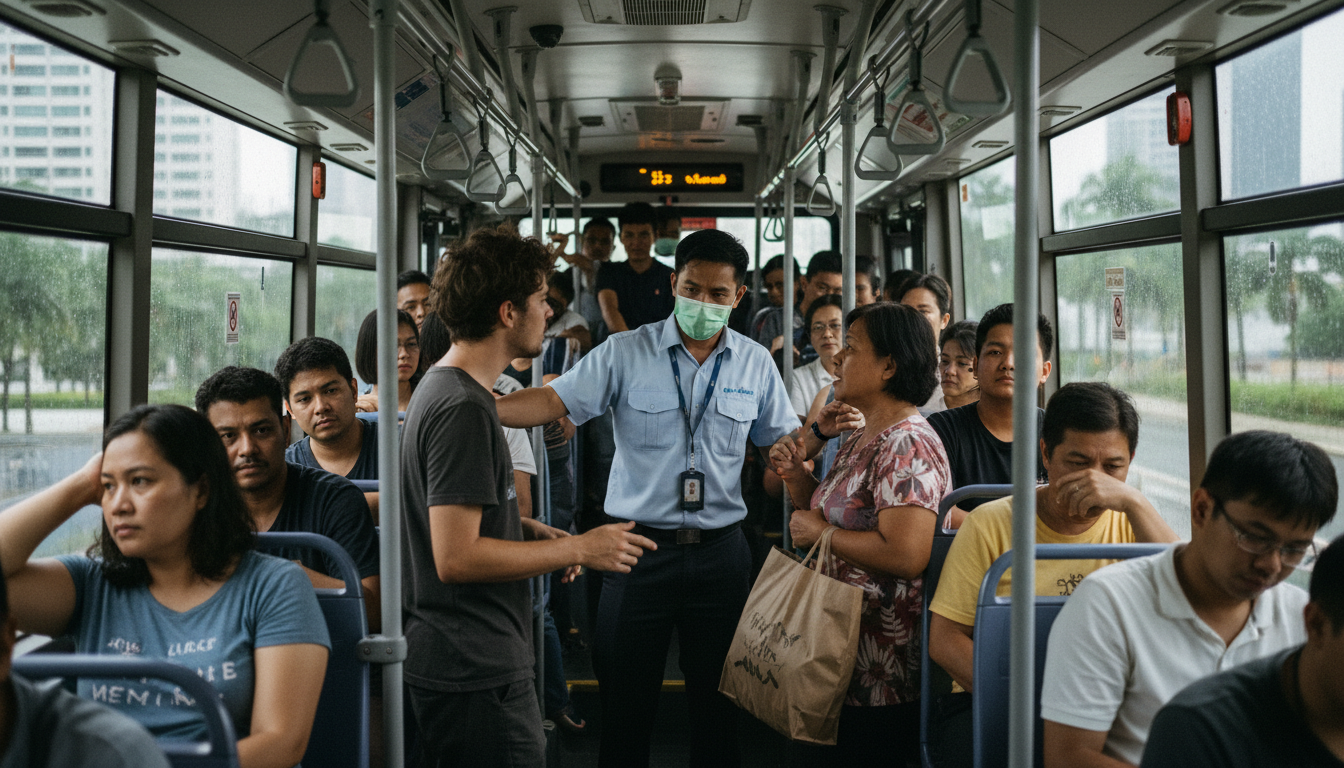
A Go-Ahead Service 2 bus, operating between Changi Village Terminal and Kampong Bahru Terminal, encountered a disruption. The National Transport Workers’ Union (NTWU) said that a bus captain was allegedly assaulted while on duty on August 16, 2026. This incident, the union stated, was the second such occurrence involving one of the operator's bus captains in three months. Go-Ahead Singapore reported lodging a police report and stated it is cooperating with authorities.
Public transit, in its essence, is a shared habit. Its functionality rests on an unspoken contract between strangers occupying a common space. When that contract is breached through acts of alleged violence against those who maintain the service, it signals a shift in a fundamental cultural signal: the expectation of civil conduct in collective environments. The specifics of the August 16 event, and a prior incident from May 2026 where a bus captain was allegedly assaulted by a passenger after a missed stop, trace a pattern.
This is not a phenomenon unique to Singapore. Similar narratives of strain within public interaction appear elsewhere. In November 2021, two men were charged in Singapore over an alleged attack on a bus driver after he told them to wear their masks properly, pointing to how minor interactions can escalate. Across the globe, reports of public disorder, even in arenas as distinct as sports, highlight a general increase in tensions that challenge established norms of interaction. The Washington Post reported in July 2026 on legal action following an arrest by the National Guard, underscoring broader societal shifts in how public authority is perceived and responded to.
Who bears the cost when these habits erode? Not just the individuals directly involved, but the wider community that relies on reliable public infrastructure. The bus captain, a frontline worker, carries the immediate burden. But the indirect costs extend to the feeling of safety and predictability that underpins urban life. When the spatial observation of a daily commute changes from routine to potential flashpoint, it affects how people engage with their city.
The alleged assault on Service 2 is more than an isolated legal matter. It is an inflection point in how a city manages the invisible agreements that allow millions to coexist daily. The question is whether the systems designed to maintain civic order can adapt to, and perhaps even reshape, these changing public habits before the shared space becomes a contested one. The outcome of the police investigation and subsequent actions will be observed as a measure of this adaptation. This incident returns us to the bus, now not just a vehicle, but a literal and figurative public stage where a critical civic habit is being tested anew.
Sources
Newsletter
Pacific Daily
A curated briefing from Thailand, Asia-Pacific and the world.